
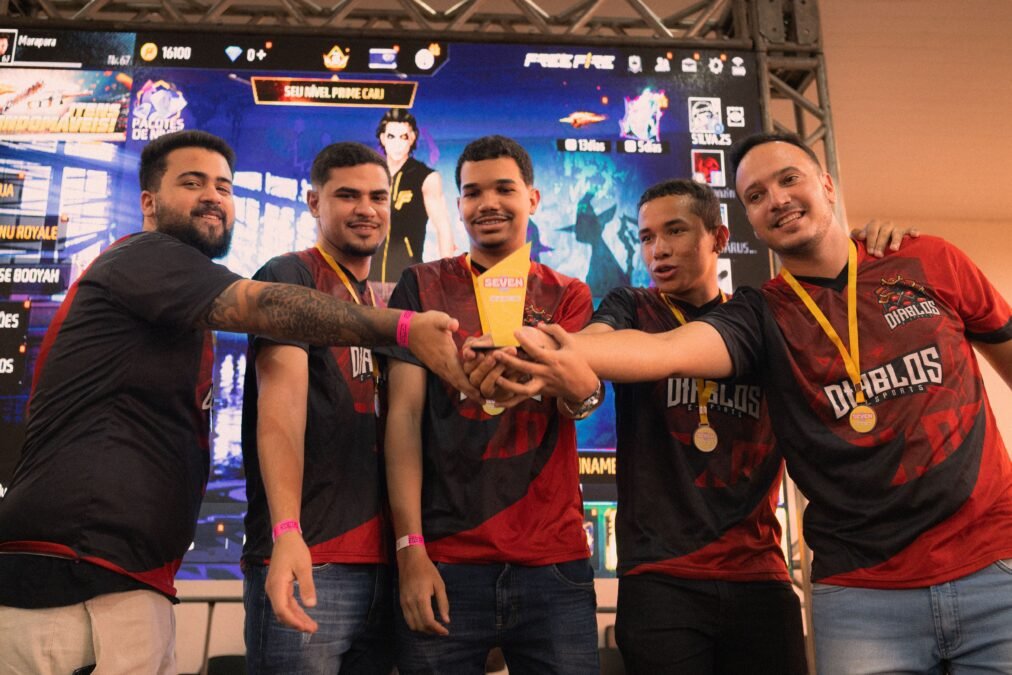

When Free Fire’s regional championship in Brazil last crowned a winner, one detail stood out more than the trophy: the broadcast’s most-watched language wasn’t English or Indonesian, the two tongues that usually dominate mobile esports viewership. It was Portuguese. Peak viewership topped 200,000 — a number that puts Brazil’s Free Fire audience in the same conversation as markets many times its size.
That’s not a fluke of one good tournament. It’s a snapshot of something bigger: Brazil has quietly become the deepest, most competitive Free Fire ecosystem on the planet, and the rest of the esports world has started to notice.
How the Ecosystem Is Built
Free Fire’s competitive structure runs on a simple idea: regional strength feeds a global stage. Countries with the biggest, most active player bases run their own domestic leagues, and the top finishers from those leagues earn a shot at the Free Fire World Series Global Finals — the tournament that decides the sport’s world champion.
Brazil’s regional league is where that idea gets tested hardest. The country runs one of the largest domestic Free Fire scenes in the world, supported by a dense network of organizations, sponsors, and dedicated arenas built specifically for offline competition — a level of infrastructure most regional esports scenes never reach. That depth is what separates a country with a few good players from a country with an actual ecosystem: multiple organizations capable of winning on a given day, a broadcast audience large enough to sustain year-round interest, and a talent pipeline that keeps producing contenders season after season.
It’s also why Brazil consistently sends more than one team capable of competing on the world stage — a rarity in mobile esports, where most regions are lucky to produce a single standout.
The Organizations That Built the Scene
Behind the results, a handful of organizations have defined what competitive Free Fire looks like in Brazil.
LOUD is the clearest example of how far the game’s popularity reaches. Founded in 2019 as a Free Fire-only outfit before expanding into other titles, LOUD is now Brazil’s most-followed esports organization — and the second most-followed on the planet. Its ownership group includes Vini Jr., the Real Madrid and Brazilian national team forward, who became a co-owner in 2023. A professional footballer buying into a Free Fire org isn’t a stunt; it’s a signal of how mainstream competitive mobile gaming has become in Brazil.
Fluxo, now competing as Fluxo W7M after a 2025 partnership, carries an even heavier credential: a Free Fire World Series Global Finals title, won in 2024. That makes it one of the few Brazilian esports organizations, in any game, to be crowned an actual world champion — a benchmark most regions never reach.
LOS rounds out the group as a fixture of the country’s top tier, regularly finishing among the sport’s strongest sides regardless of who’s holding the trophy in a given year.
Together, these organizations are why “Brazilian Free Fire team” carries weight internationally — not because of one good season, but because of a track record built over several.
Why It Matters Beyond Brazil
Mobile esports has a scale problem most Western sports fans underestimate. Free Fire is one of the most-downloaded mobile games in the world, and its competitive scene draws audiences that rival — and often exceed — traditional esports titles built for PC and console. Brazil sits at the center of that scale.
What makes the Brazilian scene worth watching isn’t just viewership numbers, though those are real. It’s the depth: a country that can consistently field multiple organizations capable of winning on the world stage, backed by real infrastructure — purpose-built arenas, established sponsors, a talent pipeline that keeps refreshing itself rather than relying on the same handful of stars. That’s a different kind of scene than one built around a single breakout team.
It also says something about where competitive gaming is headed globally. As esports matures beyond its early PC-centric roots, mobile-first markets like Brazil, Southeast Asia, and South Asia are increasingly where the sport’s deepest talent pools and largest audiences actually live — even when Western coverage hasn’t fully caught up yet.
A Scene Fans Have Made Their Own
None of this happens in a vacuum. Brazil’s Free Fire fanbase is one of the most online, most engaged communities in mobile esports — following rosters, arguing lineups, and turning matchdays into genuine cultural moments across social media.
That culture shows up in small details as much as big ones. Fans style their profiles, in-game names, and match-day posts with the same enthusiasm they bring to supporting their teams — a habit that’s spawned its own corner of Brazilian internet culture, with tools like letra-diferente.com letting supporters turn a player’s name or a team tag into something personalized before pasting it straight into a bio. The same instinct shows up inside the game itself, where fans lean on stylized Free Fire nicknames to build an identity that’s instantly recognizable in the lobby — clan tags, decorated borders, the same visual flourish teams use in their own branding.
It’s a small thing next to the scale of the competition itself. But it’s also a reminder of why Brazil’s Free Fire scene works the way it does: the players build the results, and a deeply invested fanbase makes sure the world notices.