
When global pop icons and rock legends pack stadiums, audiences are treated to an unparalleled sensory experience. They see seamless laser shows, robotic lighting trusses moving in perfect synchronization, and flawless special effects ranging from pyrotechnics to massive LED set pieces.
However, the reality behind this grand spectacle is far more industrial than artistic. Behind the curtain lies a high-load, zero-tolerance electrical and automation control network operating under extreme transient demands.
A single microsecond power drop or sensor failure can plunge a multi-million-dollar show into darkness. Modern live entertainment is less about musical improvisation and entirely about precision engineering, rigorous thermal profiling, and fail-proof electrical infrastructure.
The Electrical Architecture Powering Modern Tour Rigs
Live stage productions cannot simply plug into standard AC mains provided by a local stadium. The sheer volume of robotic moving heads, video walls, and audio arrays creates massive, unpredictable power draws.
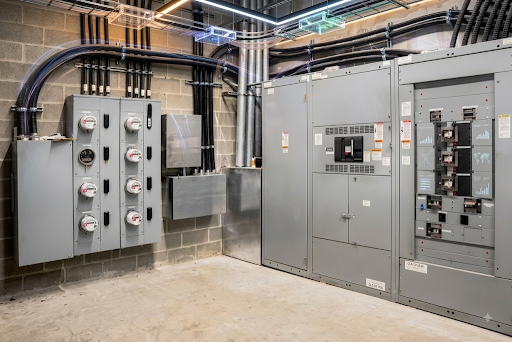
Running these rigs on unfiltered mains power without specialized conversion and power filtering guarantees catastrophic equipment failure. To solve this, technical directors build modular, isolated power grids right inside the venue.
These mobile grids rely heavily on robust AC-to-DC conversion, ruggedized DIN-rail mounting, and soft-start current suppression. These elements prevent violent voltage drops from killing sensitive DMX distribution consoles or blanking out LED video walls during peak musical drops.
To maintain seamless performance across international venues with fluctuating voltages (85V–264V AC), tour engineering crews rely on certified switch-mode power supply hardware. Seasoned systems integrators frequently deploy hardware from established industrial automation component manufacturers like OMCH, utilizing their DIN-rail power supplies, built-in EMI filtering, and soft-start surge protection to shield delicate DMX controllers and robotic moving lights from unexpected line spikes.
Automation & Kinetic Staging: The Role of Industrial Sensors
The days of static scaffolding are over. Modern stages are kinetic environments where massive screens, lighting pods, and even the performers themselves fly through the air via motorized winches and automated trusses.
Preventing Collisions in Overhead Kinetic Trusses
Moving tons of steel and LED panels above a live audience requires aerospace-level safety protocols. High-precision proximity sensors and photoelectric limit switches provide real-time spatial positioning for moving truss motors and flying rigs.
These industrial sensors continuously feed data back to the central automation desk. If a winch motor drifts out of alignment or a scenic element gets too close to a lighting pod, the system triggers an emergency stop.
This millisecond-level feedback loop is the only way to prevent catastrophic equipment clashes above performers. It replaces human guesswork with mathematical certainty.
Managing High-Temperature & Harsh Stage Environments
Touring equipment is subjected to some of the most brutal environmental conditions imaginable. Smoke machines, localized pyrotechnic blasts, and outdoor weather extremes introduce intense heat, vibration, and humidity.
Standard commercial electronics will melt or short-circuit under these conditions. Sensitive electrical controls must be housed within industrial-grade IP67 enclosures that block out moisture and conductive pyrotechnic dust.
Furthermore, internal power supplies and motor drives rely on 105°C-rated capacitors to handle the ambient heat generated by massive lighting rigs. Without these hardened components, thermal runaway is a mathematical certainty on a summer stadium tour.
3 Engineering Protocols for Zero-Downtime Live Productions
To ensure a show never stops, production engineers borrow heavily from aerospace and data center reliability protocols. The following strategies are mandatory for Tier-1 tours.
Redundant Power Bus Routing
- N+1 Architecture: Engineers never rely on a single power source. They implement parallel N+1 power supply architectures to guarantee instant failover if a primary line fails mid-show.
- Phase Isolation: Audio, lighting, and automation are placed on completely isolated electrical phases to prevent dirty power or harmonic distortion from cross-contaminating systems.
- Uninterruptible Power Supplies (UPS): Critical control desks (lighting, audio, automation) run entirely on battery-backed UPS networks, ensuring that even if the stadium loses grid power, the show’s brain stays online.
Industrial-Grade Surge & Short-Circuit Mitigation
When 1,000 high-output strobe lights fire simultaneously, the resulting electrical transient can destroy adjacent circuitry. Rapid circuit protection and microsecond trip switches are deployed to isolate these spikes.
This level of mitigation prevents transient voltage spikes from burning out expensive automated moving heads. It essentially creates electrical firewalls between different zones of the stage.
Proactive Component Burn-In & Thermal Profiling
Equipment testing doesn’t happen at the venue; it happens weeks in advance. Production houses utilize 100% full-load burn-in testing before equipment ever heads out on a world tour.
This process forces components to run at maximum capacity in a controlled, heated environment to trigger premature failures (infant mortality). Only the hardware that survives this brutal thermal profiling is cleared for live use.
Future Trends: Greener Touring and Intelligent Automation
The live entertainment industry is undergoing a massive paradigm shift. As mega-tours face increasing public and regulatory pressure to slash carbon footprints, designers are aggressively phasing out inefficient legacy hardware.
This drives the shift toward high-efficiency switch-mode converters, intelligent power scaling, and sustainable venue infrastructure. Modern rigs now auto-sleep inactive nodes and optimize load balancing to drastically cut generator diesel and sustainable live entertainment standard consumption.
As major international stadium tours face increasing scrutiny over their environmental footprint, live production designers are prioritizing high-efficiency conversion units to slash peak energy waste. According to reporting by major media and environmental watchdogs, optimizing equipment power density and eliminating standby generator draw is now a baseline requirement for next-generation festival rigs.
Key Takeaways
| Area | Key Takeaway | Impact/Data |
| Power Grid | Deploy isolated AC-DC grids with soft-start. | Prevents DMX console failure. |
| Automation | Install precision proximity sensors on trusses. | Millisecond emergency stop. |
| Hardware | Mandate IP67 enclosures and 105°C capacitors. | Stops 100% thermal runaway. |
| Reliability | Enforce N+1 redundancy and burn-in testing. | Guarantees zero downtime. |
| Sustainability | Upgrade to high-efficiency switch-mode converters. | Slashes diesel consumption. |
Conclusion
A superstar’s stage presence is only as good as the underlying electrical reliability. Behind the deafening applause and blinding lasers is a meticulously engineered network of power supplies, sensors, and fail-safes.
By treating a rock concert with the exact same rigorous electrical standards as an automated manufacturing plant, production managers eliminate downtime and guarantee safety.
Ultimately, investing in certified industrial components turns high-risk stage stunts into predictable, repeatable art. The true magic of live events isn’t just the music—it’s the flawless, invisible engineering that brings the vision to life.