

The excitement surrounding artificial intelligence has shifted. Business leaders are no longer asking if they should adopt AI, but how to do so without wasting millions of dollars on projects that never make it out of the testing phase. Moving past the initial tech hype requires a focused, structured approach to automation.
To build an AI roadmap that actually drives revenue, cuts inefficiencies, and scales across your organization, you must look past the software code itself. A successful deployment relies on a balance of data readiness, choosing the right tools, and setting clear business goals.
Why Most Enterprise AI Initiatives Fail
Every day, companies invest heavy capital into artificial intelligence, only to watch those initiatives stall. This rarely happens because the technology is broken. Instead, it happens because companies treat AI as an isolated IT project rather than a core business transformation effort.
The most common trap is focusing entirely on the tool itself. A leadership team reads about a breakthrough in machine learning and immediately mandates its implementation. This technology-first approach forces teams to hunt for problems that fit a specific solution, resulting in low-impact software that fails to deliver a measurable return on investment.
Technology-First (High Risk):
Select Cool Tech ➔ Search for a Business Use Case ➔ Fragmented System ➔ Low ROI
Strategy-First (High ROI):
Identify Core Bottleneck ➔ Run Readiness Assessment ➔ Match Right AI Tool ➔ Scalable Value
To break this cycle, organizations must pivot to a problem-first mindset. Before writing a single line of code or signing a software contract, identify the specific operational friction points that cost your business time, accuracy, or customer satisfaction.
Experienced AI consulting services providers help organizations look at their workflows objectively to determine whether a problem requires advanced automation, machine learning, or simply a cleaner manual process.
Before You Invest: Assess Your AI Readiness
Launching a new technology initiative without checking your internal capabilities is a primary reason why enterprise systems fail to scale. Many organizations choose to run an intensive AI readiness assessment before investing in larger AI Consulting Services initiatives.
A thorough assessment evaluates five foundational areas to ensure your business can support a modern AI infrastructure:
- Data Quality and Governance: AI models do not generate insights out of thin air; they reflect the data they are trained on. If your corporate information is siloed across separate legacy systems, poorly formatted, or full of historical errors, the AI will produce unreliable outputs.
- Process Maturity: You cannot automate a workflow that is fundamentally broken. Before applying machine learning to a business task, that task must be stable, well-documented, and understood by the team members who manage it manually.
- Security and Compliance Requirements: Depending on your industry, you likely handle sensitive customer data that is governed by strict privacy laws. A proper readiness check outlines exact security boundaries to ensure your proprietary data never leaks into public models.
- Integration Complexity: Modern enterprise software must communicate smoothly with your existing CRM, ERP, and communication tools. You must map out the integration requirements and APIs needed to pass data back and forth seamlessly.
- Internal Technical Expertise: Building a tool is only half the battle; your organization must also maintain it. Assessing your internal team’s current skills helps you determine what training or ongoing support will be required once the initial deployment is complete.
Not Every AI Project Needs Generative AI
Because of the massive media focus on large language models, many business leaders naturally assume that AI and ChatGPT are the same thing. This confusion can lead to incredibly expensive mistakes, such as using a creative text generator to solve a complex math or logistics problem.
A professional AI consulting company helps you evaluate the full spectrum of artificial intelligence to match the exact tool to your operational needs.
ChatGPT-Style Systems
These language models are built to process, summarize, and generate human-like text, images, or programming code. They excel at creative or communicative tasks, such as drafting customer replies, rewriting marketing copy, or analyzing lengthy legal documents for quick summaries.
AI Agents and Autonomous Workflows
An AI agent goes a step beyond a standard chatbot. Instead of just answering a prompt, an agent can carry out multi-step tasks across multiple business tools. For example, an agent can detect an incoming invoice email, verify the numbers against your accounting software, flag discrepancies, and route it to management for final approval.
Predictive Analytics
If your goal is to forecast customer churn, optimize inventory levels, or spot financial fraud, you do not need generative tools. You need traditional machine learning and predictive analytics. These systems analyze historical numbers and data trends to forecast future business metrics with high mathematical accuracy.
Workflow Automation
Many repetitive, manual tasks do not require deep cognitive thinking or complex algorithms. They simply require strict, rule-based logic. Basic workflow automation is faster, cheaper, and entirely accurate for routine data entry, meaning you save your budget for more complex technical needs.
When pursuing Generative AI consulting, an experienced partner ensures you use language models where they add genuine value, rather than forcing them into workflows where simpler software works better.
The 3 Pillars of Production-Ready AI
Scaling an intelligence system from a neat prototype to an enterprise-grade solution requires a strong foundation. True enterprise AI consulting focuses on building three core operational pillars:
1. Robust Data Infrastructure
Your long-term technology strategy is completely dependent on your data strategy. To make an AI system ready for daily operations, you must build clean, secure data pipelines. This involves setting up organized cloud storage, scheduling regular data cleaning, and creating a unified source of truth so your systems always pull from accurate data.
2. User Adoption and Change Management
An advanced algorithm is only valuable if your team actually uses it. AI adoption is fundamentally a human change management challenge.
To ensure high adoption rates, design the software to fit directly into the tools your employees already use every day—such as their email client or internal dashboard. Furthermore, maintain open communication with your staff. Show them that the software is built to handle their most tedious administrative work, freeing them up to focus on higher-value projects.
3. Clear Financial and Operational Metrics
Vague statements like “improves overall efficiency” do not provide enough clarity for boards or investors. To prove true value, you must map your technology performance directly to verifiable business KPIs:
- In Customer Service: Has the system safely lowered the total volume of incoming human support tickets while keeping customer satisfaction scores high?
- In Sales Operations: Has the automated helper allowed your team to submit client proposals faster, successfully shortening the sales cycle?
- In Supply Chain: Has predictive software accurately reduced unplanned system or machinery downtime by a verifiable percentage?
The “Crawl, Walk, Run” Framework for Implementation
Ambitious organizations often want to jump straight to the “Run” phase—spending massive amounts of time and capital to build proprietary models from scratch. Unless you have a massive budget and a dedicated team of research scientists, this approach carries high operational risk.
Instead, a practical AI implementation consulting partner will recommend a phased framework that secures low-cost, immediate wins while safely building your internal capabilities over time.
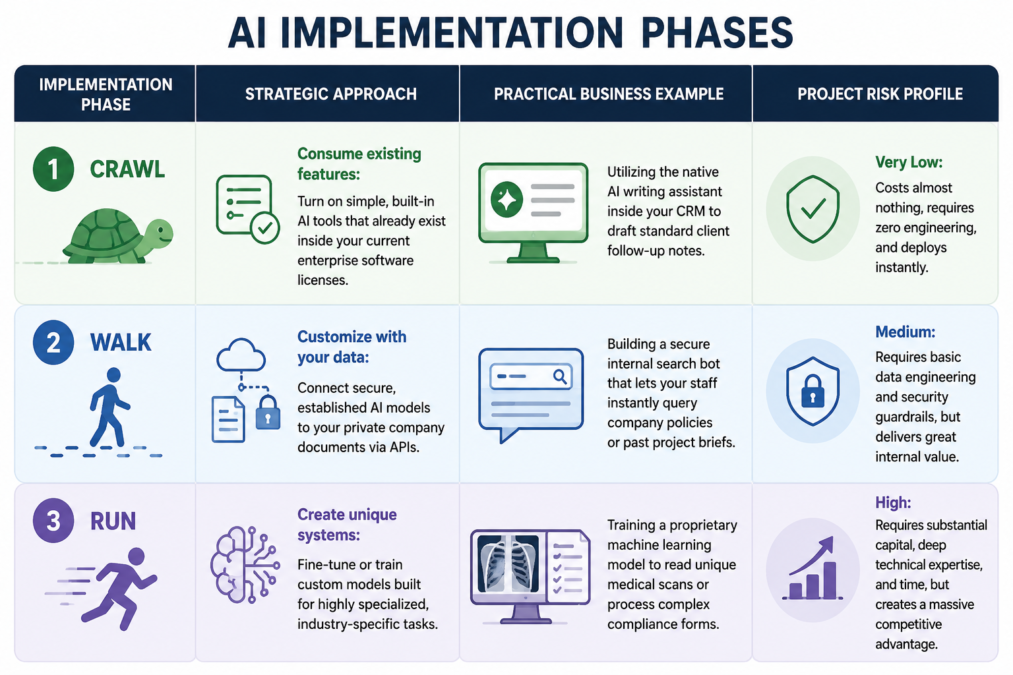
By starting with “Crawl” and “Walk” projects, you prove immediate business value to stakeholders, train your team on data safety, and use the money saved to fund your larger corporate roadmap.
Accounting for the Hidden Costs of AI
When building an AI strategy consulting roadmap, it is easy to focus only on the upfront price of development or software licenses. However, running these tools at an enterprise scale comes with ongoing operational expenses that you must plan for:
- Compute and Token Fees: Generative tools charge you based on “tokens” (fractions of a word). Every time an employee asks a system a question, and every time that tool reads a corporate document to generate an answer, you are billed. While cheap for a small test group, these costs add up quickly when scaled across thousands of employees using the system daily.
- Model Drift and Long-Term Maintenance: The real world changes constantly, which means your operational data changes too. An AI model that gives perfect answers today can slowly degrade over time—a concept known as “model drift”—as market conditions, consumer habits, or regulations shift. You must budget for continuous monitoring and periodic updates.
- The Legacy Integration Tax: Older enterprise software systems rarely connect naturally with modern cloud-based AI tools. A significant portion of your budget will inevitably go toward building custom integrations, security layers, and data pipelines. To avoid these common bottlenecks, many enterprises partner with dedicated AI Integration Services teams to securely link their legacy systems with modern AI tools.
Conclusion: Focus on Strategy over Hype
Artificial intelligence is an incredibly powerful corporate tool, but it is not a magic fix for underlying operational issues. It cannot fix a business model that is fundamentally broken, it cannot organize data that has been neglected for years, and it cannot save an uninspired corporate culture.
However, when applied to efficient, well-understood business workflows backed by clean data, it acts as a massive operational multiplier.
The most successful AI initiatives begin with a clear business objective, clean data, and a realistic implementation plan. Organizations that treat AI as a business transformation effort—not a technology experiment—are far more likely to achieve measurable ROI.
Stop looking at what AI can do in the abstract. Take a look at your unique daily operations, identify your single biggest bottleneck, and map out a practical, step-by-step strategy to solve it.