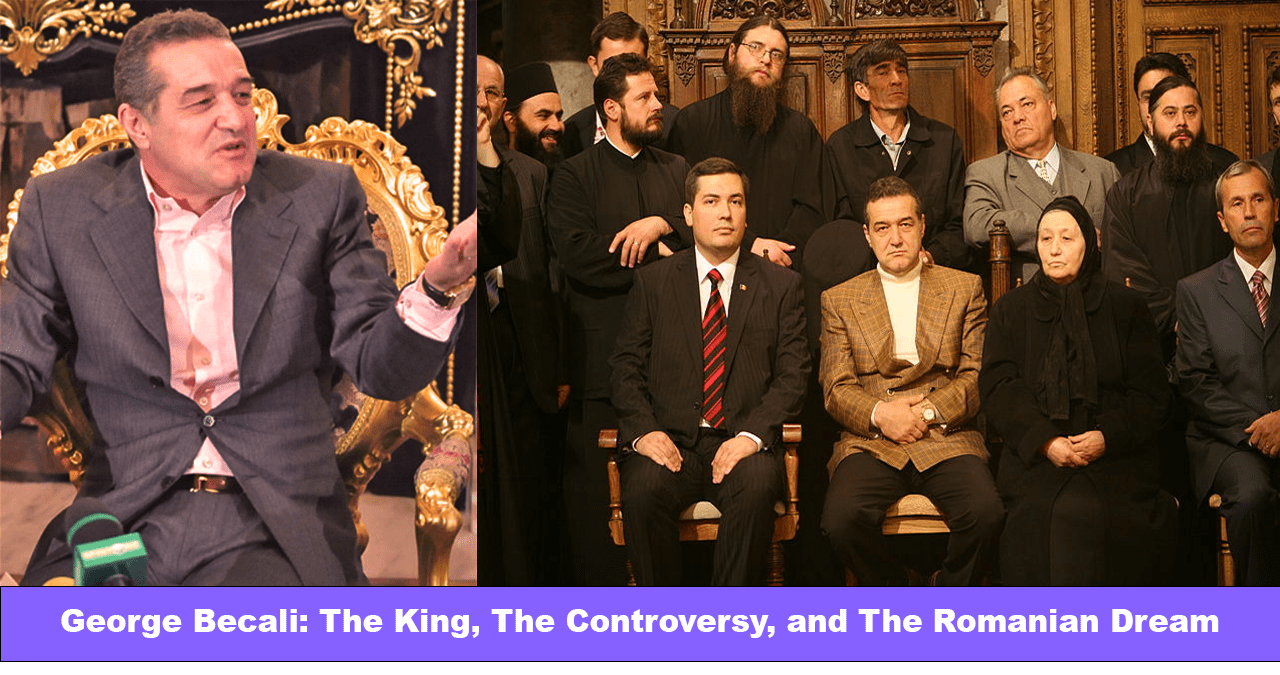

George Becali: He is a man who needs no introduction in Romania, yet remains a constant subject of fascination, debate, and headlines. To some, he is a patriot, a savior of the nation’s most beloved football club, and a straight-talking man of the people. To others, he is a clownish figure, a political opportunist, and a symbol of post-communist chaos and unbridled ambition. He is George Becali, a character so larger-than-life that he often feels more like a fictional creation than a real person. His story is not a simple biography; it is a sprawling epic that intertwines immense wealth, fanatical passion for football, deep religious conviction, turbulent political ambition, and a perpetual dance with the law. To understand George Becali is to hold a mirror up to modern Romania itself, reflecting its struggles, its aspirations, and its complex transition from a closed society to a member of the global community. This is the tale of a shepherd boy who dreamed of becoming a king, and in many ways, built his own kingdom on the pitch, in the parliament, and in the public consciousness.
His journey from obscure origins to national notoriety is a classic, albeit controversial, rags-to-riches story. It is a narrative he has carefully cultivated, one of divine providence, hard work, and a fierce love for his country. But it is also a story shadowed by questions about the true source of his wealth, his inflammatory statements, and his profound influence on Romanian culture and politics. This article will delve deep into the many facets of the man, exploring his business empire, his tumultuous relationship with FC Steaua București, his rollercoaster political career, his deeply held beliefs, and the legal challenges that have consistently punctuated his life. We will navigate the facts, the myths, and the immense polarizing force that is George Becali, aiming to provide a comprehensive portrait of one of Eastern Europe’s most unforgettable public figures.
The Making of a Mogul: From Humble Beginnings to Immense Wealth
The origin story of George Becali is a cornerstone of his public persona. He was not born into privilege or power; his beginnings were modest, rooted in the Romanian countryside. Born in 1958 in the village of Zărnești, his early life was shaped by the realities of rural Romania under the communist regime. He often recounts his time as a shepherd, a period he frames as formative, teaching him patience, a connection to the land, and a simple, honest way of life. This narrative is powerful—it positions him as a self-made man, someone who rose from nothing through sheer force of will and divine intervention, a story he frequently attributes to his strong Orthodox Christian faith. This humble past is a key part of his appeal to a certain segment of the population, who see in him a reflection of their own struggles and aspirations.
After completing his mandatory military service, Becali’s life took a dramatic turn. Like many Romanians in the early 1990s following the fall of Nicolae Ceaușescu, he seized the opportunities presented by the new market economy. He embarked on a business journey that would become the stuff of legend and, inevitably, intense scrutiny. His initial forays involved trading various goods, but his fortune was truly made in the import of used clothing and, most significantly, used tires from Western Europe. This was the wild east of capitalism, a time of rapid, often unregulated accumulation of wealth. Becali, with his sharp instincts and relentless drive, navigated this landscape masterfully. He founded a company called Gica Import-Export, which became the vehicle for his burgeoning empire, amassing a fortune that would later be estimated in the hundreds of millions of euros.
The Business Empire and the Shadow of Secrecy
As his wealth grew, so did the scope of his investments. The Becali business portfolio expanded beyond tires and textiles into much more valuable assets: real estate. He began acquiring vast swathes of land on the outskirts of Bucharest, particularly in the Pipera area, which was at the time undervalued but would later become one of the city’s most expensive commercial and residential districts. This demonstrated a remarkable foresight. He bought farmland for pennies and held onto it as the city expanded, seeing his investments multiply exponentially. Today, George Becali is considered one of the largest private landowners in Romania, with a real estate portfolio that forms the bedrock of his financial power. His properties include luxury apartments, commercial spaces, and undeveloped land worth a fortune.
However, the source and full extent of his initial capital have always been a subject of intense speculation and investigation. How did a former shepherd amass such a colossal fortune in such a short time? Critics and journalists have long pointed to the opaque nature of his early transactions, suggesting they may have benefited from the chaotic privatization process or other questionable practices common in the post-communist era. Becali has always vehemently denied any wrongdoing, consistently attributing his success to hard work, smart deals, and God’s will. He once stated, “God helped me. I was a good merchant.” This combination of immense, self-proclaimed wealth and a lack of transparent accounting has forever linked his name to the controversial phenomenon of the nouveau riche in Eastern Europe, a class of individuals who became spectacularly wealthy during the transition period.
The Passion and the Power: George Becali and FC Steaua București
If real estate made George Becali rich, it was football that made him famous. His association with FC Steaua București is the defining chapter of his public life, a saga of passion, power, conflict, and immense emotional investment. Steaua is not just any football club in Romania; it is the country’s most successful and popular team, with a storied history that includes a European Cup victory in 1986. For Becali, a lifelong fan, the club represented a national symbol. In the early 2000s, as the club struggled financially, he saw an opportunity and a calling. He began injecting massive amounts of his personal fortune into Steaua, initially as a main sponsor, and gradually taking de facto control.
His reign at Steaua was anything but boring. He brought a level of drama and spectacle to Romanian football that was unprecedented. He was not a silent owner in a boardroom; he was a constant, vocal presence. He would give fiery, emotional interviews before and after matches, publicly berate players and coaches for poor performances, and make grandiose promises of European glory. He spent lavishly on transfers, bringing in high-profile foreign players and offering huge salaries, aiming to restore Steaua to its former continental prestige. Under his financial backing, Steaua did enjoy periods of domestic success, winning several Liga I titles and cups, and even making memorable runs in European competitions, notably reaching the UEFA Cup semi-finals in 2006. For many fans, this era was a return to prominence, fueled by the passion and wallet of a true believer.
The Divisive Patron and the Legacy of Conflict
Yet, for every fan who adored him as a savior, there was another who saw him as a destructive force. His methods were often criticized as erratic and unprofessional. His public humiliation of players and his frequent interference in team affairs, including team selection, created a turbulent environment. Coaches came and went with alarming frequency, unable to work under the intense, micro-managing pressure from the top. The club became a reflection of his own personality: passionate, unpredictable, and perpetually at the center of controversy. His relationship with the fans was equally complex; while he was cheered for his investments, he was also booed during periods of poor results, a testament to the fickle and demanding nature of football fandom.
The most significant and damaging conflict, however, was not on the pitch but in the courtroom. For years, a bitter legal battle raged over the true ownership of FC Steaua București. The club was originally affiliated with the Romanian Army, and after communism, its ownership status became murky. A separate entity, CSA Steaua București, claimed the history and brand of the club. This led to an exhausting and convoluted legal dispute that divided the fanbase and tarnished the club’s legacy. After a series of rulings, George Becali ultimately lost the rights to the “Steaua” name and brand. In a move that shocked Romanian sports, he was forced to rebrand his team as FC FCSB, while the historic brand and records reverted to the army-associated CSA Steaua. This was a devastating blow, a dramatic fall from grace for a man who had poured his heart and millions of euros into the club he loved. The schism remains a painful open wound in Romanian football.
The Political Arena: From Prison to Parliament
George Becali’s ambitions were never confined to the business and sporting worlds. He harbored significant political aspirations, seeing himself as a potential leader for Romania. His foray into politics was as flamboyant and unorthodox as his management of a football club. He founded his own political party, the New Generation Party (Partidul Noua Generație – Creștin Democrat), which blended populist rhetoric, staunch nationalism, and a strong emphasis on his Orthodox Christian faith. His platform was often simplistic and built on slogans rather than detailed policy, focusing on fighting corruption, promoting traditional values, and representing the “common man” against the political elite, or what he often called “the hive.”
His political career was a rollercoaster of surprising successes and spectacular failures. In 2009, he managed to get elected as a Member of the European Parliament, a position that gave him a platform on an international stage. However, his tenure was marked more by his absence and controversial statements than by legislative achievement. His most audacious political move was running for the presidency of Romania in 2009. While he did not win, he garnered a non-trivial percentage of the vote, demonstrating that his message resonated with a significant portion of the electorate. His supporters were drawn to his anti-establishment stance, his perceived honesty in saying what he thought, and his image as a successful, self-made man who was not a career politician.
The Impact of Incarceration and a Shifting Role
A pivotal moment in both his life and political career came in 2013 when George Becali was sentenced to three years in prison for fraud related to a land exchange deal with the state. This was the culmination of a long-running legal case that he had always denounced as a political attack. His time in prison became a key part of his legend. He was released on parole after serving nearly a year, and he emerged portraying himself as a martyr, a victim of a corrupt system that sought to silence him. This narrative of persecution only strengthened his bond with his core supporters, who saw the conviction as proof of the system’s corruption.
After his release, his direct involvement in frontline politics waned, but his influence did not disappear entirely. He became a vocal supporter and sometimes a critic of other political figures and parties, particularly the Social Democratic Party (PSD), with which he has had an on-again, off-again relationship. He has occasionally thrown his political weight behind certain candidates or causes, demonstrating that he remains a player in the Romanian political landscape, even if from the sidelines. His ability to command media attention ensures that his political opinions, however unpredictable, continue to be heard by a wide audience.
The Man and His Beliefs: Faith, Nationalism, and Controversy
To separate George Becali from his deeply held beliefs is to misunderstand him completely. His identity is a potent and often volatile mix of fervent Orthodox Christianity, staunch Romanian nationalism, and a conservative social outlook. He is never shy about expressing his faith; he frequently crosses himself in public, attributes events to God’s will, and has financed the construction of churches. This public piety is a fundamental part of his brand, endearing him to a traditionally minded segment of the population and framing his actions within a divine context. For his supporters, he is a God-fearing man in a secular world.
His nationalism manifests in a passionate, sometimes aggressive, love for Romania and its history. He often speaks of a “Greater Romania,” laments the loss of territories, and champions national heroes. This rhetoric, while stirring for some, frequently crosses the line into xenophobia and homophobia. He has made numerous inflammatory statements about minorities, the LGBTQ+ community, and other nationalities, which have resulted in fines and widespread condemnation. These outbursts are a key source of the deep antipathy many Romanians feel toward him, viewing his views as bigoted and damaging to the country’s modern, European image.
The Public Persona: A Master of Media and Polarization
George Becali is, if nothing else, a master of the soundbite and a natural media personality. He understands the power of spectacle. His interviews are events, filled with grand pronouncements, emotional outbursts, witty, folksy proverbs, and confrontational language. He has a unique speaking style that is direct, unpolished, and highly memorable. This has made him a gift to television stations and tabloids, ensuring that he is almost always in the news cycle. He doesn’t shy away from conflict; he seems to thrive on it.
This carefully cultivated persona is the engine of his polarizing effect. There is very little middle ground when it comes to George Becali. He is either loved or loathed. This polarization is his greatest strength and his greatest weakness. It creates a fiercely loyal base that will support him through thick and thin, but it also ensures that a large portion of the country will never take him seriously as a businessman, a sports director, or a politician. He exists in a perpetual state of controversy, and it is within this storm that he seems most at home.
The Sonic Architect: Unpacking the Enduring Influence of Terry Bullen
The Legal Labyrinth: A Life in and out of Court
The narrative of George Becali is inextricably linked with the Romanian judicial system. His life has been a near-constant series of legal entanglements, from small-scale altercations to major fraud cases. The most significant of these was the land swap case that led to his imprisonment. The state accused him of defrauding the government by exchanging a piece of land he owned for a more valuable state-owned property, causing substantial financial damage to the public purse. His conviction was a landmark moment, proving that even the wealthiest and most powerful could be held accountable.
Beyond this high-profile case, his legal dossier is extensive. He has faced charges for assault, defamation, and incitement to hatred. Many of these stem from his public statements or physical altercations with journalists and other public figures. The table below outlines some of the key legal challenges he has faced:
| Case Type | Details | Outcome |
|---|---|---|
| Fraud | The complex land exchange with the Ministry of Defense. | 3-year prison sentence (served almost 1 year before parole). |
| Assault | Physical altercations, including an incident with a journalist. | Fines and suspended sentences. |
| Defamation & Hate Speech | Public insults and inflammatory statements against various groups and individuals. | Multiple fines and convictions from the National Council for Combating Discrimination. |
| Threats | Making public threats against other businessmen or public figures. | Investigations and minor legal penalties. |
This pattern of legal issues has painted a picture of a man who operates on the edge of the law, confident that his wealth and influence can shield him. While he has often been found guilty, his supporters frequently dismiss these convictions as politically motivated attacks, a narrative he actively promotes. The legal battles have become a core part of the George Becali story, symbolizing the ongoing struggle in Romania between old power structures and the rule of law.
The Lasting Impact on Romanian Society
The constant legal drama surrounding George Becali has had a broader impact on Romanian society. It has fueled debates about justice, corruption, and equality before the law. His case demonstrated that the judiciary could act against a powerful figure, which was a significant step for a country still grappling with its post-communist legacy. However, the perception that his sentence was relatively light and that he returned to public life largely unscathed also fuels cynicism about a two-tiered justice system where the connected and wealthy can ultimately evade the full consequences of their actions.
The Cultural Phenomenon: Beyond the Man
George Becali has transcended his individual identity to become a cultural phenomenon in Romania. He is a frequent subject of satire, imitation, and memes. Comedians mimic his distinctive voice and his habit of using the third person, as in “George Becali said…” or “George Becali will do…” His unique phrases and malapropisms have entered the popular lexicon. He is a staple of tabloid journalism and television talk shows, where his presence guarantees high ratings. This cultural footprint is perhaps as significant as his impact in business, sports, or politics.
He represents a specific archetype of the post-communist era: the flamboyant, unpredictable, and self-made tycoon who challenges the established order. In a society that experienced a rapid and often painful transition to capitalism and democracy, figures like George Becali embody both the dizzying possibilities and the profound dysfunctions of that period. He is a symbol of a certain kind of freedom—the freedom to become wildly successful, but also the freedom to be brash, controversial, and to defy political and social conventions. As one political analyst aptly noted, “George Becali is not a person, he is a syndrome. He represents the unresolved tensions of Romania’s last 30 years.”
The Enduring Legacy
As he moves into the later stages of his life and career, questions about his legacy abound. What will be remembered? The passionate football patron who bankrolled Steaua’s revival? The controversial politician who gave a voice to the disaffected? The convict who fell from grace? The truth is, his legacy is all of these things, a complex and contradictory tapestry. He has left an indelible mark on Romanian football, though it is a fractured and disputed one. He has influenced the political discourse, proving the potency of a populist, anti-establishment message. And he remains a constant, polarizing figure in the public square, a reminder of a turbulent and transformative period in the nation’s history.
Conclusion
The saga of George Becali is a story without a simple ending. It is a narrative still being written, with new chapters of drama, legal challenges, and public pronouncements added regularly. He is a figure of profound contradictions: a devout Christian known for his hateful speech, a self-proclaimed man of the people who lives in opulent wealth, a football savior who ultimately lost the club he loved, and a political outsider who became part of the system he railed against. To try to neatly categorize him is to fail to understand his essence. He is a product of his time and place, a character forged in the chaotic fires of post-communist Romania. Love him or loathe him, George Becali is impossible to ignore. He has held a mirror up to Romanian society for over two decades, and the reflection it shows is complex, troubled, passionate, and endlessly fascinating. His story is, in many ways, the story of modern Romania itself.
Frequently Asked Questions About George Becali
What is George Becali’s net worth?
Estimating the exact net worth of George Becali is difficult due to the private nature of his assets, but he is consistently ranked as one of the wealthiest individuals in Romania. His fortune is primarily derived from his massive real estate portfolio, particularly the vast tracts of land he owns in and around Bucharest. While figures have fluctuated over the years, estimates from various financial publications have placed his net worth in the range of hundreds of millions of euros. It’s important to note that his wealth has been impacted by his legal fines, his enormous spending on FC Steaua, and market fluctuations.
How did George Becali make his money?
George Becali built his initial fortune in the early 1990s following the Romanian Revolution. He started with small-scale trade but quickly found success in importing used clothing and, most lucratively, used tires from Western Europe. His company, Gica Import-Export, was the vehicle for these early ventures. He then demonstrated incredible foresight by investing his profits in real estate, buying large amounts of inexpensive land on the outskirts of Bucharest. As the city expanded, the value of this land skyrocketed, making him a real estate mogul and securing his long-term financial power.
Why is George Becali so controversial?
The controversy surrounding George Becali stems from multiple aspects of his life. His rapid wealth accumulation led to persistent questions about its origins. His management of FC Steaua was seen as erratic and unprofessional, culminating in a bitter legal loss of the club’s brand. His political career is marked by populist and often inflammatory nationalist and homophobic rhetoric, which has resulted in numerous fines. Furthermore, his conviction and imprisonment for fraud cemented his status as a figure who operates in a permanent state of legal and public controversy.
Does George Becali still own Steaua București?
No, George Becali no longer owns the historic football club FC Steaua București. After a long and complex legal battle over the club’s ownership and branding, he lost the rights to the “Steaua” name. The brand and history were returned to CSA Steaua București, the entity linked to the Romanian Army. The team that Becali owns and finances was forced to rebrand and is now officially known as FC FCSB. This remains one of the most painful and divisive episodes in his involvement with football.
What are George Becali’s political beliefs?
George Becali’s political beliefs are a blend of strong Romanian nationalism, social conservatism rooted in his Orthodox Christian faith, and populist anti-establishment rhetoric. He has consistently promoted traditional family values, a powerful national state, and has been critical of the political class, which he often accuses of corruption. His platform with the New Generation Party focused on these themes, though it was often light on specific policy details. His views, particularly on minorities and the LGBTQ+ community, have been widely condemned as xenophobic and homophobic.