
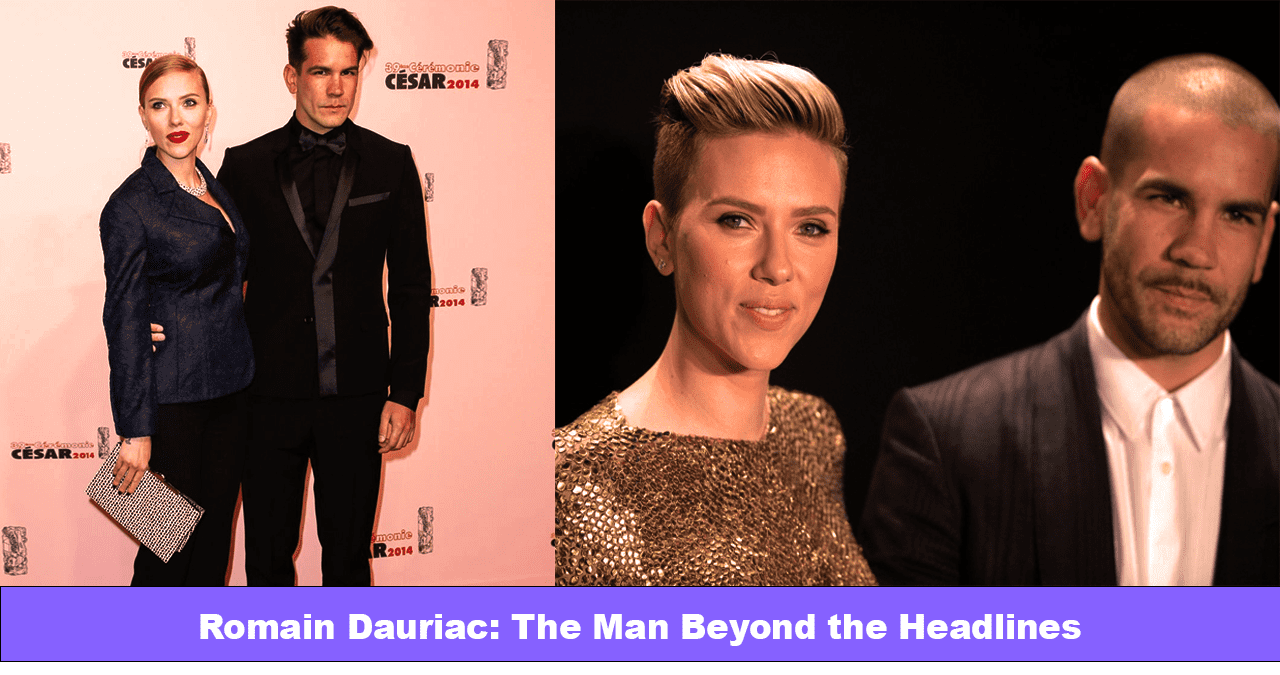

In the glittering, often harsh world of celebrity, some figures capture public attention not for their own fame, but for their proximity to it. They are cast into the spotlight, their lives dissected under a microscope they never asked for. Romain Dauriac is one such individual—a man whose identity in the public eye has been largely shaped by his past marriage to one of the most famous actresses on the planet, Scarlett Johansson. For many, he is a footnote, a “former husband” in a tabloid headline. But to reduce his story to that single chapter is to miss the entire narrative of an entrepreneur, a creative force, and, most importantly, a devoted father. This article seeks to explore the multifaceted life of Romain Dauriac, piecing together the journey of the Parisian art and design connoisseur who found himself navigating the surreal waters of global stardom before stepping back into a life of purposeful anonymity.
The story of Romain Dauriac is not just a biography; it’s a case study in identity. It raises questions about how we perceive the partners of celebrities, often projecting our own narratives onto them while knowing very little about their actual lives and accomplishments. Before the paparazzi flashes and the red-carpet appearances, Dauriac was building a name for himself in the creative industries of Paris. He was a man with a vision, curating spaces and launching ventures that reflected a distinct aesthetic and a sharp business mind. Understanding his path from a trendy Parisian gallery to co-parenting a daughter in a carefully managed private life allows us to see the person behind the label. It’s a tale of two worlds colliding—the intimate, conceptual world of European art and design with the blockbuster, global phenomenon of Hollywood—and the man who walked the line between them.
The Early Life and Parisian Roots of Romain Dauriac
To understand Romain Dauriac, one must first travel to Paris, the city that shaped his sensibilities. Born on September 11, 1981, in France, Dauriac was immersed in a culture renowned for its art, history, and intellectualism. While specific details about his immediate family and childhood are kept fiercely private, a common thread in the understanding of his background points toward a journalistic lineage. It is widely reported that his father, Jean Dauriac, was a journalist, which suggests that Romain was raised in an environment that valued communication, critical thinking, and a keen awareness of current events and cultural shifts. This upbringing likely planted the early seeds of his future endeavors, which would all revolve around curation, presentation, and narrative—whether through art, design, or publishing.
This Parisian foundation is crucial. It’s a city where aesthetics are a language, and Dauriac became fluent. He moved through the vibrant arrondissements, absorbing the interplay of classic and contemporary that defines modern Paris. Before any thought of Hollywood, his world was one of gallery openings, design fairs, and intellectual cafes. He developed a specific taste, an eye for the unique and the avant-garde. This period of his life was about building a foundation, forming the core identity of a creative entrepreneur. The skills he honed during this time—networking, branding, identifying talent, and creating desirable consumer experiences—would become the bedrock of his professional life, long before and long after his name became synonymous with a movie star. It was in this fertile ground that his first major business venture would take root.
The Creative Entrepreneur: Dauriac’s Ventures in Art and Design
Romain Dauriac was not an idle heir to any fortune; he was a hustler in the creative world. His first significant foray into the public sphere was with the founding of General Press, a publishing house and creative agency. This venture was a clear reflection of his interests and his father’s potential influence. General Press wasn’t just about printing books; it was about curating content, working with artists and thinkers to produce tangible pieces of culture. It established Dauriac as a player in the Parisian creative scene, a man with the vision to bring ideas to life. This endeavor demonstrated his understanding of a market that craved niche, high-quality, and intellectually stimulating products.
However, his most notable pre-fame business was the Junction magazine and the accompanying Junction store and gallery. This is where the full picture of Romain Dauriac’s aesthetic began to crystallize. Junction was more than a retail space; it was a concept. Located in the trendy Marais district, it was a hybrid environment that blended a magazine office, a art gallery, and a boutique selling designer toys, art books, and unique collectibles. It became a hub for a certain creative crowd, a place where street art met high design. Dauriac, as the founder and director, was the curator-in-chief. He was known for his sharp, slightly edgy style and his ability to spot trends. As one associate quoted in a Vanity Fair article noted, “He has a very good eye”—a simple yet powerful testament to his innate sense of curation. This table summarizes his key known ventures:
| Venture | Type | Primary Focus | Significance |
|---|---|---|---|
| General Press | Publishing House/Creative Agency | Curating and producing art books and intellectual content | Established his base in the Parisian creative industry. |
| Junction | Magazine & Concept Store/Gallery | Blending street art, designer toys, and high-end collectibles | Solidified his reputation as a influential curator and tastemaker. |
His work with Junction and his involvement in the street art scene, including collaborations with famous artists, positioned him as a respected figure in his own right. He was building a legacy based on his own merits and taste, creating a world that was distinctly and authentically his. This chapter of his life is essential to counter the narrative that he was merely a satellite to fame. He was, by all accounts, a successful and driven creative entrepreneur in one of the world’s most competitive cultural capitals.
A Whirlwind Romance: Meeting and Marrying Scarlett Johansson
The trajectory of Romain Dauriac’s life changed irrevocably when his path crossed with that of Scarlett Johansson. Their meeting was not a Hollywood cliché but a story born from the very world Dauriac had built. The connection was made through the street art scene; Johansson, a fan of the artist Invader, was in Paris to acquire one of his pieces. Dauriac, deeply embedded in that world, was the natural point of contact. Their first meeting was professional, revolving around a shared appreciation for art, but it quickly blossomed into a personal connection. For Johansson, Dauriac represented something different from the Hollywood milieu she was accustomed to—he was worldly, creative, and anchored in the grounded, gritty reality of the Parisian art scene.
Their relationship progressed quickly and with intense privacy, a rarity for a star of Johansson’s magnitude. After a relatively short period of dating, the couple announced their engagement in September 2013. The media and public were fascinated. Who was this Frenchman who had won the heart of Black Widow? The narrative was enticing: the cosmopolitan American movie star and the enigmatic Parisian gallerist. They married in a small, intimate ceremony in Philipsburg, Montana, in October 2014, opting for seclusion over spectacle. The following year, in August 2015, they welcomed their daughter, Rose Dorothy Dauriac. For a time, their life seemed to be a perfect fusion of their two worlds—split between a penthouse in Manhattan’s West Village and their life in Paris, with Dauriac often photographed alongside Johansson at high-profile events, looking the part of the stylish, if somewhat reserved, consort.
George Becali: The King, The Controversy, and The Romanian Dream
Navigating the Spotlight and the Challenges of a High-Profile Marriage
Stepping into a relationship with Scarlett Johansson meant stepping into a relentless spotlight. For Romain Dauriac, a man who had operated in the relatively niche circles of Parisian art, the adjustment was undoubtedly jarring. Paparazzi followed their every move, and his image was suddenly splashed across tabloids and entertainment news websites worldwide. Every detail of his life, from his fashion choices to his past, became fodder for public consumption. This level of scrutiny is a pressure cooker for any relationship, but for one built on a foundation of two vastly different cultures and career paths, the challenges were magnified. Dauriac was now living a bifurcated existence: he was still the owner of Junction, but he was also “Scarlett Johansson’s husband.”
Reports began to surface of the strains in their marriage. The primary challenge, often cited in media reports, was the fundamental issue of geography and career priorities. Johansson’s career was at its zenith, requiring her to be on set for long periods in various locations around the globe. Dauriac, on the other hand, had his business and life rooted in Paris. He was not a man content to simply be a trailing spouse; he had his own ambitions and his own empire to run. This created a natural tension. Could he relocate his entire life and business to the United States? Could she step back from her career to focus on family life in France? These are difficult questions for any couple, but under the magnifying glass of fame, every potential disagreement becomes a narrative of impending doom. The cultural differences, once a source of attraction, may have also become points of friction as the realities of building a life together set in.
Life After the Split: Co-parenting and Personal Growth
In January 2017, the couple announced their separation, and their divorce was finalized later that year. The split was described as amicable, with a primary focus on the well-being of their young daughter, Rose. For Romain Dauriac, this period marked a significant transition. He was stepping out of the blinding Hollywood spotlight and back into a life where he could reclaim his narrative. The end of the marriage was not an end to his family, but a restructuring of it. He and Johansson committed to a co-parenting arrangement, one that would require cooperation, communication, and a shared commitment to giving Rose a stable and normal upbringing, despite her famous mother.
Following the divorce, Dauriac largely retreated from public view. He returned to Paris, the city that had always been his home base, and refocused on his business ventures. Reports indicated that he took over the primary care of Rose for a significant period, with Johansson having flexible visitation. This demonstrated a profound shift from the traditional model and highlighted Dauriac’s dedication to his role as a father. He was often seen around Paris, taking his daughter to school, to parks, and to everyday activities, presenting an image of a deeply involved and present parent. This chapter of his life is arguably the most defining—moving from “Scarlett Johansson’s ex-husband” to “Rose’s dad.” He embraced a life of quiet normalcy, prioritizing his daughter’s privacy and his own peace over the allure of the public sphere.
What Does Romain Dauriac Do for a Living Now?
A common question that arises about figures like Romain Dauriac is, what do they do after the fame? In his case, the answer lies in a return to his roots. After the dissolution of his marriage and his return to Paris, Dauriac continued his work in the creative and business worlds. While the specific Junction storefront as it was known may have evolved or closed, his entrepreneurial spirit did not. His expertise lies in curation, branding, and the intersection of art and commerce. He has been involved in various consulting roles and creative director positions, leveraging the keen eye that first made him successful.
Most notably, Dauriac has been deeply involved in the world of NFTs and digital art, a natural progression for someone with his background in street art and collectibles. He has worked as a curator and strategist for platforms like Superchief Gallery NFT, helping to bridge the gap between traditional physical art and the burgeoning digital space. This move demonstrates an adaptability and a continued finger on the pulse of contemporary culture. He is not resting on the laurels of his past but is actively engaging with the future of art and collectibles. His career path shows a consistent thread: he is a facilitator and a tastemaker, whether the medium is a printed magazine, a designer toy, or a digital asset on the blockchain.
The Private Figure in a Public World: Analyzing Dauriac’s Persona
Romain Dauriac presents a fascinating study in contrast. In an era where people often crave fame for fame’s sake, he appears to be someone who had it thrust upon him and, when given the choice, largely walked away from it. His public persona, as much as we can glean from limited information, is that of a reserved, private, and fiercely independent individual. He is not active on social media, does not give interviews about his personal life, and seems to have no interest in leveraging his past relationship for personal gain. This silence, in itself, speaks volumes about his character and priorities.
This deliberate choice to remain private has only added to his enigmatic aura. In the absence of his own narrative, the media and public have often had to project or speculate. However, the consistent testimony from those who know him or have worked with him points to a man of substance—intelligent, driven, and possessing a dry wit. He is often described as “cool,” not in a performative way, but in an innate, self-assured manner. He carries the confidence of someone whose identity is not derived from external validation but from an internal sense of self and accomplishment. In a world obsessed with personal branding, Romain Dauriac’s brand is, paradoxically, his lack of one. He is a reminder that not every story needs to be shared to be valid, and that a life lived well away from the cameras can be the richest of all.
The Public Fascination and Media Portrayal
Why does the public remain so fascinated with Romain Dauriac? The answer lies in the allure of the unknown and the compelling nature of his “story arc.” He fits a certain archetype—the mysterious ex-partner who exists just outside the periphery of our constant consumption of a celebrity’s life. The media portrayal of him has been a mixed bag. Initially, he was the “lucky guy,” the man who “won” the heart of a coveted star. This narrative is often laced with a subtle (and sometimes not-so-subtle) sexism, framing the male partner as a passive beneficiary of the woman’s success.
As his relationship with Johansson progressed and then ended, the narrative shifted. He was sometimes painted as the “obstacle” to her career, the “root of the problems” in their marriage, or simply the “aloof Frenchman” who didn’t fit into the Hollywood mold. These portrayals are often reductive, failing to capture the complexity of any relationship, let alone one conducted under extreme pressure. The truth, as it almost always is, lies somewhere in the middle. Romain Dauriac was neither a villain nor a saint; he was a complex individual trying to navigate an incredibly unusual situation. The public’s continued interest is a testament to our collective desire to complete a story, to understand the “what happened next” for every character in the drama of a celebrity’s life.
The Legacy and Future of Romain Dauriac
When we attempt to define the legacy of a figure like Romain Dauriac, we must look beyond the tabloid headlines. His legacy is not tied to a five-year marriage, but to the life he has built before, during, and after it. His true legacy lies in his contributions to the creative landscapes of Paris and beyond, through his work with General Press, Junction, and now in the digital art world. He is a curator and entrepreneur who helped platform certain artists and trends, leaving a subtle but definite mark on contemporary visual culture.
Looking forward, the future for Romain Dauriac seems to be one of continued creative exploration and dedicated fatherhood. All indications suggest that he will maintain his cherished privacy, focusing on raising his daughter and pursuing business ventures that stimulate his intellect and passion. He may never again be a constant feature in the public eye, and that appears to be exactly his intention. His story serves as an important narrative in our celebrity-obsessed culture: that there is a whole, complex, and fulfilling life that exists outside the glare of the spotlight. The legacy of Romain Dauriac is, ultimately, one of self-possession. It is the story of a man who entered a world of global fame, experienced its heights and its challenges, and then made the conscious choice to return to a life defined by his own terms, his own work, and his own love for his child.
Conclusion
The journey of Romain Dauriac is a compelling narrative that transcends the simplistic label of “celebrity ex-husband.” From his early days as a Parisian tastemaker and gallerist to the whirlwind years of a high-profile marriage and his current chapter as a private entrepreneur and devoted father, his life reflects a consistent pursuit of personal and creative authenticity. He is a figure who reminds us that identity is multifaceted and that the stories we see in the media are often just a fragment of a much richer, more complex reality. By stepping away from the fame he never actively sought, Romain Dauriac has, in a paradoxical way, crafted a far more powerful and enduring identity—that of a self-made man who defines success on his own terms, with his daughter and his work at the center of his world.
Frequently Asked Questions About Romain Dauriac
How did Romain Dauriac and Scarlett Johansson meet?
Their meeting was rooted in the art world, which was Romain Dauriac’s professional domain. Scarlett Johansson, a fan of the street artist Invader, was connected with Dauriac as he was a known figure in that scene and could facilitate her acquisition of the artist’s work. Their shared interest in art sparked an initial connection that quickly evolved into a romantic relationship.
What was Romain Dauriac’s career before he was famous?
Long before his relationship with Scarlett Johansson made him a tabloid fixture, Romain Dauriac was an established creative entrepreneur in Paris. He founded a publishing house and creative agency called General Press. His most prominent venture was Junction, a hybrid concept that included a magazine, a gallery, and a boutique selling designer toys, art books, and unique collectibles, establishing him as a significant curator in the Parisian creative scene.
What is Romain Dauriac doing now in his professional life?
Romain Dauriac has continued his work in the creative industries, often focusing on the cutting edge of art and technology. He has been actively involved in the NFT and digital art space, working as a curator and strategist for platforms like Superchief Gallery NFT. This role allows him to leverage his expertise in identifying and promoting talent, bridging his background in physical art with the new digital frontier.
How is the co-parenting relationship between Romain Dauriac and Scarlett Johansson?
By all public accounts, Romain Dauriac and Scarlett Johansson have a very functional and amicable co-parenting relationship focused on the well-being of their daughter, Rose. Following their divorce, Dauriac reportedly took on a significant portion of the day-to-day care for Rose, living with her in Paris. They have managed to keep the details of their arrangement private, which suggests a mature and cooperative partnership dedicated to providing their daughter with a stable and normal life.
Why is Romain Dauriac considered such a private person?
Romain Dauriac’s inclination towards privacy seems to be a fundamental aspect of his character. He was a private businessman before his relationship and has returned to that state afterward. He avoids social media, does not give interviews about his personal life, and has never sought to capitalize on his fame. This desire for a low-profile life is likely a conscious choice to protect his own peace and, most importantly, the privacy and normal upbringing of his daughter.