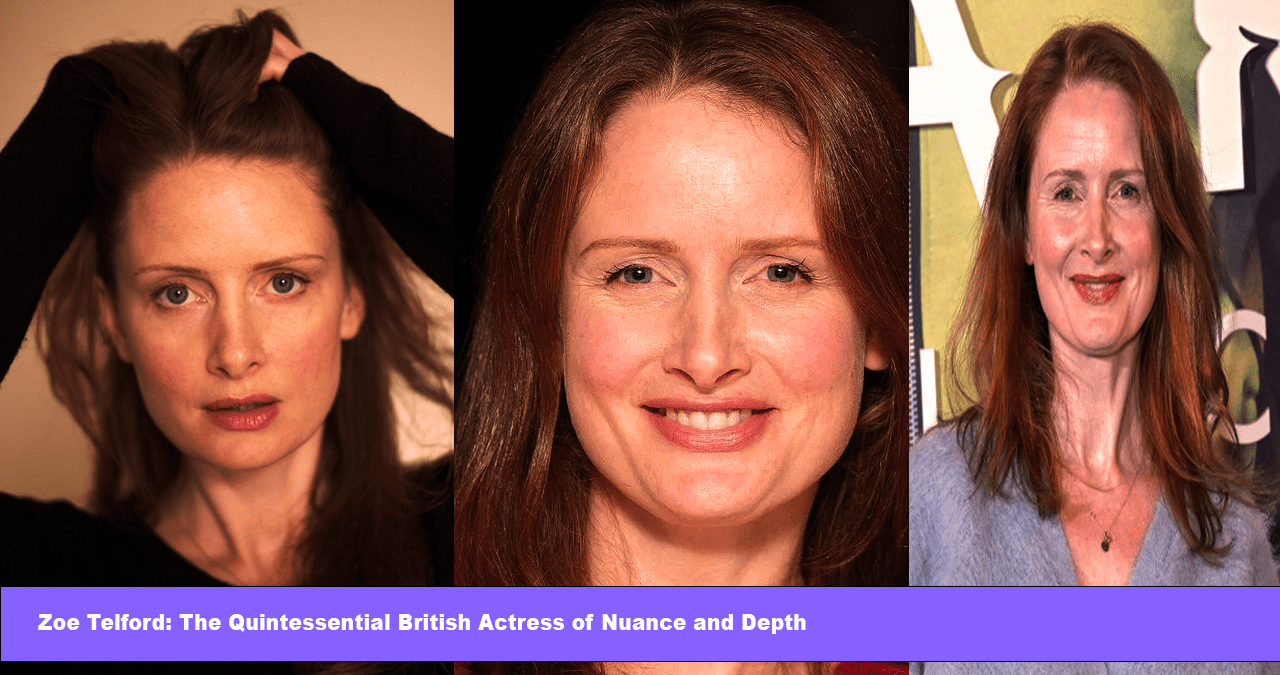

When you think of the formidable, reliable, and captivatingly nuanced actors who form the backbone of British film and television, Zoe Telford is a name that inevitably rises to the surface. Her career is a masterclass in versatility, a journey not marked by deafening Hollywood fanfare but by a steady, compelling accumulation of unforgettable characters. Zoe Telford possesses that rare quality: an ability to be completely transformative yet consistently, magnetically herself. Whether she’s portraying the intelligent, forthright Sarah in the global phenomenon Sherlock, navigating the raw emotional terrain of Trust Me, or bringing grounded humanity to the sci-fi epic The Ark, Telford commands the screen with a potent mix of strength, vulnerability, and startling authenticity. She is an actor’s actor, beloved by casting directors for her reliability and depth, and a viewer’s anchor, the character you instinctively trust and root for, even when the narrative waters become murky. This exploration delves into the craft, career, and quiet brilliance of Zoe Telford, celebrating her journey from promising newcomer to an indispensable pillar of the UK’s acting landscape.
The Formative Years and Early Career Foundations
Every enduring career has its roots, and for Zoe Telford, the path to performance began early, nurtured by a natural inclination towards storytelling and character. Born in Chelmsford, Essex, her passion for acting wasn’t a sudden epiphany but a gradual, growing certainty. Unlike some child stars thrust into the limelight, Telford’s early career was built on the solid, traditional groundwork of theatre and television guest spots, honing her craft in the crucible of varied roles and demanding sets.
Her initial forays into television in the 1990s saw her appearing in popular series like The Bill and Casualty, those quintessential training grounds for a generation of British actors. These roles, while perhaps small, were invaluable. They taught her the mechanics of television production, the pace of filming, and the art of creating a believable character with limited screen time. It was a period of apprenticeship, where she absorbed the atmosphere of professional sets and learned from established actors. This foundational phase was crucial, building not just her resume but her professional resilience and adaptability—traits that would define her career. Zoe Telford was not an overnight sensation; she was a craftsman learning her tools, a process that ensured her longevity and depth when bigger opportunities arrived.
These early years also saw her balance television work with stage performances, a discipline that demands a different kind of energy and presence. Theatre work, with its live audience and lack of second takes, sharpens an actor’s instincts, voice, and emotional immediacy. This theatrical foundation is often palpable in Telford’s screen work; there’s a clarity of intention and a precision in her delivery that speaks to rigorous training and live performance experience. By the turn of the millennium, Zoe Telford had built a solid, if under-the-radar, foundation. She was ready to graduate from compelling guest star to captivating lead and supporting player, bringing with her all the nuanced skills gathered from those formative years on stage and screen.
Breakthrough Roles and Defining Performances
While Zoe Telford had been turning in reliable work for years, the 2000s ushered in a series of roles that began to define her public persona and showcase her range to a wider audience. These were the parts that moved her from “that familiar face” to an actor whose name audiences remembered and sought out. One of her earliest notable film appearances came in the 2002 comedy Once Upon a Time in the Midlands, directed by Shane Meadows. Here, she shared the screen with a powerhouse ensemble including Robert Carlyle, Rhys Ifans, and Kathy Burke. Playing Sharon, she demonstrated a flair for the comedic and the gritty, holding her own in a cast of established heavyweights and proving she could navigate the tonal shifts of a British dramedy with ease.
However, it was her venture into the realm of science-fiction that provided a truly unique and memorable showcase. In the 2005 revival of the iconic BBC series Doctor Who, Zoe Telford appeared in the episode “The Christmas Invasion” as Sally Jacobs. Though a single episode, her performance was a perfect snapshot of her ability to inject a wholly believable, contemporary human reality into the most fantastical of scenarios. As a journalist both skeptical and irresistibly drawn into the Doctor’s world, she served as an effective audience surrogate, her reactions grounding the extraterrestrial events. This role connected her to one of Britain’s most beloved franchises and demonstrated her versatility across genres.
But perhaps the role that cemented her status as a versatile and compelling leading actor came in the 2008 ITV drama The Last Detective, based on the novels by Leslie Thomas. As Detective Constable “Dangerous” Davies’ long-suffering girlfriend, Julie, Telford brought a wonderful warmth, wit, and emotional complexity to the part. She was the heart of the series, providing not just a romantic interest but a moral and emotional counterpoint to the protagonist. This was a character with her own agency, frustrations, and journey, and Telford portrayed her with a relatable authenticity that made Julie a fan favourite. It was a lead role that demanded sustained emotional engagement and comic timing, proving she could carry a series with charm and substance.
“Acting is about finding the truth in the imaginary circumstances. The more real it feels to you, the more it will resonate with an audience.” — A reflection on the craft that mirrors Telford’s own approach.
These breakthrough roles shared a common thread: Zoe Telford’s characters were never mere ciphers or plot devices. They were fully realized women with interior lives, strengths, flaws, and compelling motivations. Whether in comedy, sci-fi, or detective drama, she ensured they felt authentic. This period transformed her from a promising talent into a proven, bankable, and deeply respected performer capable of elevating any project she was part of.
The Sherlock Phenomenon: A Role of Enduring Impact
No discussion of Zoe Telford’s career is complete without dedicating significant attention to her role in the cultural juggernaut that is Sherlock. In the 2014 special “The Abominable Bride” and the subsequent fourth series, Telford stepped into the shoes of John Watson’s wife, Mary Morstan—a character with a profound and complicated legacy in the Holmes canon. This was not a simple, supportive spouse role; the modern Sherlock interpretation, crafted by Steven Moffat and Mark Gatiss, gave Mary a secretive, formidable past as a former intelligence agent. This provided Zoe Telford with some of the most complex and challenging material of her career.
Telford’s portrayal of Mary was a masterstroke of layered performance. On the surface, she presented the warm, witty, grounded, and immensely likeable partner John Watson desperately needed—a stabilizing force in the whirlwind of Sherlock’s world. Her chemistry with Martin Freeman’s John was immediate and convincing, filled with affectionate banter and palpable mutual respect. Audiences believed in their love story. Yet, Telford simultaneously, with the subtlest of glances and slight shifts in demeanor, hinted at the steel and secrets beneath. When Mary’s past as AGRA operative is revealed, the performance seamlessly pivoted. The warmth remained, but it was now intertwined with a lethal capability and a profound moral ambiguity.
The brilliance of Zoe Telford’s work in Sherlock lay in making all these facets co-exist believably in one person. She ensured Mary was never defined solely by her secret or her relationship to John. She was a protector, a strategist on par with Sherlock, a fiercely loving mother-to-be, and a woman grappling with the shadows of her own history. Her final arc, sacrificing herself for Sherlock, was rendered with devastating emotional truth by Telford, cementing Mary as one of the most memorable and tragically poignant characters in the series. The role showcased her ability to handle high-stakes drama within a globally scrutinized franchise, delivering a performance that satisfied ardent Sherlockians and casual viewers alike. It introduced her to a massive international audience and remains a definitive part of her artistic legacy.
Following the intensity of Sherlock, Telford continued to choose roles that demonstrated her range, but the shadow—or rather, the light—of Mary Morstan lingered. It proved her capacity to thrive in a pressure-cooker environment of fan theories and immense expectations. The role demanded a delicate balance: honoring the source material while embracing a bold, modern reinterpretation, and Telford executed it flawlessly. It stands as a testament to her skill that in a series defined by the titanic performances of Benedict Cumberbatch and Martin Freeman, Zoe Telford carved out a space that was entirely her own, unforgettable and integral to the show’s emotional core.
Exploring Range: From Period Drama to Psychological Thriller
A true measure of an actor’s mettle is their range—the ability to convincingly inhabit wildly different worlds and mental states. Following her high-profile work in Sherlock, Zoe Telford deliberately pursued projects that showcased this very versatility, refusing to be pigeonholed. She moved seamlessly from the misty, moral landscapes of period drama to the claustrophobic, intense realms of psychological thriller, proving her adaptability and depth.
In the BBC’s 2015 adaptation of The Go-Between, Telford took on the role of Marian Maudsley, a character trapped by the rigid social conventions of Edwardian England. This was a departure from the modern, capable women she often played. Marian is a figure of suppressed desire and profound frustration, her life dictated by class and gender expectations. Telford captured this inner turmoil with exquisite subtlety, conveying volumes through restrained gestures and a voice laden with unspoken yearning. Her performance was a beautiful study in repression and the tragic cost of societal pressures, demonstrating her command of period nuance and emotional restraint.
Then, in a stark contrast, she delivered a powerhouse performance in the 2017 BBC psychological thriller Trust Me. This series presented a chilling premise: a nurse, dismissed for whistleblowing, steals her best friend’s identity to start a new life as a doctor. Telford played Dr. Brigitte Rayne, the skeptical, sharp, and ultimately compassionate colleague who becomes entangled in the deception. Here, Telford was the anchor of reality in a world spiraling into lies. Brigitte’s intelligence and medical professionalism were palpable, but so was her growing unease and moral conflict. The role required Telford to be investigative, empathetic, and increasingly terrified, often reacting to the protagonist’s dangerous actions. She served as the audience’s conscience and guide, a role she performed with gripping credibility.
This deliberate swing from Edwardian repression to contemporary medical thriller highlighted a key aspect of Zoe Telford’s craft: her profound relatability. Whether in a corset or scrubs, she locates the universal human emotions within a character—fear, love, doubt, determination. She makes every character, regardless of genre or era, feel like a real person you might know or understand. This chameleonic quality, paired with her consistent emotional truth, is what makes her such a valuable asset to any production. She doesn’t just play parts; she builds believable human beings from the script outwards, ensuring they resonate with authenticity whether they’re navigating a 1900s country estate or a modern hospital under siege.
The Craft of Character: An Analysis of Telford’s Method
What is it about Zoe Telford’s performances that makes them so consistently compelling and believable? While not one to loudly proclaim a specific “method,” her body of work suggests a deeply intuitive and technically assured approach to building character. Her process appears rooted in a fundamental search for psychological truth and a meticulous attention to the details of everyday behavior.
Observers of her work will note a mastery of subtlety. Telford is not a performer who relies on grand, theatrical gestures. Instead, she communicates a wealth of information through micro-expressions—a slight tightening around the eyes, a barely perceptible shift in posture, a hesitation in speech that speaks to unvoiced thought. Think of Mary Morstan in Sherlock: in moments of tension, it was often the calm stillness Telford embodied that was most frightening, hinting at a mind calculating options far beyond what was being said. This economical use of physicality makes her performances feel naturalistic and deeply immersive; she behaves as people do in real life, where much of our communication is subtextual.
Furthermore, Zoe Telford possesses an exceptional ability to portray intelligence. This is harder than it sounds. Many actors play “smart” by being verbose or arrogant. Telford portrays intelligence as a process of observation, synthesis, and quiet confidence. Her characters think on screen. You can see them listening, processing, and arriving at conclusions. This is evident in roles like Brigitte in Trust Me or her more recent work in The Ark; she embodies professionals who are competent and thoughtful, their intellect being a tool rather than a personality trait. This quality makes her characters immensely credible and trustworthy.
Finally, there is the emotional accessibility she brings to every part. Even in her most hardened or secretive roles, Telford allows the audience a window into her character’s vulnerability. It might be a fleeting moment of doubt, a crack in the armor, or a surge of protective love. This access creates empathy. We may not always agree with her characters’ choices (like Mary’s secrets or Marian’s decisions in The Go-Between), but through Telford’s performance, we always understand their motivations on a human level. Her craft is a blend of keen observation, technical control, and generous emotional honesty, resulting in characters that linger in the memory long after the credits roll.
Recent Work and Future Trajectory
In recent years, Zoe Telford has continued to demonstrate her vitality and relevance by embracing new genres and platforms, proving that her career is on a trajectory of continual evolution rather than resting on past laurels. A prime example of this forward momentum is her significant role in the 2023 sci-fi series The Ark, created by Dean Devlin. In a genre often dominated by spectacle, Telford brought her signature grounded humanity to the role of Dr. Cat Brandice, a senior medical officer aboard a perilous generational starship mission. Once again, she was the voice of reason, expertise, and compassion amidst crisis, showcasing her ability to anchor a high-concept narrative in believable human emotion. The series, with its international cast and ambitious premise, highlighted Telford’s appeal to global streaming audiences and her comfort within effects-driven productions.
Alongside this venture into sci-fi, she has maintained a strong presence in British television drama. She appeared in the 2022 crime drama The Midwich Cuckoos, a contemporary adaptation of John Wyndham’s classic novel, playing a mother grappling with an unimaginable supernatural dilemma. This role tapped into her strengths in portraying parental anxiety and moral fortitude under extreme pressure. Furthermore, her return to more terrestrial thrills came with a role in the popular BBC series Vigil, starring alongside Suranne Jones. In this tense submarine-set thriller, Telford slipped seamlessly into the ensemble, further solidifying her reputation as a go-to actor for adding immediate depth and credibility to any cast.
Looking ahead, the future for Zoe Telford seems boundless. Her filmography suggests an artist unafraid of challenge, equally adept at intimate indie films, large-scale television events, and genre fare. One can easily imagine her taking on more commanding lead roles in limited series, exploring complex historical figures, or bringing her nuanced presence to darker, auteur-driven projects. The industry’s growing appetite for strong, multifaceted female characters over 40 plays directly to her strengths. She possesses the experience, the technical skill, and the compelling screen presence to carry narratives focused on women’s lives, careers, and challenges with authenticity and power.
Amy Carter Net Worth: The Private Fortune of a Presidential Daughter
The trajectory of Zoe Telford’s career is a refreshing narrative in an industry often obsessed with youth and transient fame. It is a story of gradual ascent, built on consistent quality, intelligent role selection, and a profound dedication to the craft of acting. She has reached a stage where her name attached to a project signifies a guarantee of a certain calibre of performance—a marker of integrity and depth. As television and film continue to diversify in storytelling, there is little doubt that Zoe Telford will remain a sought-after and cherished figure, continuing to captivate audiences with her unique blend of strength, subtlety, and soul.
Zoe Telford’s Place in the Pantheon of British Acting
To contextualize the work of Zoe Telford is to place her within the rich and enduring tradition of British character acting—a tradition prized for its subtlety, technique, and commitment to serving the story. She belongs not to the flash-and-burn school of celebrity, but to the lineage of actors like Sarah Lancashire, Olivia Colman (in her earlier character work), and Lesley Manville: performers who build an illustrious career scene by scene, character by character, earning deep respect within the industry and a devoted following among viewers.
What sets her apart and solidifies her place in this pantheon is her remarkable consistency and her chameleonic yet identifiable presence. She is the antithesis of the “star turn” that overshadows a narrative; instead, she melds into the world of the story, strengthening it from within. Casting directors and producers know that with Zoe Telford, you receive more than just an actor saying lines. You get a fully formed perspective, a nuanced history implied in every reaction, and a professional reliability that elevates everyone around her. She is the bedrock upon which more flamboyant characters can safely play, knowing she provides the solid ground of reality.
Furthermore, Telford represents a specific and crucial archetype in modern storytelling: the intelligent, capable, and emotionally complex adult woman. She rarely plays the ingénue or the passive love interest. Her characters are doctors, detectives, agents, mothers, and leaders—women with agency, expertise, and interior conflicts. In an era where representation and dimensionality for women on screen are rightfully demanded, Telford’s body of work stands as a testament to the power and audience appeal of such roles. She has, often without explicit fanfare, been portraying these kinds of women for decades, proving their viability and importance long before it became a concentrated industry talking point.
Ultimately, Zoe Telford’s place is secured by the simple, powerful impact of her work: it is memorable. From the heartbreaking sacrifice of Mary Morstan to the determined resilience of Dr. Cat Brandice on The Ark, she creates moments and personas that stick with you. She has contributed significantly to the cultural tapestry of 21st-century British television, appearing in some of its most defining series. In the pantheon, she is both a respected craftsman and a beloved artist, an actor whose quiet power continues to resonate loudly in an often noisy landscape.
Beyond the Screen: Philanthropy and Personal Insights
While Zoe Telford guards her private life with a dignified reserve typical of British actors of her calibre, glimpses beyond the screen reveal a person of principle and compassion, aligning with the thoughtful integrity she brings to her roles. Although not one for relentless self-promotion on social media or in tabloids, her professional choices and occasional public engagements paint a picture of an artist deeply connected to the human stories she helps tell.
Telford has lent her support to charitable causes close to her heart, particularly those involving children’s welfare and health. She has been associated with and supported organizations like the NSPCC (National Society for the Prevention of Cruelty to Children), using her platform to raise awareness for vulnerable young people. This advocacy mirrors the protective, nurturing qualities she often embodies on screen, suggesting a genuine alignment between her personal values and her artistic expressions. In an industry that can sometimes feel detached, this connection to real-world issues grounds her work in a wider context of empathy and social responsibility.
In rare interviews, Telford speaks about her craft with a refreshing lack of pretension, focusing on the work rather than the glamour. She discusses the collaborative nature of filmmaking, her respect for writers and directors, and the joy of discovering a character. This lack of ego is telling; it confirms that for her, acting is a vocation about connection and storytelling, not celebrity. She has spoken about the challenges of balancing motherhood with a demanding career, adding a layer of relatable authenticity to her public persona. These insights reveal a woman who is not just playing multifaceted characters but living a multifaceted life, navigating the same challenges of work, family, and purpose as her audience.
This grounded, principled approach to life and career undoubtedly feeds back into her performances. There is an authenticity to her that cannot be manufactured, a sense that she draws from a well of real human experience and empathy. It explains why her performances never feel false or contrived. Whether she is portraying joy, grief, fear, or determination, it rings true because it is filtered through the sensibility of an actor who observes, cares, and understands the world beyond the soundstage. Zoe Telford, the person, informs and enriches Zoe Telford, the artist, making her contributions to screen all the more valuable and profound.
A Selected Filmography of Key Roles
| Year | Title | Role | Medium | Significance |
|---|---|---|---|---|
| 2002 | Once Upon a Time in the Midlands | Sharon | Film | Early film role in a major ensemble dramedy. |
| 2005 | Doctor Who | Sally Jacobs | TV (Episode) | Connection to iconic British sci-fi series. |
| 2008-2010 | The Last Detective | Julie | TV Series | Lead role showcasing warmth and comic timing. |
| 2014, 2017 | Sherlock | Mary Morstan | TV Series | Iconic role in a global phenomenon; complex, layered performance. |
| 2015 | The Go-Between | Marian Maudsley | TV Film | Showcased range in period drama and emotional repression. |
| 2017 | Trust Me | Dr. Brigitte Rayne | TV Series | Lead role in a high-stakes psychological thriller. |
| 2022 | The Midwich Cuckoos | Hannah | TV Series | Role in a modern supernatural thriller. |
| 2023 | The Ark | Dr. Cat Brandice | TV Series | Venturing into sci-fi, showcasing adaptability to new genres. |
Conclusion: The Enduring Appeal of a Consummate Professional
Zoe Telford’s journey through the landscape of British acting is a narrative that rewards close attention. It is not a story of meteoric fame, but of a steady, bright, and enduring flame. From her foundational years in theatre and television guest spots to her unforgettable turn in Sherlock and her compelling work in contemporary series like The Ark, she has charted a course defined by integrity, versatility, and profound skill. She embodies the very best of what makes British actors so revered worldwide: a commitment to craft over celebrity, to character over caricature, and to emotional truth over easy spectacle.
Her appeal lies in this potent combination of reliability and surprise. Audiences know that a performance by Zoe Telford will be grounded, intelligent, and emotionally resonant—a guarantee of quality. Yet, they are also consistently surprised by the new shades she reveals, the different worlds she convincingly inhabits, and the depth she finds in every character. She makes the difficult art of acting look effortless and true, a sign of a master at work. As the industry evolves and expands, the need for actors of her calibre—actors who can anchor a blockbuster series, elevate an indie film, and everything in between—only grows.
In celebrating Zoe Telford, we celebrate a career built on substance. She is a reminder that lasting impact in the arts often comes not from the loudest voice, but from the most authentic one. Whether she is saving galaxies in deep space, solving crimes in modern London, or navigating the stifling drawing rooms of the past, Zoe Telford brings a humanity to her roles that is both unique and universally recognizable. Her body of work is a gift to viewers—a collection of nuanced, powerful, and deeply human portraits that will continue to captivate and inspire for years to come.
Frequently Asked Questions (FAQs)
What is Zoe Telford best known for?
Zoe Telford is arguably best known for her role as Mary Morstan, the wife of John Watson, in the globally popular BBC series Sherlock. Her portrayal of the warm yet deeply complex former intelligence agent was a standout in the show’s fourth series and special, earning her widespread recognition and praise. This role showcased her ability to balance strength, vulnerability, and moral ambiguity, cementing her place in a modern television phenomenon. Beyond Sherlock, she is also well-known for lead roles in series like The Last Detective and Trust Me, as well as her recent venture into science fiction with The Ark.
How did Zoe Telford start her acting career?
Zoe Telford began her acting career in the classic, time-honored way for many British actors: through theatre and television guest appearances. She cut her teeth on staple UK series like The Bill and Casualty in the 1990s, which served as crucial training grounds. These early roles allowed her to learn the rhythms of television production and develop her craft in a professional setting. She balanced this screen work with stage performances, honing her skills in live theatre—a background that contributes to the clarity and presence she brings to her screen roles today. It was a gradual, solid foundation that prepared her for more substantial and defining parts.
Has Zoe Telford been in any science-fiction projects?
Yes, Zoe Telford has appeared in notable science-fiction projects at two key points in her career. Early on, she appeared in the 2005 Doctor Who episode “The Christmas Invasion” as journalist Sally Jacobs, connecting her to one of Britain’s most iconic sci-fi franchises. More recently, she took on a significant role in the 2023 series The Ark, created by Dean Devlin. In The Ark, she plays Dr. Cat Brandice, the chief medical officer on a perilous interstellar mission. This role demonstrates her adaptability and ability to bring grounded, human emotion to high-concept, genre-driven storytelling.
What are some of the key qualities of Zoe Telford’s acting style?
Zoe Telford’s acting style is characterized by remarkable subtlety, emotional intelligence, and a powerful sense of authenticity. She is a master of “less is more,” conveying complex internal states through nuanced micro-expressions and careful listening. She excels at portraying intelligent, capable professionals, making their expertise feel real and earned. A key quality is her ability to foster immediate empathy; she allows the audience to see her characters’ vulnerabilities, making them relatable and complex. Her performances are never showy but are instead deeply rooted in psychological truth, making every character she plays feel like a complete, believable person.
What can we expect from Zoe Telford in the future?
Given her consistent track record and recent work, we can expect Zoe Telford to continue choosing diverse, challenging roles across television and film. Her performance in The Ark shows she is open to big-scale genre projects for streaming platforms. She will likely continue to be a sought-after presence in high-quality British dramas, possibly taking on more lead roles in limited series or returning to period pieces. Her reputation for integrity and skill makes her an ideal candidate for complex narratives about women’s lives and professions. Ultimately, audiences can expect more of the compelling, nuanced, and expertly crafted performances that have become her hallmark.