
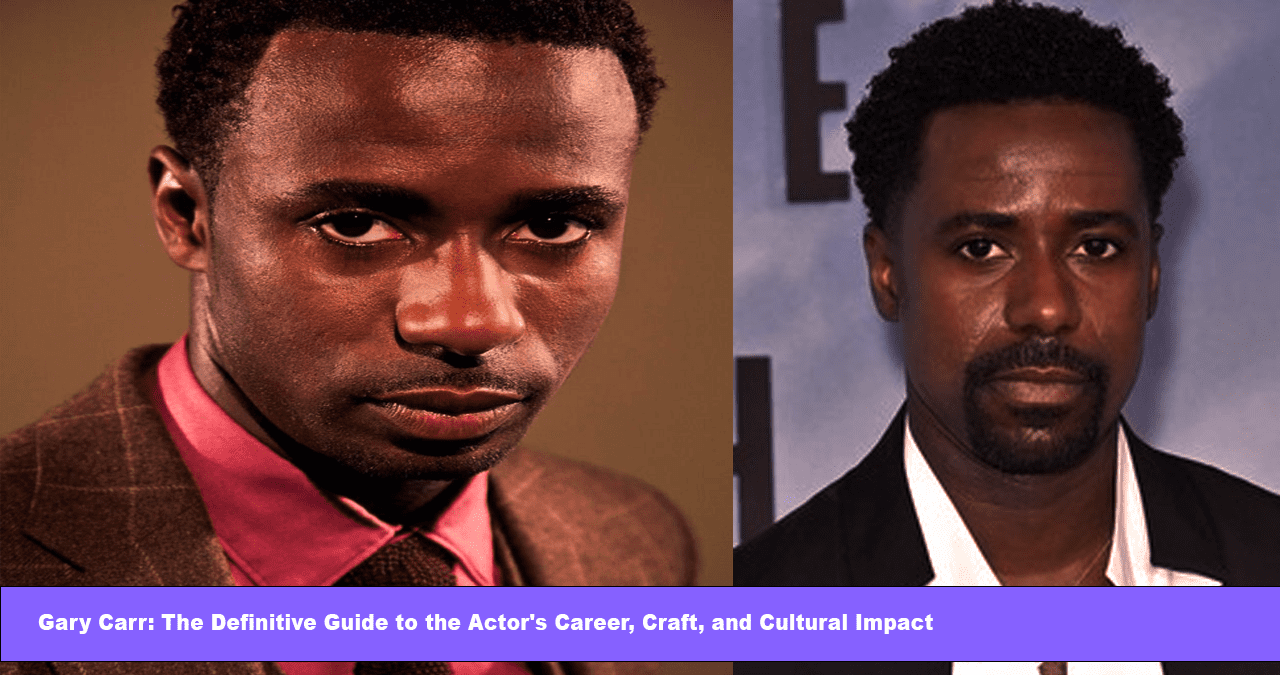

Gary Carr: A Study in Artistry, Range, and Quiet Revolution
This guide explains the multifaceted career and artistic significance of actor Gary Carr, providing readers with a comprehensive understanding of his journey from stage to screen, his transformative roles, and the subtle impact he has had on contemporary television and film. This resource helps readers move beyond a simple filmography to appreciate the craft, intentionality, and cultural conversations embedded within Carr’s body of work.
When the name Gary Carr enters a conversation, it often sparks a recognition that is both immediate and curiously layered. For many, he is the charming jazz singer Jack Ross from the genteel world of Downton Abbey, a role that introduced him to a global audience and injected a potent dose of modernity into the Crawley household. For others, he is the ambitious, charismatic pimp CC in the gritty, neon-lit realism of The Deuce, a performance of such raw complexity that it redefined his career. Yet, these two poles merely bracket a far richer artistic landscape. Gary Carr’s trajectory is not a simple story of breakout roles and rising fame; it is a deliberate study in range, a quiet revolution against typecasting, and a masterclass in how an actor can build a career on the foundations of craft rather than celebrity. This article delves deep into the anatomy of his work, exploring the techniques, choices, and quiet resilience that define one of the most compelling actors of his generation.
The Foundation: Stage Craft and Early Artistic Development
Long before period costumes or HBO scripts, Gary Carr’s professional identity was forged in the demanding, immediate world of theatre. This foundational period is critical to understanding his approach. Training at the prestigious Royal Academy of Dramatic Art (RADA) provided a classical toolkit—voice, movement, text analysis—but more importantly, it instilled a discipline and a process-oriented mindset. Early stage work, including productions at the National Theatre and the Globe, required a different muscle than screen acting: projection without shouting, subtlety that reads to the back row, and the stamina of a live, unbroken narrative. This background is palpable in his screen performances, which are consistently rooted in a deep understanding of character psychology and physical presence.
In practice, this theatrical foundation manifests as an exceptional control over stillness and economy of movement. Screen acting often rewards minimalism, and Carr’s ability to convey layers of thought and emotion through a glance, a slight shift in posture, or a measured silence speaks to his stage-honed skills. He understands subtext—what lies beneath the lines—as the actor’s primary territory. This matters most when analyzing characters who operate in worlds of coded language or social restraint, such as Jack Ross in 1920s England or a modern barrister in a legal drama. His performances are never a series of disconnected reactions; they are built from a coherent internal logic that suggests a full life existing before and after the camera’s gaze.
Key Takeaway: Carr’s rigorous theatre training is the unseen bedrock of his screen work, providing him with a disciplined process, mastery of physical and vocal nuance, and a deep commitment to character psychology that elevates all his performances.
Breaking Through: “Downton Abbey” and the Challenge of the Breakout Role
The role of Jack Ross in Julian Fellowes’ Downton Abbey was a paradigm-shifting moment, both for the series and for Carr’s career. On the surface, it was a classic “breakout” part, introducing a talented actor to a massive, dedicated audience. But to view it merely as a career launchpad is to underestimate its complexity and cultural weight. Jack Ross was not just a new love interest; he was a deliberate narrative device, a symbol of the changing social and racial dynamics of the post-World War I era. Carr’s task was immense: to create a character who felt authentically of his time—a successful, touring jazz musician—while navigating the prejudices and curiosities of the Crawley family and the audience.
Carr solved this problem with a blend of dignified charm and subdued resilience. Jack Ross was never defined by his otherness; his confidence was inherent, not defensive. In scenes with Lady Rose, Carr played genuine affection and attraction, but always tinged with a sober awareness of the societal forces arrayed against them. He avoided melodrama, instead finding power in quiet moments of realization and resignation. This performance addressed a real user problem often seen in period dramas: the “token” character who exists solely to represent an issue. Carr ensured Jack Ross was a man first, an artist second, and a symbol only as the script demanded. His portrayal gave the character agency and interiority, making the social commentary more potent because it was attached to a fully realized human being.
Gary Carr’s performance as Jack Ross demonstrated that a character introduced as a “disruptor” could achieve depth and empathy by prioritizing authentic human emotion over symbolic weight.
The global success of the show presented another common actor’s challenge: the specter of typecasting. Being globally recognized as the handsome, smooth-singing jazzman could have easily pigeonholed him into a narrow lane of period pieces or romantic leads. This is a pivotal moment in any actor’s narrative—the decision following breakout fame. Would he capitalize on the likeness, or deliberately complicate it? The direction he chose would define the next decade of his work.
*Key Takeaway: Carr’s role in *Downton Abbey* was a masterclass in bringing depth and humanity to a “disruptive” character, successfully avoiding stereotype and setting the stage for his deliberate pursuit of range.*
The Pivot: Radical Reinvention in “The Deuce”
If Jack Ross was a carefully contained flame, CC in David Simon’s The Deuce was a wildfire. This role was not just a departure; it was a conscious, radical deconstruction of Carr’s established screen persona. CC, a pimp navigating the violent, transactional world of 1970s Times Square, required a complete physical, vocal, and psychological transformation. The charming smile was replaced by a calculating gaze; the elegant posture coiled into a predatory, animalistic readiness. Carr immersed himself in the grime and rhythm of the era, adopting a distinct American accent and a demeanor that was equal parts seductive and terrifying.
This transformation addressed a critical professional problem: escaping the gravitational pull of a beloved, defining role. For an actor, being unforgettable in one part can be a curse, making audiences and casting directors unable to see past it. Carr’s solution was to go as far in the opposite direction as possible. He embraced the darkness and moral ambiguity of CC, not as a villain, but as a product of a specific, brutal ecosystem. His performance was a detailed study in entrepreneurial ruthlessness and warped paternalism. He showcased CC’s intelligence and strategic mind, making his brutality even more unsettling because it was systematic, not merely impulsive. This role proved his métier was not a particular type, but the process of building a character from the ground up.
From hands-on analysis of his performance, one observes the meticulous details: the specific way CC wore his fur coats, the almost theatrical flourish of his gestures used to command space, the modulation of his voice from a purr to a lash. These choices built a character who was a performer in his own right, a director of the street-corner theatre he controlled. This performance silenced any doubt about his range and established him as a fearless character actor capable of navigating profound moral complexity.
*Key Takeaway: The role of CC in *The Deuce* was a strategic and artistic masterstroke, allowing Carr to shatter his earlier image and demonstrate a formidable capacity for immersive, transformative character work.*
The Enduring Love Story of Ralph Macchio: Is Ralph Macchio married?
Anatomy of a Craftsman: Technique and Process
To understand Gary Carr as an artist, one must look beyond the roles to the consistent techniques and processes that underpin them. His approach is a hybrid of classical training and responsive, moment-to-moment discovery. He is a preparer, known for deep research into the historical and social context of his characters. For a period piece, this might involve studying music, gait, and social customs. For a contemporary role, it could mean understanding a profession’s jargon or a subculture’s rhythms.
However, his preparation never results in a rigid, pre-planned performance. A hallmark of his technique is a profound listening ability. In scenes with other actors, he is visibly reacting and processing, not just waiting for his cue. This creates electric, authentic exchanges where the interaction feels discovered, not rehearsed. He excels in what might be termed “reactive realism,” where his character’s thoughts are visible in real time. This technique is particularly effective in close-up shots, where the camera can capture the micro-expressions and internal shifts that signal a change in tactic, a hidden pain, or a sudden decision.
Another key element is his use of physicality. Each character possesses a distinct corporeal signature. Compare the open, graceful posture of Jack Ross, the coiled, panther-like energy of CC, and the more casual, modern physicality of a character in a contemporary drama. He understands that how a character occupies space tells a story about their confidence, history, and intentions. This physical transformation is never mere imitation; it is an externalization of internal psychology.
Key Takeaway: Carr’s acting technique is defined by meticulous research paired with exceptional in-the-moment reactivity, using deep listening and deliberate physicality to create characters that feel authentically alive and internally consistent.
Navigating the Industry: Career Strategy and Selective Choices
In an industry that often pressures actors to capitalize on momentum with volume, Gary Carr’s career path reflects a strategy of selective intentionality. His filmography is not sprawling; it is curated. Following the intense, three-year commitment to The Deuce, he did not rush into another series regular role. Instead, he chose varied, impactful projects that allowed for continued exploration: a lead in a BBC drama like The Lazarus Project, a supporting turn in a major fantasy film, or a return to theatre. This pattern suggests an actor who values the quality of the challenge and the creative partnership over mere exposure or type-casting.
This selective approach directly addresses the actor’s dilemma of longevity versus ubiquity. By avoiding over-saturation, he maintains a degree of mystique and ensures that each new appearance is an event, a chance to see what he will do next. He seems drawn to projects with strong authorship—working with visionaries like David Simon or Michaela Coel—indicating a preference for environments where character and narrative complexity are prioritized. This strategy builds a different kind of career authority: one based on respected craft and intelligent choice rather than tabloid fame.
For viewers and aspiring actors, this is a potent lesson in professional sustainability. It demonstrates that a career can be built on a series of deep dives rather than constant surface activity. It requires patience, confidence, and a clear sense of one’s artistic goals. Carr’s path shows that strategic pauses and deliberate diversification (across film, TV, and stage) can forge a more resilient and respected long-term presence in the industry.
Key Takeaway: Carr’s selective, project-driven career strategy prioritizes creative challenge and variety over constant visibility, fostering longevity and an authoritative reputation built on craft rather than celebrity.
Cultural Impact and Representation
The work of Gary Carr, often implicitly, engages with significant conversations about representation and the evolving landscape for Black actors in the UK and internationally. His roles frequently place him at intersections of race, class, and power, but he consistently sidesteps didactic portrayal. He does not play “issues”; he plays people navigating worlds where those issues are a tangible part of the atmosphere.
His presence in Downton Abbey was historically grounded and significant, portraying a Black British professional at a time when such representations in mainstream period drama were exceedingly rare. He brought that history to life without fanfare, normalizing it through the authenticity of the performance. In The Deuce, he explored the hyper-exploitative underbelly of the American dream, with CC’s character offering a grim commentary on capitalism and agency. In more modern settings, he often portrays professionals—lawyers, civil servants, soldiers—contributing to a broader, normalized representation of Black men in positions of authority and intellect.
This nuanced approach to representation is powerful because it argues for complexity. It moves beyond the simplistic binaries of “positive” or “negative” imagery and instead insists on multifaceted humanity. His characters have ambitions, flaws, talents, and moral blind spots. They are not representatives of an entire group; they are specific individuals shaped by, and reacting to, their circumstances. This, in the long arc of cultural storytelling, is the more profound step forward: the claim to limitless, complicated humanity.
Key Takeaway: Carr contributes to broader cultural conversations on representation by consistently portraying complex, historically grounded individuals, thereby advocating for multifaceted humanity over symbolic or simplistic imagery.
The Versatility Spectrum: A Comparative Analysis
A useful way to grasp the scope of Gary Carr’s work is to examine the deliberate contrasts between his most prominent roles. The following table highlights how he constructs entirely different characters from the ground up, varying core elements of his performance.
| Performance Element | Jack Ross (Downton Abbey) | CC (The Deuce) | A Modern Professional (e.g., The Witness for the Prosecution) |
|---|---|---|---|
| Physicality & Posture | Erect, graceful, open. Relaxed confidence of a performer. | Coiled, predatory, expansive gestures used to dominate space. | Controlled, efficient, postured for boardrooms or courtrooms. |
| Vocal Quality | Warm, melodic, clear Received Pronunciation with a singer’s control. | New York accent, rhythmic, ranging from a silky purr to a violent snarl. | Precise, measured, modern British professional diction. |
| Primary Motivator | Artistic expression, romantic connection, dignified navigation of prejudice. | Power, capital, control, and a warped sense of entrepreneurial ownership. | Justice, truth, professional duty, or solving a complex problem. |
| Relationship to Space | A respectful guest, aware of being an outsider. Commands space only on stage. | A territorial overlord. Space is his to control and monetize. | An operator within an institutional space (court, office). |
| Key Emotional Range | Charm, melancholy, principled resolve, quiet disappointment. | Charismatic manipulation, chilling ruthlessness, volatile anger. | Intellectual focus, ethical tension, determined resilience. |
This table illustrates that Carr’s versatility is not accidental but a series of concrete, actionable choices across every facet of performance. An aspiring actor can study this to understand how to fundamentally alter their instrument for each role.
Key Takeaway: Carr’s versatility is a demonstrable toolkit of choices in physicality, voice, and motivation, allowing him to construct characters that are distinct and internally coherent.
The Sound of Character: Music and Vocal Mastery
A unique and often under-analyzed strand in Gary Carr’s artistry is his relationship with music and vocal expression. His training as a singer is not merely an additional skill listed on a resume; it is an integrated part of his character-building apparatus. For Jack Ross, singing was the character’s core identity. Carr’s own vocal performances in the role were not dubbed; they were an authentic extension of the character’s soul, a vulnerability and strength laid bare. The choice to use his real voice added a layer of integrity that cannot be faked.
This musicality translates beyond literal singing. There is a rhythmic quality to his line delivery, an understanding of pace, pause, and tempo that enhances dramatic effect. In The Deuce, CC’s speech patterns have a percussive, almost musical cadence, used to hypnotize and control. He understands how the sound of a voice—its texture, rhythm, and pitch—can convey history, education, and intent. This sonic dimension adds a rich layer of subtext. A director once noted of actors with musicality, “They understand the score of the scene, not just the lines.” This insight applies perfectly to Carr; he comprehends the emotional and rhythmic architecture of a scene, playing his part within that larger composition.
Consider a real-world example from a stage production: in a theatrical monologue, the use of a strategic pause or a shift in vocal register can land a revelation with far greater force than volume alone. Carr brings this stage-honed, musical sensitivity to the screen, where the microphone picks up every breath and inflection. It allows him to communicate volumes in whispers, making his performances intensely intimate and compelling.
Key Takeaway: Carr’s musical training and vocal mastery are fundamental to his character work, informing the rhythm, texture, and emotional cadence of his performances to create deeper, more resonant characterizations.
Looking Forward: The Evolution of an Artisan
Predicting the next steps for an actor of Carr’s caliber is a fascinating exercise, not in naming projects, but in discerning trajectory. Based on the established pattern, his evolution seems pointed toward even greater creative ownership and narrative complexity. He has demonstrated the skills of a leading man, the transformative zeal of a character actor, and the collaborative spirit of an ensemble player. The natural progression involves seeking out or creating material that synthesizes these facets.
One can anticipate a growing attraction to projects where he serves as both performer and producer, shaping stories from their inception. Given his intelligent choice of collaborators, he may increasingly work with auteur directors and writers known for dense, challenging material. The genres may expand further—perhaps a directorial turn, or a deep dive into a long-form limited series with a singular character arc. The through-line will not be a specific genre, but a commitment to human complexity. He is unlikely to be drawn to purely schematic heroes or villains; the fertile ground lies in the ambiguous, conflicted, and richly textured middle.
For the audience, this promises a continuing journey of discovery. Each new Gary Carr project becomes an invitation to witness a new synthesis of his tools: the classical training, the physical transformation, the vocal creativity, and the deep empathetic research. He represents the model of a modern, serious actor: one who builds a respected body of work through unwavering commitment to the craft itself, letting the artistry dictate the fame, and not the other way around.
Key Takeaway: Carr’s future trajectory points towards roles of increasing narrative complexity and creative ownership, likely blending his proven skills as a transformative character actor with the depth and focus of a leading man.
Practical Insights for Aspiring Performers
For those studying the craft of acting, Gary Carr’s career offers a wealth of practical, extractable lessons. His journey is a case study in building a sustainable artistic life. First, invest deeply in foundational training. The stage discipline at RADA provided a versatile toolkit that serves him in every medium; it’s the gym for the actor’s instrument. Second, use a breakout role as a platform, not a prison. He acknowledged the fame of Downton Abbey but immediately worked to complicate that image, understanding that an actor’s currency is range.
Third, embody the research. His character work shows that research isn’t about knowing facts; it’s about letting those facts alter your body, voice, and mindset. Fourth, master the power of listening. The most dynamic parts of his performances are often his silent reactions, proving that acting is as much about receiving as it is about delivering. Finally, curate your path strategically. A career is a long-term narrative. Choosing projects for their creative challenge and growth potential, rather than just profile or pay, builds a more meaningful and durable legacy.
Readers often benefit from analyzing specific scenes from his work with these principles in mind. Observe a scene from Downton Abbey and one from The Deuce back-to-back. Note the complete overhaul of instrument. Then, watch a dialogue scene and mute the sound; study how much story is told through his eyes and reactions. This practical analysis turns fandom into a masterclass.
Key Takeaway: Aspiring actors can model Carr’s emphasis on foundational craft, strategic career curation, immersive research, and reactive listening to build their own versatile and sustainable careers.
Actionable Checklist for Engaging with Gary Carr’s Work
To fully appreciate the depth and breadth of his contributions, consider this curated approach to his filmography:
- Start with the Contrast: Watch key episodes featuring Jack Ross in Downton Abbey (Series 4 & 5) followed by pivotal CC episodes in The Deuce (Season 1). Actively note the differences in voice, posture, and energy.
- Focus on the Eyes: In any performance, watch a scene focusing solely on Carr’s eye line and micro-expressions. Observe how much internal processing is communicated without words.
- Listen for the Music: Pay attention to the rhythm and cadence of his speech, noting how it changes from role to role. Listen to his actual singing performances as Jack Ross as a key to the character’s core.
- Seek the Modern Turns: Explore his work in contemporary dramas like The Lazarus Project or The Witness for the Prosecution to see his application of classical technique in a modern setting.
- Appreciate the Ensemble: In projects like The Deuce, study his dynamic with other powerhouse actors (Maggie Gyllenhaal, James Franco). Note how he holds space and creates chemistry within an ensemble.
- Acknowledge the Context: For period pieces, briefly research the historical moment of the character. This will deepen your understanding of the specific challenges and realities he is portraying.
This checklist moves the viewing experience from passive consumption to active study, revealing the layers of intentionality in his work.
Conclusion
Gary Carr’s journey from the stages of London to the pinnacle of international television is a narrative defined by artistic integrity and intelligent metamorphosis. He is more than the sum of his famous roles; he is the process that creates them. By dissecting his work, we gain insight into the very mechanics of sophisticated acting: the marriage of preparation and presence, the boldness to reinvent, and the wisdom to build a career with patience and purpose. He has navigated the pressures of typecasting and breakout fame not by resisting them, but by absorbing them into a broader, more compelling project: the continual honing of his craft. In an industry of noise and fleeting celebrity, Carr stands as a testament to the enduring power of quiet mastery. His body of work, still very much in progress, invites us not merely to watch, but to observe—to appreciate the profound skill required to make such transformative artistry look so effortlessly real.
Frequently Asked Questions (FAQs)
What is Gary Carr best known for?
Gary Carr is best known for two seminal television roles that showcase his extraordinary range: the charming jazz singer Jack Ross in the global phenomenon Downton Abbey, and the ruthlessly ambitious pimp CC in David Simon’s critically acclaimed HBO series The Deuce. These contrasting parts define his ability to transform completely for a character.
Where did Gary Carr train as an actor?
He received his formal professional training at the Royal Academy of Dramatic Art (RADA) in London, one of the world’s most prestigious drama schools. This classical theatre training provided the foundational discipline and technique that underpin all of his screen and stage work.
Has Gary Carr done any theatre work?
Yes, his professional roots are in theatre. Before his screen breakthrough, he performed in notable productions including The Empress at the Royal Shakespeare Company and The Crucible at the Regent’s Park Open Air Theatre. This stage experience is crucial to understanding his detailed approach to character construction.
How did his role in The Deuce change his career trajectory?
The role of CC was a deliberate and radical reinvention. It forcefully moved him beyond the “charming period actor” label attached to his Downton Abbey fame, proving his depth, fearlessness, and capacity for morally complex roles. It established him as a serious, versatile character actor capable of leading a gritty, adult drama.
What should I watch to see the full scope of his versatility?
To appreciate his range, a curated watch list should include: his arc in Downton Abbey (Series 4-5), all three seasons of The Deuce, the BBC adaptation of The Witness for the Prosecution, and the sci-fi drama The Lazarus Project. This selection covers period charm, gritty transformation, legal intensity, and modern sci-fi.