
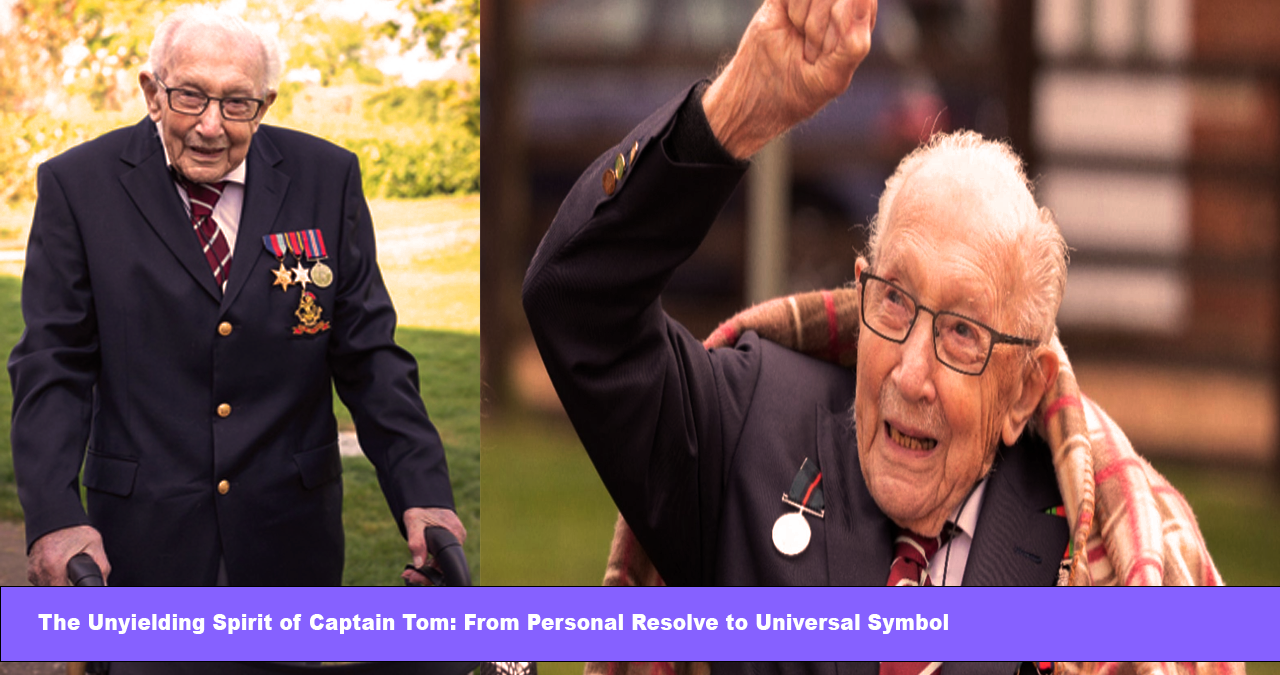

Executive Summary: This comprehensive guide explores the profound legacy of Captain Sir Tom Moore, the centenarian who captured the world’s heart by walking laps of his garden. Moving beyond the simple narrative of charitable fundraising, this resource helps readers understand how an individual’s quiet determination can evolve into a global symbol of hope, resilience, and communal action. We examine the historical context, the psychological underpinnings of his appeal, the practical mechanics of his campaign’s success, and the lasting strategic lessons his story offers for fostering positive change in an uncertain world.
Introduction
In a time of global uncertainty, a solitary figure in England stepped into his garden and, with the aid of a walking frame, began a journey that would traverse the globe in spirit. Captain Tom, as he became universally known, was a man whose advanced years belied a youthful resolve, undertaking a simple pledge to walk one hundred laps before his 100th birthday to raise funds for healthcare workers. This guide explains how this modest endeavor transcended its initial goal to become a cultural touchstone, a masterclass in narrative-driven action, and a beacon of collective optimism. It is a story that interweaves personal history, media evolution, societal psychology, and philanthropic strategy, offering insights far beyond the staggering sum of money raised. This resource helps readers deconstruct the phenomenon to understand not just what happened, but why it resonated so deeply and what enduring principles we can apply to our own challenges.
The Man Before the Mission: Foundations of a Character
To understand the phenomenon of Captain Tom, one must first meet the man—Tom Moore. His story did not begin at age 99; it was forged over a century of lived experience. Born into an era of steam trains and empire, his formative years were shaped by the austerity of the interwar period. His service as a captain in the British Army during the Second World War, specifically in the brutal campaigns in Burma and India, instilled in him a particular kind of discipline, camaraderie, and an intimate understanding of hardship and survival. This was not a man unfamiliar with global crisis or personal trial.
After the war, he returned to a quiet life in Yorkshire, working in the concrete industry and later as a salesman for roofing materials. He was, by all accounts, an unassuming figure—a father, a grandfather, a man who enjoyed watching rugby and tinkering in his garden. The qualities that would later captivate millions—his stoic positivity, his dry humor, his unwavering politeness—were not a performance for the cameras. They were the bedrock of his character, polished over a lifetime. This matters most when we consider authenticity in public endeavors; Captain Tom’s appeal was rooted in a palpable, pre-existing genuineness. He was not manufactured; he was revealed. His advanced age was not a gimmick but a credential, a visual testament to endurance. When he spoke of “tomorrow being a good day,” it carried the weight of having seen over 36,000 of them, through war and peace, joy and loss. His personal history provided the unshakable credibility that made his later actions so powerful.
Key Takeaway: Captain Tom’s global impact was possible only because it was built upon a foundation of authentic, lived experience and a character refined by a century of history, making his message of hope inherently trustworthy.
Anatomy of a Phenomenon: How a Garden Walk Captured the World
The initial goal was straightforward, even quaint: to raise £1,000 for NHS Charities Together by walking 100 laps of his 25-meter garden before his 100th birthday. The user problem this addressed was widespread but diffuse—a feeling of helplessness and a desire to contribute during a national lockdown. Captain Tom provided a tangible, human-scale solution. The outcome was a fundraising campaign that shattered every possible expectation, ultimately raising nearly £33 million from over 1.5 million donors in over 160 countries. This staggering result was not accidental but the product of a perfect convergence of elements.
First, the action was visibly effortful. The image of a frail but determined nonagenarian, pushing his walking frame in the rain or sun, was a powerful narrative engine. It represented the antithesis of passive charity. Donors weren’t just giving money; they were sponsoring effort, a transaction that feels profoundly more meaningful. Second, the narrative was effortlessly simple to understand and share. In an age of complex, systemic problems, here was a story with a clear hero, a clear mission, and a clear metric for success (laps walked, pounds raised). This simplicity made it virally shareable across social media platforms and traditional news outlets alike.
Third, the timing was historically precise. The campaign launched into a global atmosphere thick with fear, isolation, and anxiety. Captain Tom’s walk became a shared project for a fragmented public. Donating was not only an act of charity but also an act of participation in a collective, positive story. It allowed individuals to feel connected to something uplifting beyond their own four walls. The media, itself searching for narratives of hope, amplified this cycle exponentially. Each milestone—£1 million, £5 million, £10 million—became a new news story, fueling further donations and engagement.
Visual Suggestion: An infographic tracing the exponential growth of donations against key media events and Captain Tom’s lap milestones.
Key Takeaway: The campaign’s unprecedented success was a perfect storm of a visually compelling effort, a simple narrative, impeccable timing, and a public desperate for a unifying symbol of hope and agency.
Beyond the Pounds: The Multifaceted Legacy of Symbolic Action
While the financial contribution was monumental, to view Captain Tom’s legacy solely through the lens of philanthropy is to miss its deeper cultural impact. His actions solved several profound, non-financial user problems. For a society in lockdown, he provided a shared emotional outlet and a counter-narrative to despair. He became a living metaphor for resilience—if a man of 99 could keep walking forward, surely the rest of us could find a way to persevere through our own challenges.
His influence also sparked a re-evaluation of age and contribution. In a culture often focused on youth and speed, Captain Tom championed the virtues of patience, perspective, and the quiet power of late-life purpose. He disrupted ageist stereotypes, demonstrating that capacity and inspiration are not bound by chronology. Furthermore, his steadfast, polite, and quintessentially understated demeanor offered a model of leadership rooted in service and humility rather than ego or aggression. In a world of noisy confrontation, his quiet determination was revolutionary.
His knighthood, granted by the Queen, was a formal recognition of this symbolic service. “Captain Sir Tom Moore” became a title that encapsulated both his past military service and his present civilian heroism. The establishment of The Captain Tom Foundation aimed to institutionalize his ethos, promoting causes that combat loneliness and support the elderly and those facing bereavement. His legacy, therefore, exists in three interconnected layers: the tangible funds raised, the intangible uplift in public spirit, and the ongoing mission to perpetuate his values of hope and togetherness.
Key Takeaway: Captain Tom’s true legacy extends far beyond charitable funds, offering a powerful symbol of resilience that addressed societal needs for hope, redefined perceptions of aging, and modeled a form of humble, service-oriented leadership.
Strategic Communications and Modern Storytelling
From a strategic communications perspective, Captain Tom’s campaign was a masterclass in organic, narrative-driven engagement. It succeeded without a traditional marketing playbook, yet its dynamics align with the most effective modern storytelling principles. In practice, the campaign was driven by a core, authentic story that was “found” rather than “created.” The media and the public became co-authors and amplifiers, not just passive audiences.
A critical lesson is the power of a simple, repeatable visual and narrative hook. The image of the garden walk was instantly recognizable and emotionally charged. His daily updates, delivered with characteristic humility, created a serialized narrative that kept the public invested. This approach taps into a fundamental human desire to follow and support a journey. Furthermore, the campaign brilliantly leveraged intermediate victories. Celebrating each fundraising milestone sustained momentum and gave the media continual reasons to report, transforming a one-week story into a month-long global event.
The digital infrastructure, primarily a JustGiving page, was simple but crucial. It served as the frictionless conversion point where inspired sentiment could turn into actionable support. The campaign also demonstrated the evolving best practice of hybrid media engagement. It thrived on social sharing but was validated and magnified by front-page newspaper coverage and prime-time television news segments. This created a virtuous circle where online buzz drove offline coverage, which in turn drove more online donations.
Supporting Quote: A communications strategist might reflect, “Captain Tom’s campaign was a pristine example of earned media at its most potent. It presented a story so inherently powerful and perfectly timed that it commanded attention organically, requiring no paid promotion. It reminds us that at the heart of every viral phenomenon is a human truth, plainly told.”
Key Takeaway: The campaign’s communications success was built on an authentic, visual core narrative, sustained by celebrating incremental progress, and amplified through a synergistic loop of social and traditional media.
Practical Philanthropy: Mechanics of a Record-Breaking Fundraiser
For individuals or organizations interested in community fundraising, the Captain Tom phenomenon offers actionable, albeit uniquely scaled, insights. Let’s dissect the practical mechanics. The initiative began with a personal, meaningful commitment. It wasn’t an abstract ask for money; it was a pledge of personal effort tied to a specific, relatable goal (the 100th birthday). This personal stake created a powerful contract with donors.
Secondly, the barrier to donation was intentionally low. The JustGiving platform allowed for micro-donations from millions of people. This created a powerful sense of mass participation; it wasn’t a cause just for the wealthy. The campaign also brilliantly harnessed the network effect. People didn’t just donate; they shared their donation and the story on their own social networks, acting as peer-to-peer advocates. This organic, distributed advocacy is far more credible than centralised advertising.
A practical consideration often overlooked is the importance of backend support. Captain Tom’s family, particularly his daughter Hannah, managed the practicalities—setting up the page, handling media inquiries, and ensuring Captain Tom’s wellbeing. This allowed the figurehead to focus on the core activity (walking) and interacting positively with well-wishers. Commonly seen in real projects, even the most inspiring grassroots efforts require a logistical foundation to sustain momentum and manage scale.
Visual Suggestion: A simple flowchart illustrating the campaign’s flywheel: Personal Action -> Initial Media Coverage -> Social Sharing & Donations -> Further Media Coverage -> Expanded Social Sharing.
Key Takeaway: Effective grassroots philanthropy combines a personal commitment from the fundraiser, low barriers to entry for supporters, strategic use of digital tools to enable sharing, and a solid logistical backbone to manage growth.
Historical Context and the Archetype of the Citizen Hero
Captain Tom’s story, while unique in its details, resonates because it taps into a deep and recurring historical archetype: that of the unlikely or citizen hero. Throughout history, moments of national crisis have a way of elevating ordinary individuals who perform extraordinary acts of courage or kindness. These figures often emerge not from centers of power, but from the periphery, and their power stems from their perceived “everyman” status.
We can see echoes of this in figures from past crises—the firefighters and volunteers during the Blitz, the community responders after natural disasters. Captain Tom fits squarely into this lineage. He was not a celebrity, a politician, or a billionaire philanthropist. He was a retired grandfather, a figure familiar and unthreatening. His military past connected him to the “Greatest Generation” narrative, a generation synonymous with stoicism and sacrifice, which added a layer of poignant historical resonance, especially for a nation once again facing a collective challenge.
His archetypal role was to provide moral leadership rather than political or operational direction. He led by example, not by decree. This allowed people of all backgrounds and beliefs to project their own hopes onto him without partisan conflict. He became a neutral vessel for national, and indeed international, good feeling. Understanding this historical context helps explain why his message transcended demographics and borders; it spoke to a universal human need for stories of decency and perseverance in dark times.
Key Takeaway: Captain Tom succeeded in part because he embodied a timeless historical archetype—the ordinary citizen who rises to meet a moment with extraordinary grace, providing apolitical moral leadership during a crisis.
The Snoochie Shy: A Comprehensive Guide to Understanding and Mastering a Unique Creative Philosophy
Navigating the Modern Media Landscape
The role of media was not just to report on Captain Tom; it was an active, shaping force in the phenomenon. The relationship demonstrated both the best potentials and the inherent complexities of the 24-hour news cycle. Initially, local media picked up the story, followed by national newspapers and broadcasters. The narrative was irresistibly positive—a welcome respite from the relentless, grim statistics dominating the news.
However, this level of scrutiny also presents challenges. The intensification of the public gaze can place immense pressure on individuals and families unprepared for global fame. Every word and action is analyzed. After the initial walk, Captain Tom’s every public appearance, comment, or holiday became a news item. This highlights a critical trade-off: media amplification is essential for scale, but it can also consume the very authenticity that made the story compelling in the first place.
Furthermore, the story inevitably attracted a minor degree of critique and conspiracy, a common feature of modern digital discourse where any significant figure becomes a site of contestation. This underscores the importance of having a clear, consistent narrative and a supportive circle to help navigate the inevitable complexities of fame. The family’s handling of this, focusing on the core message of hope and thanking supporters, was generally effective in maintaining the campaign’s positive tone.
Real-World Example: Consider how other viral, positive stories—like a local community coming together to support a family in need—often follow a similar, if smaller, trajectory: local news coverage leads to social media sharing, which can sometimes trigger national interest. The key difference with Captain Tom was the unprecedented scale, fueled by the pandemic’s unique global context.
Key Takeaway: While modern media can catapult a positive story to global prominence at unprecedented speed, it also demands careful navigation to protect the authentic core of the story from the pressures of constant public scrutiny.
Psychological and Sociological Resonance
At its heart, the global embrace of Captain Tom was a psychological event. It satisfied several fundamental human needs, particularly acute during a pandemic. Firstly, it offered a powerful sense of agency. Lockdowns created a pervasive feeling of powerlessness. Donating to Captain Tom’s walk was a concrete, positive action individuals could take to fight back against the virus’s impact, if not the virus itself. It was a way to reclaim control.
Secondly, it fostered shared identity and collective effervescence. Sociologist Émile Durkheim used this term to describe the feeling of energy and unity people experience when they come together in a common purpose. While physically isolated, millions of people were united in following and supporting Captain Tom’s journey. They shared in the collective joy of each milestone, creating a temporary, global community of goodwill.
Thirdly, Captain Tom embodied the psychology of hope. His mantra, “Please always remember, tomorrow will be a good day,” is a classic cognitive-behavioral technique—a positive affirmation. In a climate of fear, his unwavering optimism was not naive; it was a disciplined practice. For the public, he became an external locus of hope, a figure who steadfastly held optimism on behalf of others who might be struggling to maintain it themselves. This vicarious hope was a precious commodity.
Key Takeaway: The phenomenon resonated because it addressed deep psychological needs for agency, shared community, and accessible hope during a period of widespread anxiety and disconnection.
Enduring Lessons for Community Action and Personal Resilience
The story of Captain Tom is replete with lessons that can be adapted to smaller-scale community actions and personal mindsets. For community organizers, the core lesson is to start with action, not abstraction. Don’t just announce a cause; model the commitment. A personal, tangible effort is more galvanizing than a generic plea. Furthermore, celebrate small wins publicly. This builds momentum and makes participants feel the progress of their collective effort.
For individuals, Captain Tom’s life offers a masterclass in late-life purpose and incremental progress. His greatest impact came in his 100th year, a powerful rebuke to the idea that one’s best years are behind them after a certain age. His method was the antithesis of quick fixes; it was about putting one foot in front of the other, day after day. This philosophy is applicable to any personal goal, from fitness to learning a new skill to recovering from adversity.
If you’re deciding between a complex, multi-faceted campaign and a simple, clear action, the latter often has more power. Complexity can paralyze; simplicity mobilizes. Captain Tom’s walk was the ultimate simple action. It also teaches the importance of grace under scrutiny. His unwavering politeness and gratitude, even when tired or besieged by attention, were integral to maintaining the campaign’s positive spirit. In an age of quick tempers and online vitriol, his demeanor was a strategic and moral asset.
Visual Suggestion: A side-by-side comparison chart of traditional charity campaign elements versus the organic elements of the Captain Tom campaign.
| Traditional Campaign Element | Captain Tom’s Manifestation | Key Insight |
|---|---|---|
| Central Messaging | Top-down, crafted by committee. | Bottom-up, emerged from personal action. |
| Fundraising Ask | Often abstract (“support our mission”). | Concrete (“sponsor my lap”). |
| Media Strategy | Relies on paid promotion and press releases. | Driven by earned media and organic sharing. |
| Celebration Points | Often only final, large goals. | Every milestone (£1k, £1m, etc.) was celebrated. |
| Figurehead Role | Often a distant CEO or ambassador. | The fundraiser was the embodied action. |
Key Takeaway: The practical lessons from Captain Tom’s story emphasize starting with simple, personal action, celebrating incremental progress, and maintaining a spirit of gratitude—principles applicable to both community projects and personal development.
Ethical Considerations and the Weight of a Legacy
With great impact comes great ethical consideration. The immense attention and fundraising success, while overwhelmingly positive, also created a complex landscape for Captain Tom and his family. One key consideration is the stewardship of a public symbol. When an individual becomes an icon, they and their legacy managers must navigate how that symbolic power is used. The establishment of The Captain Tom Foundation was a clear effort to channel this energy into lasting, structured good, focusing on causes he cared about.
Another consideration is the balance between public ownership and private life. The public felt a deep, personal connection to Captain Tom, which is a beautiful thing, but it can also lead to expectations that blur boundaries. Every aspect of his life, including family decisions, became of public interest. This highlights a common trade-off in our connected age: the price of becoming a beloved public figure is a degree of personal privacy.
There’s also the challenge of managing expectations post-peak. After an unprecedented viral moment, what follows? The work of a foundation is long-term, unglamorous, and subject to scrutiny. The ethical imperative is to ensure that the initial wave of emotion is translated into sustainable, effective charitable work that honors the spirit of the original act. This requires a different skill set—governance, strategy, transparency—than that needed to inspire a viral moment.
Key Takeaway: The transition from viral phenomenon to sustained legacy requires careful ethical stewardship, balancing the public’s emotional investment with the need for sustainable, transparent, and effective charitable governance.
Captain Tom in the Cultural Lexicon
The term “Captain Tom” has evolved from a man’s name into a cultural shorthand. It now references a specific kind of action: a humble, determined, against-the-odds effort that inspires widespread goodwill. You might hear someone say an initiative has “a bit of the Captain Tom spirit,” implying it is authentic, effort-driven, and unifying. His image—the walking frame, the blazer adorned with war medals, the smile—is instantly recognizable, a modern-day pictogram of resilience.
His phrases, particularly “Tomorrow will be a good day,” have entered common parlance as affirmations of optimism. This linguistic adoption is a true marker of cultural impact. He has been referenced in political speeches, documentaries, and countless articles as a benchmark for positive public action. In this way, his legacy is cemented not just in the history books or the funds raised, but in the very language we use to describe hope and community action.
This cultural embedding ensures his story’s longevity. It becomes a reference point for future generations facing their own crises, a reminder that individual action can spark collective transformation. Readers often benefit from considering what their own “garden walk” might be—not necessarily a global fundraiser, but a simple, consistent action that demonstrates commitment to a cause or personal goal within their own community.
Key Takeaway: Captain Tom has transcended individual celebrity to become a permanent cultural archetype and a linguistic shorthand for humble determination and community-focused optimism.
Actionable Checklist: Applying the Principles of Purposeful Action
Before concluding, let’s distill the core insights into a practical checklist. Whether you’re planning a community initiative, a personal challenge, or simply seeking to embody a more resilient mindset, consider these questions inspired by the Captain Tom phenomenon:
- Anchor in Authenticity: Is your action or project rooted in your genuine values, skills, or experiences? Does it feel true to who you are?
- Simplify the Core Action: Can you describe the primary activity in one clear, compelling sentence? Is it visually or narratively easy for others to understand and share?
- Personalize the Commitment: What tangible, personal effort are you investing? How are you “walking the walk” yourself?
- Define Milestones: Have you identified small, celebratable wins along the way to maintain momentum and show progress?
- Lower Barriers to Participation: How can you make it easy for the first person to support you, whether through a small donation, a share, or a word of encouragement?
- Prepare for Scaling (Even Modestly): Who can help manage logistics if interest grows? Have you thought through simple systems for communication or coordination?
- Maintain a Spirit of Gratitude: How will you consistently acknowledge and thank those who support the effort, reinforcing the communal spirit?
- Focus on the Action, Not Just the Outcome: Can you find purpose and satisfaction in the daily process itself, as Captain Tom found in his walking, regardless of the final scale of impact?
Final Reinforcing Conclusion
The story of Captain Sir Tom Moore is, at its simplest, about a man who went for a walk. But as we have explored, it is also a rich, multi-layered study in human psychology, modern media, historical resonance, and strategic communication. It demonstrates that in an age of digital complexity and global challenges, the most powerful forces remain fundamentally human: authenticity, perseverance, and shared hope. His journey from a private garden to the global stage reminds us that leadership can be quiet, that contribution has no age limit, and that a simple act of determination can become a lighthouse for millions. The enduring lesson of Captain Tom is not that we must all raise millions, but that we can all choose to put one foot in front of the other, with purpose and hope, and in doing so, we might just inspire others to walk alongside us. His legacy is a permanent invitation to believe that tomorrow can indeed be a good day.
Frequently Asked Questions
H3: Who was Captain Tom before he became famous?
Captain Tom, born Thomas Moore, was a British Army officer who served as a captain during the Second World War, seeing combat in the Burma and India campaigns. After the war, he worked in the building materials industry and lived a quiet, private life in Bedfordshire, England. He was a father and grandfather, and his now-famous characteristics—his stoicism, politeness, and optimism—were long-held traits, not a public persona.
H3: What was the original goal of Captain Tom’s walk?
The original, modest goal was to raise £1,000 for NHS Charities Together by walking 100 laps of his 25-meter garden before his 100th birthday. This was a personal challenge to thank healthcare workers for the treatment he had received. The campaign’s scale exploded far beyond this initial target due to its powerful resonance with the public during the national lockdown.
H3: How much money did Captain Tom ultimately raise?
Captain Tom’s garden walk campaign ultimately raised nearly £33 million (approximately $39 million USD at the time) from over 1.5 million individual donors around the world. The funds were donated to NHS Charities Together to support healthcare workers, patients, and volunteers within the UK’s National Health Service.
H3: Why did Captain Tom’s story resonate so deeply with people globally?
His story resonated due to a perfect convergence of factors: his authentic, frail-yet-determined effort provided a tangible symbol of hope; the simple narrative was easy to share; and it arrived during a global pandemic when people felt isolated, fearful, and eager for a positive, unifying story they could participate in through donations and sharing.
H3: What is The Captain Tom Foundation?
The Captain Tom Foundation is a charity established by Captain Tom and his family to continue his legacy of promoting hope and combating loneliness. Its mission is to support charities that help older people, those facing bereavement, and other causes aligned with Captain Tom’s spirit, ensuring his inspirational impact leads to sustained, practical support for vulnerable groups.
Metadata
- SEO Title: Captain Tom: The Complete Story Behind the Walk That Inspired the World
- Meta Description: Explore the profound legacy of Captain Tom Moore. This definitive guide covers his history, the psychology of his global impact, practical lessons in resilience, and his enduring cultural symbol.