
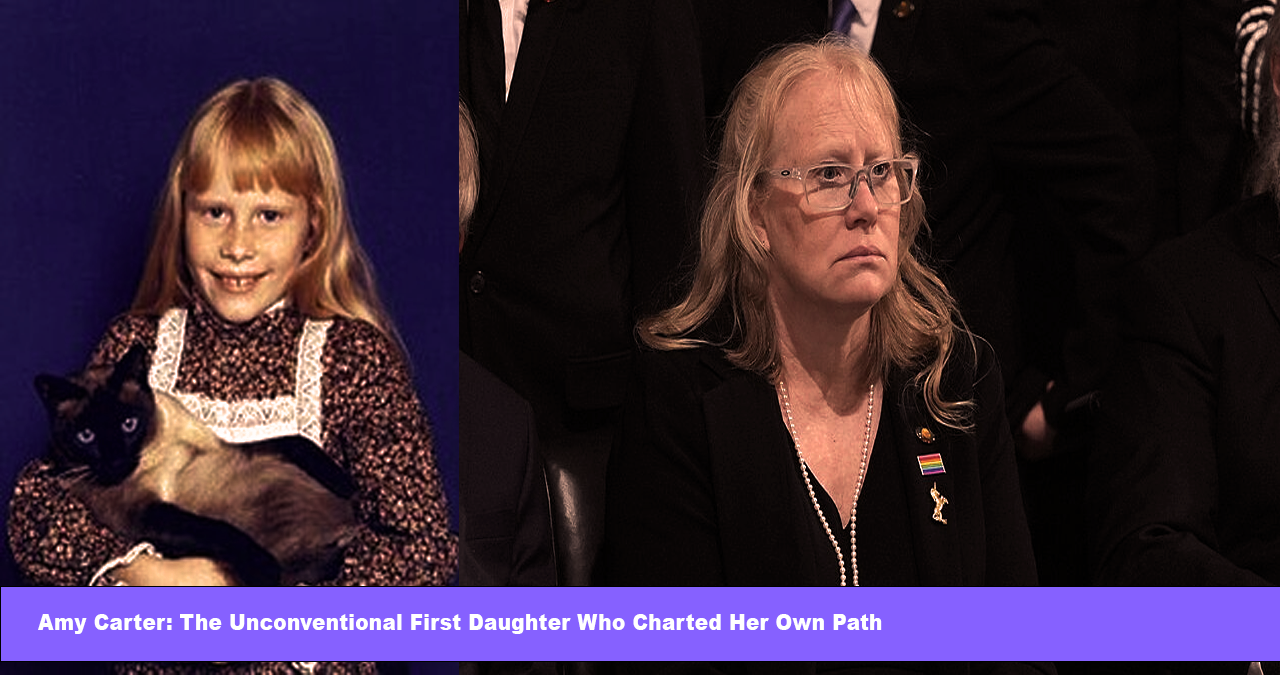

The image of a child in the White House has always captivated the American public. From the Kennedy children playing under the Resolute Desk to the Obama girls growing up in the national eye, the First Family’s youngest members bring a touch of relatable humanity to the highest office. Yet, among these familiar stories, one stands out for its quiet defiance of convention: that of Amy Carter, the only child of President Jimmy Carter and First Lady Rosalynn Carter. Her journey from a somewhat shy nine-year-old thrust into the global spotlight to a dedicated activist and fiercely private artist is a fascinating narrative of an individual navigating an extraordinary upbringing on her own terms. Unlike many political offspring, Amy Carter never sought the limelight; instead, she used the principles instilled by her parents—a deep sense of social justice and humility—to forge a life dedicated to activism, education, and family, far from the political fray. Her story is not one of political dynasty or celebrity, but of a person who absorbed the profound lessons of her unique childhood and applied them in her own, authentic way.
To understand Amy Carter is to understand a specific moment in American history. She entered the White House in 1977, a period of post-Watergate cynicism and economic malaise. Her father campaigned and governed on a platform of earnest morality and austerity, a tone that directly influenced the environment she grew up in. While the White House is a palace, the Carters deliberately fostered a sense of normalcy and simplicity. Amy Carter’s experience was less about state dinners and more about reading a book on the floor of the Oval Office or roller-skating through the mansion’s grand halls. This unique backdrop shaped a young woman who saw the presidency not as a symbol of imperial power, but as a platform for service—a lesson that would deeply inform her future choices. Her path offers a compelling look at the personal cost and unexpected freedoms of being a First Child, and how the daughter of Jimmy Carter carved out an identity that was entirely her own.
The White House Years of a Reluctant First Daughter
When the Carter family moved into 1600 Pennsylvania Avenue, Amy Carter was just a few weeks shy of her tenth birthday. Overnight, her life transformed from that of a relatively private schoolgirl in Plains, Georgia, to perhaps the world’s most famous fourth grader. The press and public were intensely curious about the cute, bespectacled child with two front teeth missing. However, the Carter administration was determined to shield her as much as possible and provide a semblance of a normal childhood. This was a radical departure from some previous administrations. President Jimmy Carter and Rosalynn were hands-on parents who insisted that Amy Carter do her own chores, make her bed, and even clean the rabbit cages for her pet rabbits, which lived on the White House grounds. She attended public school, first at Stevens Elementary and later at the mostly Black Thaddeus Stevens School, a conscious decision by her parents to integrate her life and signal their commitment to civil rights.
Life inside the White House for Amy Carter was a strange blend of the monumental and the mundane. She was a child living in a museum, with Secret Service codename “Dynamo” always nearby. Famous photographs capture her sitting on her father’s lap during a cabinet meeting, or curled up reading a book as world leaders conversed around her. These images became iconic, symbolizing the approachable, family-oriented nature of the Carter presidency. Yet, for Amy, it was simply her life. She had a treehouse built on the South Lawn. She took piano and violin lessons. She played with her brother Jeff’s children and her cat, Misty Malarky Ying Yang. However, the pressure and scrutiny were constant. Her every appearance, her choice of school, and even her somewhat reserved demeanor were subjects of public commentary and sometimes criticism. Through it all, her parents remained her anchor, ensuring that despite the historic walls around her, her core values—simplicity, humility, and a duty to others—were reinforced daily.
The Weight of Public Scrutiny and Finding Normalcy
Navigating childhood under a microscope is an immense challenge, and for Amy Carter, the public gaze was not always kind. Media outlets sometimes portrayed her as awkward or too plain, missing the point that she was a real child, not a political prop. The choice to send her to a D.C. public school, while ideologically consistent with her parents’ values, also exposed her to the complexities of the city’s social landscape and attracted both praise and controversy. The family’s efforts to maintain normalcy were a constant battle against the institution of the presidency itself. Birthday parties became semi-public events, and simple outings required meticulous planning and security. This environment inevitably shaped her personality, fostering a desire for privacy and a wariness of the media that would last a lifetime.
Perhaps one of the most telling episodes of her time as First Daughter was her visible participation in her parents’ political life, not as a performer, but as an observant child. She was present at the famous Camp David Accords, a moment of towering historical importance, yet through her eyes, it might have also been a long, formal event to sit through. This duality—being present for history while experiencing it as a young person—defined her White House years. When her father lost the 1980 election to Ronald Reagan, Amy Carter, then 13, returned to Plains. For many, this would have been a traumatic transition from the pinnacle of power to small-town life. For Amy, it may have also been a relief. Plains offered the genuine normalcy the White House could only simulate: anonymity, lifelong friends, and a chance to be a teenager away from the flashbulbs. This return to her roots provided the foundation for her next act, one where she would begin to apply the lessons of her childhood on her own volition.
From First Daughter to Arrested Activist: A Path of Principle
If the public expected Amy Carter to fade into quiet obscurity after leaving Washington, they were mistaken. The values of social justice and peaceful protest that permeated her upbringing found a powerful outlet in her college years. Enrolling at Brown University, she stepped decisively into the role of a student activist. The shy girl from the White House photos transformed into a committed protestor, demonstrating against apartheid in South Africa and, most notably, against CIA recruitment on college campuses. Her activism was not a rejection of her parents’ values, but rather an extension of them, pursued with the fervor of a young adult finding her own voice. In 1985, this commitment led to her first arrest at an anti-apartheid sit-in at the South African embassy, an event that made national headlines primarily because of her identity as the former president’s daughter.
Her most famous act of civil disobedience occurred in 1986 at the University of Massachusetts Amherst. Amy Carter, along with activist Abbie Hoffman and others, was arrested for protesting CIA recruitment. The charges were serious: disorderly conduct and trespassing. The ensuing trial became a spectacle, dubbed the “CIA on Trial” case, where the defense successfully argued that the protest was necessary to prevent the greater crime of the CIA’s activities in Central America. In a remarkable verdict, Amy Carter and her co-defendants were acquitted by a jury, a significant victory for the necessity defense in protest cases. This period solidified her public identity not as Jimmy Carter’s daughter in a passive sense, but as her own person—a principled activist willing to face legal consequences for her beliefs. As one reporter noted at the time, it was clear she had inherited her father’s moral compass, if not his political tactics. The quiet child had found a powerful, public voice.
The Evolution of a Private Life: Art, Family, and Legacy
Following the intensity of her activist years, Amy Carter deliberately retreated from public life, choosing a path of quiet dedication to the causes she believed in, away from media glare. She completed her degree in art history from Brown University and later earned a Master’s from Tulane. Art became a central focus, not as a public career, but as a personal pursuit. She worked as an artist, a photographer, and a curator, often focusing on themes of social justice and family. This choice reflects a consistent theme in her life: using her voice and talents in meaningful, but not necessarily headline-grabbing, ways. She has been involved with the Carter Center’s mental health programs, honoring her mother’s longtime advocacy, and has supported various humanitarian efforts, often without fanfare.
The core of her adult life, however, is her family. In 1996, she married computer consultant James Wentzel, and together they have one son, Hugo. They have lived a determinedly private life, splitting time between Georgia and the Caribbean. By all accounts, Amy Carter has been fiercely protective of her son’s privacy, ensuring he has the normal childhood she experienced only in fragments. She occasionally appears at Carter family events—book signings, the opening of the Carter Presidential Library, or during her father’s later public appearances—but always on the periphery, supportive but not seeking attention. This deliberate choice underscores her fundamental character: she is a person who values substance over ceremony, action over accolade. Her legacy is not one of political power or celebrity, but of continuity—living out the ethos of her parents in a modern, personal context.
“I’m not a public person. I never have been. I’m just trying to live my life.” — Amy Carter, in a rare interview.
The Carter Family Dynamic and Its Lasting Influence
To fully appreciate Amy Carter’s journey, one must understand the unique family environment created by President Jimmy Carter and Rosalynn. The Carters are famously close-knit, grounded in their shared faith, their hometown of Plains, and a collective commitment to service. Amy was not raised in isolation; she is the youngest of four children, with older brothers Jack, Chip, and Jeff. This larger family unit provided a buffer and a sense of normal sibling dynamics even in the White House. The family’s post-presidency life, centered around the Carter Center and Habitat for Humanity, presented a model of how to leverage influence for tangible good, a lesson Amy Carter internalized deeply. The Carters demonstrated that a life of purpose does not end with political office; it evolves.
The influence of her parents, particularly her father’s deep integrity and her mother’s pioneering work in mental health, is evident in Amy Carter’s life choices. While she never entered politics, the Carter ethic of “why not the best?” and a duty to help the less fortunate clearly guided her activism and her quieter charitable work. Her relationship with her parents remains strong, and she has spoken of their unwavering support even during her arrests, understanding that her protests were an expression of the conscience they helped shape. This familial support system allowed her the freedom to dissent and to define herself outside the shadow of the presidency, knowing that her fundamental bond with her family was unshakable. The Carter family exemplifies how public service can be a family value, expressed in diverse ways across generations.
Public Perception Versus Private Reality
The story of Amy Carter is also a story of media narrative versus personal truth. For the public, she has been a series of snapshots: the little girl in the Oval Office, the protestor being handcuffed, the quiet woman at a Carter family event. These snapshots create an incomplete picture, often framed by outside perceptions. Early on, she was sometimes unfairly labeled as “peculiar” or “withdrawn” by pundits who expected a more gregarious First Daughter. Later, her activism was occasionally dismissed as the rebellious phase of a privileged child, rather than being recognized as a sincere engagement with critical issues. These perceptions say more about the public’s need to categorize the families of leaders than they do about Amy Carter herself.
In reality, those who know her describe a thoughtful, intelligent, and deeply principled person with a strong sense of humor and a love for her family. Her choice for privacy is not a sign of aloofness, but a conscious decision to maintain autonomy over her identity. In an era where every celebrity child has an Instagram following, her nearly complete absence from social media and the tabloids is a radical act of self-preservation. She has mastered the art of controlling her narrative by refusing to have one in the public sphere, instead defining herself through her actions, her relationships, and her work. This disconnect between perception and reality makes her one of the most intriguing and perhaps misunderstood figures among modern First Families.
The Enduring Values of the Carter Legacy Through Amy’s Life
Examining the life of Amy Carter provides a unique lens through which to view the enduring impact of the Carter presidency and its underlying values. While President Jimmy Carter’s single term is often analyzed through political and economic metrics, the humanistic principles he championed—human rights, peace, humility, and service—found a lasting home in his family’s life. Amy Carter’s trajectory shows that these values, when genuinely lived, translate beyond politics into a meaningful personal philosophy. Her activism in the 1980s was a direct application of the human rights focus her father brought to foreign policy. Her later work in art and curation engages with culture and mental health, echoing her mother’s lifelong passions.
In this way, Amy Carter serves as a living bridge between the Carter White House and the ongoing work of the Carter Center. She embodies the idea that the presidency is a chapter, but citizenship is a lifetime commitment. Her life reminds us that the children of leaders are not mere footnotes; they are individuals who process and interpret their extraordinary experiences in deeply personal ways. Her story validates a path less traveled: one of principled dissent, quiet service, and the relentless pursuit of a normal life amidst abnormal circumstances. It is a testament to the strength of character that can be forged when a child is raised not on pomp and privilege, but on purpose and perspective.
The Elusive Truth: Rose Bundy Today and the Complex Legacy of Infamy
Table: The Phases of Amy Carter’s Public Life
| Phase | Time Period | Key Characteristics | Public Perception |
|---|---|---|---|
| White House Child | 1977-1981 (Ages 9-13) | Youngest child in White House in decades; attended public school; symbol of Carter normalcy. | Seen as cute, shy, and a refreshingly “normal” kid in a powerful place. |
| Student Activist | Mid-1980s | Brown University student; arrested for anti-apartheid and anti-CIA protests; used necessity defense. | Viewed as a rebellious First Daughter or a serious activist, depending on perspective. |
| Private Citizen & Artist | 1990s-Present | Earned advanced degree; worked as artist/curator; married with child; fiercely guards privacy. | Seen as reclusive or enigmatic; respected for staying out of the spotlight while supporting family causes. |
Conclusion
The narrative of Amy Carter, the daughter of President Jimmy Carter, is a compelling study in authenticity. It is a story that defies the typical arcs of fame, politics, or celebrity offspring drama. From her unconventional childhood in the world’s most famous house to her courageous stands as a young activist and her subsequent embrace of a private, creative, and family-centered life, Amy has consistently marched to the beat of her own drum. She absorbed the profound lessons of service, justice, and humility from her remarkable parents and translated them into a life that is uniquely her own—not as a replica of her father’s path, but as a distinct expression of the same core values.
Her journey reminds us that the true measure of an upbringing is not the height of the platform it provides, but the depth of the character it instills. Amy Carter could have leveraged her name for countless opportunities in the public eye, yet she chose a different definition of success: one based on principle, privacy, and personal fulfillment. In doing so, she has written a powerful, quiet legacy. She is a testament to the idea that the most impactful lives are often those lived with conviction away from the glare of the spotlight, and that the daughter of a president can find her greatest power not in proximity to power, but in the steadfast commitment to being herself.
Frequently Asked Questions
What is Amy Carter known for?
Amy Carter is known for two primary phases of her life. First, she was the young daughter of President Jimmy Carter, who lived in the White House from ages 9 to 13 and became a symbolic figure of childhood innocence and her parents’ efforts to maintain a normal life in the presidency. Second, she is known for her activism as a college student at Brown University in the 1980s, where she was arrested multiple times for protesting apartheid and CIA recruitment on campus. Her trial and acquittal in the “CIA on Trial” case was a significant moment for protest law.
Where is Jimmy Carter’s daughter Amy now?
Amy Carter leads a very private life. She is married to James Wentzel, and they have a son named Hugo. The family splits their time between Atlanta, Georgia, and a home in the Caribbean. She has worked as an artist, photographer, and curator, and remains involved with her family’s philanthropic work, particularly with the Carter Center’s mental health programs, but she actively avoids the media and public spotlight.
How did President Carter react to Amy’s arrests?
By all accounts, President Jimmy Carter and Rosalynn Carter were supportive parents who understood that their daughter’s activism stemmed from the strong moral conscience they had helped foster. While they may have been concerned for her safety, they respected her right to protest and engage in civil disobedience for causes she believed in. They provided emotional support during her legal battles, viewing her actions as an extension of the family’s commitment to peace and justice, even if her methods differed from her father’s diplomatic approach.
Did Amy Carter ever pursue a political career like other presidential children?
No, Amy Carter has never pursued a political career. Unlike some children of presidents who have entered politics (e.g., George W. Bush, Ron Reagan Jr.), Amy’s path led her to activism, art, and academia. She has expressed no interest in running for office, preferring to advocate for issues she cares about outside the formal political system. Her focus has been on her family, her artistic work, and supporting the charitable endeavors of the Carter Center.
What was Amy Carter’s relationship like with her famous parents?
Amy Carter has always had a very close and supportive relationship with her parents, President Jimmy Carter and Rosalynn Carter. Despite the extraordinary circumstances of her childhood, the family unit remained strong and grounded. Her parents’ emphasis on humility and family bonding provided stability. This closeness continued into her adulthood, with Amy frequently visiting Plains and participating in private family gatherings. She has been a steadfast presence during her father’s later years and health challenges, indicating a deep, enduring familial bond.