
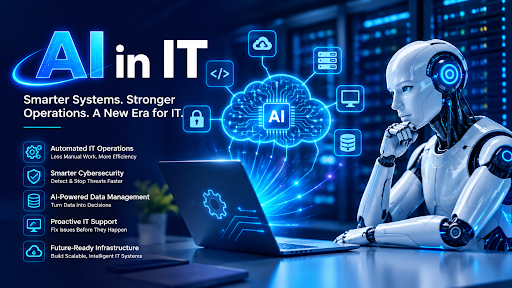

Technology organizations are investing in artificial intelligence to improve productivity, accelerate software development and modernize IT operations. AI in IT can automate repetitive work, improve service management, strengthen knowledge access and support faster technology decisions. However, expanding AI capabilities does not automatically translate into stronger business performance.
AI ROI provides a framework for evaluating whether AI investments generate sufficient financial and operational value relative to their total costs. For technology leaders, this means moving beyond measures such as tool usage or number of AI deployments and connecting investments with productivity, service quality, operating costs and enterprise performance.
This article explores how AI in IT creates value, how organizations can evaluate AI ROI, the most important use cases and the practices required to build a value-focused AI strategy.
What is AI in IT?
AI in IT refers to the application of artificial intelligence across technology processes, services and operations. It includes machine learning, predictive analytics, generative AI, intelligent automation and AI agents.
Organizations can apply these capabilities across IT service management, software development, infrastructure operations, cybersecurity and enterprise knowledge management.
Unlike traditional automation, which generally follows predefined rules, AI can interpret information, identify patterns and generate recommendations. This expands the range of technology work that can be automated or augmented.
What is AI ROI?
AI ROI measures the business value generated by an artificial intelligence investment relative to the costs required to implement, operate and maintain it.
For AI in IT, costs can include software licenses, infrastructure, cloud consumption, integration, data preparation, implementation, cybersecurity, governance, training and ongoing model management.
Benefits may include higher developer productivity, lower service delivery costs, reduced incident resolution time, improved infrastructure utilization and avoided operational losses.
A comprehensive AI ROI assessment helps technology leaders determine whether these benefits justify the total investment.
Why AI ROI matters for technology leaders
IT organizations face a growing list of potential AI opportunities but limited budgets and implementation capacity. Without clear value criteria, investment can become distributed across experiments that demonstrate technical capabilities without materially improving business performance.
AI ROI creates discipline around investment prioritization.
Technology leaders can compare potential use cases according to expected value, implementation cost, feasibility, risk and time to value. This makes it easier to determine which AI initiatives should receive funding and which should remain lower priorities.
As AI in IT moves from experimentation toward enterprise-scale deployment, this value discipline becomes increasingly important.
Core technologies driving AI in IT
Several technologies are creating new opportunities across technology operations.
Generative AI
Generative AI can create code, summarize incidents, prepare technical documentation and improve access to enterprise knowledge.
Machine learning
Machine learning analyzes historical and real-time technology data to identify patterns, detect anomalies and anticipate potential issues.
Predictive analytics
Predictive analytics can help IT teams forecast infrastructure requirements, service demand and operational risks.
Intelligent automation
Automation executes repetitive workflows, while AI can extend automation into activities requiring interpretation and decision support.
AI agents
AI agents can potentially coordinate multistep technology workflows, interact with enterprise systems and execute approved actions while escalating exceptions requiring specialist intervention.
The AI ROI of each technology depends on the specific business problem it addresses and the performance improvement it delivers.
Key use cases of AI in IT
Organizations can apply AI across multiple areas of the technology function.
IT service management
AI can categorize incidents, summarize tickets, retrieve relevant knowledge and recommend potential resolutions. Value can come from faster resolution, higher employee productivity and lower support costs.
Software development
Generative AI can assist developers with coding, testing, debugging and documentation. The potential return comes from shorter development cycles and increased engineering capacity.
Infrastructure operations
AI can analyze infrastructure data, detect unusual conditions and support proactive issue management. Benefits may include higher availability and reduced operational effort.
Cybersecurity
AI can summarize security alerts, prioritize potential threats and assist investigations. AI ROI may include analyst productivity and avoided costs associated with security incidents.
Knowledge management
Generative AI can improve access to technical documentation and enterprise knowledge, reducing the time employees spend searching for information.
These applications demonstrate why AI in IT should be evaluated through use-case-specific business outcomes.
Where AI ROI comes from in IT
The value generated by AI can emerge through several performance levers.
Greater IT productivity
AI can reduce time spent on repetitive support, development, documentation and administrative activities.
Lower operating costs
Automation and better resource utilization can reduce the cost of delivering technology services.
Faster service resolution
AI-supported diagnosis and knowledge retrieval can reduce incident resolution times and improve employee experience.
Accelerated software delivery
AI can reduce time spent on routine development work, enabling teams to deliver applications and enhancements faster.
Risk avoidance
Predictive monitoring and intelligent security analysis can help organizations identify issues before they result in larger operational or financial impacts.
Each benefit should be translated into measurable outcomes when evaluating AI ROI.
How to measure AI ROI in IT
Organizations should establish baseline performance before introducing AI. Without understanding current costs and service levels, it becomes difficult to determine whether AI has created meaningful improvement.
Relevant measures can include:
- Developer productivity.
- Software development cycle time.
- Incident resolution time.
- Cost per IT service request.
- Automation rates.
- Service availability.
- Infrastructure utilization.
- Employee time saved.
- Cybersecurity analyst productivity.
- Cost or loss avoidance.
The appropriate measures depend on the use case. An AI coding assistant should not be evaluated using the same KPIs as an incident-management solution.
Turning productivity gains into financial value
One of the most important challenges in measuring AI ROI is translating employee time savings into realized financial value.
If AI allows developers to complete a task faster, the saved time does not automatically reduce IT costs. Leaders need to determine how that additional capacity is used.
Development teams may deliver more projects without increasing staffing, accelerate strategic initiatives or reduce reliance on external resources. Service teams may manage higher ticket volumes with existing capacity.
AI ROI should therefore distinguish between theoretical time savings and improvements that translate into actual technology or business outcomes.
Best practices for improving AI ROI
Organizations can improve the returns from AI in IT by applying a disciplined investment approach:
- Start with specific technology and business problems rather than AI tools.
- Establish baseline performance before implementation.
- Prioritize use cases based on value, feasibility and time to value.
- Include infrastructure, integration, security, governance and ongoing operating costs in the business case.
- Integrate AI into existing IT workflows and platforms.
- Define ownership for realizing expected benefits.
- Maintain human oversight for cybersecurity and high-risk technology decisions.
- Continuously compare actual outcomes with the original investment case.
- Scale successful applications and reconsider initiatives that consistently underperform.
This creates a portfolio approach to AI investment rather than a collection of disconnected pilots.
Common challenges in realizing AI ROI
Technology organizations may underestimate the full cost of implementing AI. Cloud consumption, data preparation, integration, security and ongoing model management can materially affect returns.
Another challenge is measuring productivity improvements accurately. Employee surveys or estimated time savings may not reflect actual improvements in business output.
Legacy technology can also increase implementation costs and limit the scalability of AI capabilities.
Organizations must consider risk as well. An AI application that improves productivity but introduces significant cybersecurity or operational exposure may not deliver an acceptable risk-adjusted return.
The future of AI in IT
The next phase of AI in IT will increasingly involve AI agents capable of coordinating activities across technology environments.
An agent could identify an incident, retrieve relevant information, recommend a resolution, initiate an authorized workflow and verify whether the issue has been resolved. Multiple agents may eventually collaborate across software development, service management, infrastructure and cybersecurity.
These capabilities could increase AI ROI by extending automation from individual tasks to broader end-to-end processes. However, they will also introduce additional integration, governance and security requirements.
Technology leaders will therefore need to continuously evaluate whether increased AI autonomy generates sufficient incremental value relative to its cost and risk.
Conclusion
AI in IT can create significant opportunities to improve technology productivity, service delivery, software development and operational resilience. But the number of AI applications deployed is not a meaningful measure of success.
AI ROI provides the financial and operational discipline needed to determine which investments are creating genuine value. By establishing clear baselines, accounting for total costs and measuring realized outcomes, technology leaders can make more informed AI investment decisions.
Organizations that consistently identify and scale high-value AI in IT use cases will be better positioned to build efficient, intelligent and future-ready technology organizations while ensuring AI investments contribute directly to enterprise performance.