
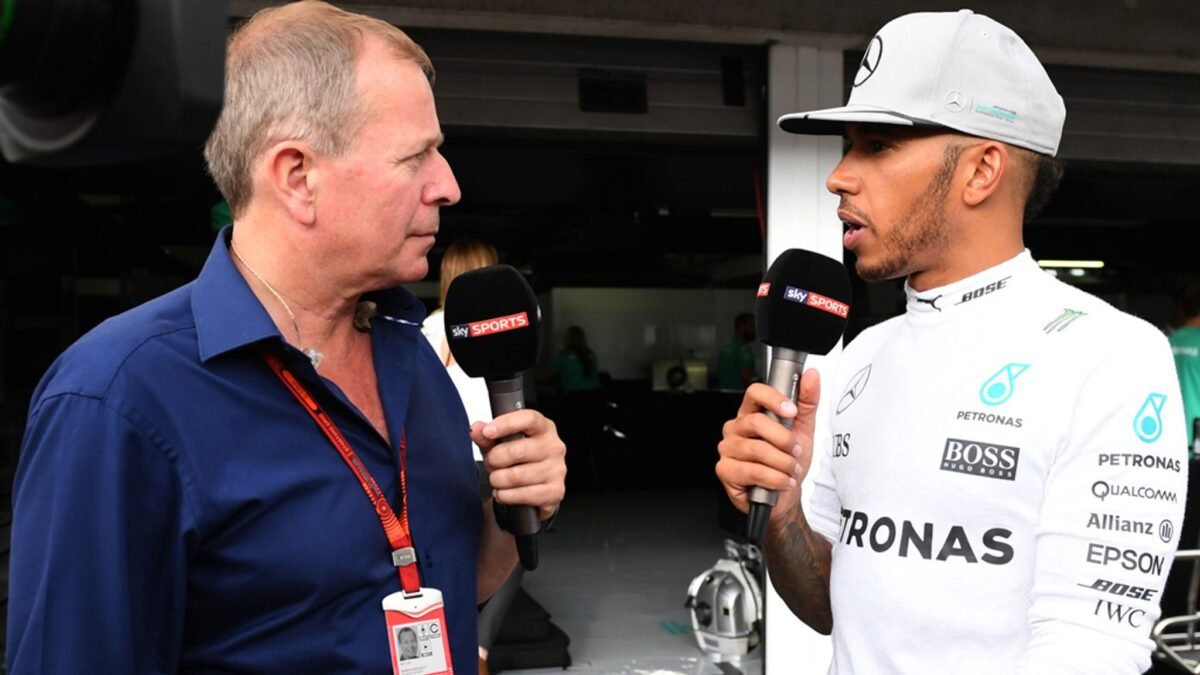

Martin Brundle: The Voice, The Driver, The Unrivalled Insider of Formula 1
Executive Summary: This article provides the ultimate exploration of Martin Brundle, a figure who embodies modern Formula 1. It moves beyond a simple biography to dissect how his unique dual perspective—as a former Grand Prix driver and the sport’s most authoritative broadcaster—has shaped the understanding of motorsport for a global audience. We will navigate his racing career, analyse his transformative approach to commentary, and understand why his voice has become synonymous with the authentic, technical, and human narrative of F1. This resource helps readers comprehend the profound impact one individual can have on the perception and storytelling of a global sport.
Introduction: To understand the complex, high-stakes theatre of Formula 1 is to understand the insights of Martin Brundle. For millions, the roar of engines on a Sunday is intrinsically paired with his lucid, authoritative, and often wry commentary. But this voice carries a weight few others can claim: the firsthand experience of having battled wheel-to-wheel on the same circuits, under the same immense physical and mental pressures. This guide explains how Brundle evolved from a talented driver navigating the perilous era of the 1980s and 90s into the indispensable narrator of the sport’s modern epoch. We will dissect his journey, his philosophy, and the unique expertise that makes his analysis not just informative, but foundational to the viewing experience. His career arc addresses a core user problem: the gap between the spectacle seen on screen and the intricate technical and strategic reality of Grand Prix racing. Brundle bridges that gap seamlessly.
The Driver: A Career Forged in a Brutal Era
Before the microphone, there was the helmet. Martin Brundle’s racing career is often summarised by a single, haunting fact: he was a contemporary of Ayrton Senna, both in Formula 3 and later in F1. While that benchmark is telling, it also oversimplifies a resilient and highly respectable Grand Prix tenure. Brundle entered Formula 1 with Tyrrell in 1984, a period defined by raw danger, ground-effect aerodynamics, and cars that were physical beasts to wrestle. His debut season was strong, but it was punctuated by the era’s ever-present risk—a severe accident at Dallas left him with broken ankles, a setback that required immense determination to overcome.
His path through the pinnacle of motorsport was not one of fairy-tale championships, but of consistent professionalism and flashes of brilliance. The 1992 season, driving for Benetton alongside Michael Schumacher, stands as a high point. He secured multiple podiums and finished a career-best sixth in the Drivers’ Championship, often extracting the maximum from the package beneath him. Later, drives for McLaren, Ligier, and Jordan showcased his adaptability and racecraft. His crowning achievement as a driver came not in F1, but at the 24 Hours of Le Mans, where he secured a famous victory in 1990, proving his elite endurance and skill across disciplines.
This period of his life is crucial context. It provides the bedrock of his credibility. When Brundle discusses tyre management, he speaks from the muscle memory of feeling a set of slicks go off. His analysis of overtaking moves is informed by thousands of real attempts, successes, and failures. He understands the trepidation of a rain-soaked grid and the split-second decisions of a race start because he has lived them. This direct, visceral experience is the differentiator between a commentator and an expert commentator. It addresses a fundamental user need: trust. Viewers seek an authentic guide, and there is no substitute for the authority earned on the track.
Key Takeaway: Martin Brundle’s nine-season F1 career, forged in a dangerous period, provides the unshakeable technical and experiential foundation that makes his broadcasting analysis uniquely authoritative and trusted.
The Evolution of a Broadcast Voice: From Grid to Commentary Box
The transition from athlete to analyst is fraught with difficulty, but Martin Brundle managed it with a clarity of purpose that redefined the role. His initial forays into television in the late 1990s coincided with a pivotal moment for F1’s global broadcast reach. He didn’t just bring a driver’s insight; he brought a new language and a new focus. Brundle pioneered the now-essential practice of the pre-race grid walk, transforming a chaotic parade of celebrities and engineers into a masterclass in live, unscripted broadcasting.
The grid walk is a microcosm of his approach. It is high-pressure, unpredictable, and requires an encyclopaedic knowledge not just of the sport’s technical figures, but of its politics, personalities, and history. Viewers watch not only for the celebrity interviews but for the moments of pure, unvarnished insight—a quick word with a team principal about a suspension setting, a pointed question to a driver about brake balance. Brundle operates in this space with a journalist’s instinct and a driver’s understanding, cutting through PR speak to seek genuine nuggets of information. This directly solves a user problem: the feeling of being kept at arm’s length by the polished façade of the sport. Brundle walks into the heart of the paddock and takes the audience with him.
In the commentary box, his partnership with Murray Walker and later with David Croft became the soundtrack of F1 for generations. His style is defined by concise, predictive commentary. He often explains what a driver will do or is likely to experience several corners before it happens, based on car behaviour, tyre wear, or fuel load. This proactive analysis, rather than reactive description, elevates the viewer’s understanding. He decodes the sport’s complexity, whether it’s the strategic implications of a virtual safety car or the aerodynamic reason a car cannot follow closely through a high-speed sequence. Furthermore, he isn’t afraid of silence, allowing the pictures and the sound of the cars to tell their own story when necessary—a mark of a broadcaster confident in the power of the sport itself.
Key Takeaway: Brundle revolutionized F1 broadcasting by introducing the high-stakes grid walk and a predictive, technical commentary style that actively deciphers the sport’s complexity for the viewer, bridging the gap between the spectacle and its underlying realities.
Brundle-isms: The Language and Lasting Legacy of an F1 Icon
The cultural impact of Martin Brundle extends into the very lexicon of Formula 1 fandom. His unique turns of phrase—often dry, always perceptive—have become known as “Brundle-isms.” These are not mere soundbites; they are crystallised pieces of expert analysis, delivered with a wit that makes them memorable and shareable. Phrases like “he’s in the marbles,” describing a car sliding off-line onto the rubber debris, or his classic description of a chaotic start as “a concertina effect” have entered common parlance among fans.
His legacy is multifaceted. Strategically, he has set the gold standard for what expert analysis in motorsport should be—a blend of deep technical knowledge, tactical foresight, and an unwavering focus on the sporting contest. He treats the audience as intelligent but not necessarily expert, explaining complex concepts like energy recovery systems or tyre thermal operating windows without patronising. From a historical perspective, he is a living link between F1’s past and present. He can contextualise Lewis Hamilton’ achievements by comparing his driving style or career trajectory to those of Alain Prost or Nigel Mansell, offering a continuity of narrative few others can provide.
A prime example of his hands-on understanding shaping broadcast innovation is his advocacy for and explanation of driver telemetry graphics. He was instrumental in persuading producers to show throttle, brake, and steering traces, then interpreting them in real-time for viewers. “Look at that,” he might say, pointing to a telemetry trace, “see how he’s short-shifting here to manage a rear stability issue, you can tell the car is nervous on the exit.” This transforms an abstract squiggle on a screen into a vivid story of a driver wrestling with his machine. It solves a practical user problem: the desire to see what the driver is doing inside the cockpit, to understand the inputs that create the spectacle.
Key Takeaway: Martin Brundle’s enduring legacy is cemented both in the shared language of F1 fans and his role as a crucial educational bridge, using tools like telemetry to translate a driver’s real-time challenges into accessible, compelling narrative.
The Art of the Grid Walk: A Masterclass in Unscripted Broadcasting
No analysis of Martin Brundle is complete without a deep dive into his signature segment: the pre-race grid walk. This several-minute window has become must-see television, a stunning feat of live broadcasting that combines journalism, diplomacy, and sheer nerve. The environment is inherently hostile to a coherent broadcast: it is deafeningly loud, densely packed with moving people and machinery, and fraught with the intense pre-race focus of every individual involved.
Brundle’s skill here is multilayered. First, his reconnaissance is meticulous. He identifies key figures—not just drivers, but technical directors, team owners, and sporting delegates—whose comments might shed light on the upcoming race. Second, his approach is respectful but persistent. He understands the pressure everyone is under, but his credibility often grants him a few seconds where others would be brushed aside. Third, and most importantly, he listens and reacts instantly. He isn’t just reading questions from a card; he engages in genuine, albeit brief, conversations, following up on answers and seizing on unexpected moments.
The segment’s value is immense. For the viewer, it provides last-minute tactical intelligence: a confirmed engine penalty, a worry about brake wear, a strategic gamble on fuel load. It also humanises the sport, capturing the nervous energy of a debutant or the focused calm of a veteran. However, it also has its inherent limitations and trade-offs. Not every interaction is gold; some celebrities have little to offer, and some team personnel are tight-lipped. Yet, even a failed attempt or a brusque dismissal can be revealing of the paddock’s mood or a team’s state of mind. Brundle navigates these successes and failures with equal grace, often turning an awkward moment into a wry aside that includes the audience in the joke.
Key Takeaway: The grid walk is a high-wire act of live broadcasting that, under Brundle’s stewardship, delivers unique tactical insights and human drama, demystifying the pressurized pre-race atmosphere for the global audience.
Decoding the Commentary: A Framework for Understanding Grand Prix Racing
To appreciate Martin Brundle’s contribution is to understand the framework he applies during a race broadcast. His commentary is structured around several core, evergreen principles that guide viewers through the strategic and technical labyrinth of a Grand Prix. Recognising these pillars can transform how any fan watches a race.
The Three-Stage Race Model: Brundle often implicitly frames a race in phases: the initial lap drama and settling of order; the long middle phase defined by tyre management, fuel load, and strategic chess; and the final stint where drivers push to the flag or defend positions. He constantly signposts which phase the race is in and what the key objectives are for each driver within it.
David Ornstein: The Anatomy of a Modern Transfer Reporter and How Football Journalism Really Works
The Overtaking Blueprint: His analysis of passing moves is systematic. He assesses the relative straight-line speed (often informed by knowledge of drag reduction system and engine modes), the corner exit speed of the car ahead, the braking stability under attack, and the driver’s preferred passing spot on any given circuit. He will explain why certain cars are “trains” and why others can pick rivals off with ease.
The Tyre Narrative: More than any other factor, Brundle focuses on tyre life. He interprets team radio messages about “graining” or “deg,” explains how track temperature or fuel load affects wear, and predicts the “cliff” where performance falls away dramatically. This focus solves a common viewer confusion: why a faster car is not overtaking a slower one. The answer often lies in tyre preservation for a later strategic window.
The Psychological Layer: He frequently comments on driver body language, team radio tone, and in-car camera shots. A slumped posture in the garage, a terse radio response, or a series of aggressive steering corrections tells a story of frustration, mechanical worry, or physical struggle. This adds a crucial human dimension to the technical data.
A Definition of Racecraft: In Brundle’s lexicon, racecraft is the practical application of racing intelligence. It encompasses spatial awareness, strategic opportunism, defensive positioning, and the psychological combat between drivers. It’s not purely innate talent but a learned skill he respects immensely, often highlighting drivers who excel in wheel-to-wheel combat versus those who are pure qualifiers.
Key Takeaway: Brundle’s commentary provides a consistent analytical framework—focusing on race phases, overtaking determinants, tyre management, and driver psychology—that educates viewers on how to interpret the unfolding story of a Grand Prix.
The Modern Paddock: Brundle’s Role in a Changing Sport
Formula 1 has undergone a radical transformation in the 21st century, becoming a global entertainment leviathan with a new generation of fans, drivers, and commercial dynamics. Martin Brundle’s role has evolved in parallel, positioning him as both a respected elder statesman and a sharp critic of the sport’s direction when necessary. His perspective is vital in assessing what changes are progressive and what may erode the core sporting challenge.
He has been a vocal advocate for certain modern innovations that enhance the show and fairness, such as the halo safety device, which he supported unequivocally despite its aesthetic impact, understanding its life-saving potential from a driver’s perspective. Similarly, he appreciates the clarity that modern data and graphics bring to broadcasts. However, he maintains a healthy scepticism towards excessive gimmickry that may artificially distort competition, often arguing for a purer sporting contest. His criticism is always measured and constructive, rooted in a desire for the sport to retain its integrity.
His interactions with the new generation of drivers are particularly telling. While he respects their immense talent, he doesn’t shy away from holding them to the standards of professionalism and resilience he knew from his era. A pointed question to a driver about a lacklustre performance or a critical error is delivered not with malice, but with the expectation of accountability. This resonates with a segment of the audience that feels some modern narratives are overly sanitised. Brundle provides a necessary, grounded counterpoint, reminding everyone that F1 is, at its heart, a brutally difficult and demanding profession.
A relevant supporting quote that encapsulates his philosophy comes from his former rival and colleague, the late Murray Walker, who once said of Brundle: “He has the priceless ability to analyse and explain a highly complex situation in a few succinct, understandable and interesting words. He is quite simply the best.” This endorsement underscores the unique skill set that remains as relevant today as ever.
Key Takeaway: In the modern F1 era, Brundle acts as a crucial bridge between the sport’s heritage and its future, advocating for genuine progress while applying timeless standards of driver accountability and sporting purity to his analysis.
Comparative Analysis: The Brundle Benchmark in Motorsport Media
To fully grasp Martin Brundle’s unique position, it is instructive to consider the landscape of motorsport analysis. While many former drivers have moved into broadcasting, the synthesis of skills Brundle possesses is rare. The table below outlines the key dimensions of elite motorsport commentary and how Brundle’s profile defines the benchmark.
| Analytical Dimension | The Brundle Benchmark | Common Alternatives or Gaps |
|---|---|---|
| Source of Credibility | Extensive, top-level driving career (F1, Le Mans winner). | Pundits with junior racing or no racing background; pure journalists. |
| Technical Explanation | Explains why from first principles (e.g., car balance, tyre physics). | Describes what is happening; relies on provided data or speculation. |
| Predictive Analysis | Consistently forecasts strategic moves, pit windows, and driver actions. | Reactive commentary, describing events as they appear on screen. |
| Live Broadcasting Skill | Masters unscripted, high-pressure environments (Grid Walk). | Often reliant on scripts, pre-recorded segments, or studio safety. |
| Tone & Audience Rapport | Authoritative yet conversational; respects viewer’s intelligence. | Can be overly technical/jargony, or conversely, overly simplistic/entertainment-focused. |
| Historical Context | Uses personal experience to link past and present drivers/eras. | Historical references may feel academic or anecdotal, not experiential. |
This comparison highlights why his coverage satisfies such a broad spectrum of fans. The hardcore technical enthusiast gets the deep engineering dive; the casual viewer gets the clear narrative of the race; the long-time fan gets the connective tissue to the sport’s history. He avoids the trap of speaking only to the purist or dumbing down for the newcomer, a balance exceptionally difficult to strike. If you’re deciding between sources for F1 insight, the presence of Brundle’s analysis is often the differentiating factor for depth and reliability.
Key Takeaway: Martin Brundle sets the industry benchmark by uniquely combining elite driving experience, predictive technical insight, peerless live broadcasting skill, and a tone that educates without alienating, a blend rarely matched in global sports media.
Practical Applications: How to Watch an F1 Race Like Martin Brundle
One of the greatest values of studying Martin Brundle’s methodology is that it provides a toolkit for any fan to elevate their own understanding and enjoyment of a Grand Prix weekend. By adopting some of his focal points, you can move from passive viewer to engaged analyst.
Pre-Race Preparation: Don’t just tune in at lights out. Watch the qualifying analysis and note the tyre choices each driver has available for the race (the “tyre bank”). Listen to the driver interviews for hints of concern—over kerbs, braking stability, or race pace. When Brundle is on the grid, pay less attention to the celebrity cameos and more to his quick technical conversations with engineers.
The Lap One Scan: As the cars complete the formation lap, look at tyre temperatures on the graphics. Note which drivers are weaving aggressively to generate heat and which are taking it calm—this can indicate who is struggling with warm-up. After the start, watch the cars in the midfield closely; the first-lap battles often reveal the true racecraft of drivers under maximum pressure.
Following the Strategic Narrative: Instead of just following the leader, pick two drivers in a close battle or from different strategies. Use the timing tower to monitor their sector times and their gap. Ask yourself: Is the chasing car managing its tyres to attack later? Is the leader pushing to build a pit-stop window? Listen for Brundle’s comments on their relative pace; he is often tracing these sub-plots in real-time.
Interpreting Team Radio: When a driver’s radio message is broadcast, Brundle provides immediate context. You can practice this. A message like “tyres are gone” has different meanings on Lap 10 versus Lap 40. Is it a genuine crisis, or a driver lobbying for a different strategy? Cross-reference it with their immediate lap time drop-off.
The Big Picture: In the final laps, consider the championship implications, not just the race result. How do these points affect the standings? Who gained or lost ground psychologically? This is where Brundle often broadens the lens, connecting the race result to the season’s overarching story.
Key Takeaway: By focusing on pre-race tyre choices, strategic battles beyond the lead, and the contextual meaning of team radio, viewers can actively apply Brundle’s analytical framework to dramatically deepen their comprehension and engagement with a Grand Prix.
Frequently Asked Questions About Martin Brundle
What were Martin Brundle’s biggest achievements as a racing driver?
While his F1 career yielded nine podiums and a best championship finish of sixth, Martin Brundle’s crowning achievement was winning the 24 Hours of Le Mans in 1990 driving a Jaguar XJR-12. This victory, in one of the world’s most prestigious endurance races, showcased his exceptional skill, consistency, and mechanical sympathy over a grueling 24-hour period, cementing his reputation as a world-class driver beyond Formula 1.
Why is Martin Brundle’s grid walk so famous?
The grid walk is famous because it is a unique, high-risk segment of unscripted live television. Martin Brundle navigates the chaotic, noisy pre-race grid to secure instant, insightful comments from drivers, team principals, and technical figures, often uncovering last-minute strategic news. Its fame also stems from occasional awkward encounters with celebrities unfamiliar with F1, which Brundle handles with a blend of wit and impatience that viewers relish.
How did Martin Brundle become an F1 commentator?
His transition followed his driving career. After retiring from F1, his articulate, insightful persona was quickly recognised by broadcasters. He began as an analyst for British television, with his deep knowledge and clear communication making him a natural fit. His breakthrough innovation was the grid walk, and his expert chemistry with lead commentators solidified his position as the voice of expert analysis for a generation of fans.
What makes his commentary style different from others?
Martin Brundle’s style is defined by predictive, technical analysis delivered with concise authority. He doesn’t just describe events; he explains their cause and likely consequence based on firsthand experience. He focuses on tyre management, race strategy, and car behaviour, translating engineering data into the narrative of the race. His tone is trusted because it’s informed by the physical reality of driving these cars at the limit.
Has Martin Brundle ever been critical of modern F1?
Yes, he offers balanced but firm criticism when he feels it’s warranted. He has been critical of certain racing regulations he views as gimmicky, of circuits he considers lacking in challenge or overtaking opportunity, and of driver behaviour he deems unprofessional. His criticism is valued because it comes from a place of deep care for the sport’s integrity and is always coupled with constructive insight.
Actionable Insights Checklist: The Brundle Perspective on F1
Before the next Grand Prix, consider this checklist of insights inspired by Martin Brundle’s analytical approach:
- [ ] Identify the tyre strategy: Check each driver’s available compound sets after qualifying; the starting tyre is only one piece of the puzzle.
- [ ] Listen for the subtext: During driver interviews and team radio, listen beyond the words for hints of concern, confidence, or strategic intent.
- [ ] Track a midfield battle: Choose a duel outside the top three and follow its strategic progression, noting pit stops and tyre offsets.
- [ ] Analyse an overtake: When a pass happens, rewind and note the corner exit speed, DRS usage, and braking point that made it possible.
- [ ] Assess driver management: Note when a driver’s lap times stabilise or drop—this is often deliberate tyre or fuel management, not a lack of pace.
- [ ] Contextualise the result: Post-race, consider how the points affect the championship narrative and team dynamics for the coming weeks.
Conclusion: The Unchallenged Voice of Authority
The story of Martin Brundle is the story of modern Formula 1 finding its most authentic and authoritative voice. From the cockpit of a roaring Tyrrell to the global broadcast booth, his journey has been one of continuous, intelligent adaptation. He has taken the visceral, often ineffable experience of driving a Grand Prix car and transformed it into a language millions can understand and appreciate. He is not merely a commentator but an interpreter, a historian, a critic, and, above all, an educator.
His value lies in that rare duality: the unassailable credibility of the former combatant paired with the eloquent clarity of the master communicator. In a sport increasingly framed by data, marketing, and global spectacle, Brundle remains the human anchor, reminding us of the fundamental sporting contest—the skill, the courage, the strategy, and the human endeavour at its core. For the veteran fan, he is a trusted companion. For the newcomer, he is the essential guide. To understand his role is to understand a vital component of why Formula 1 captivates so profoundly. His legacy is that he has made a deeply complex sport comprehensible, without ever making it seem simple.