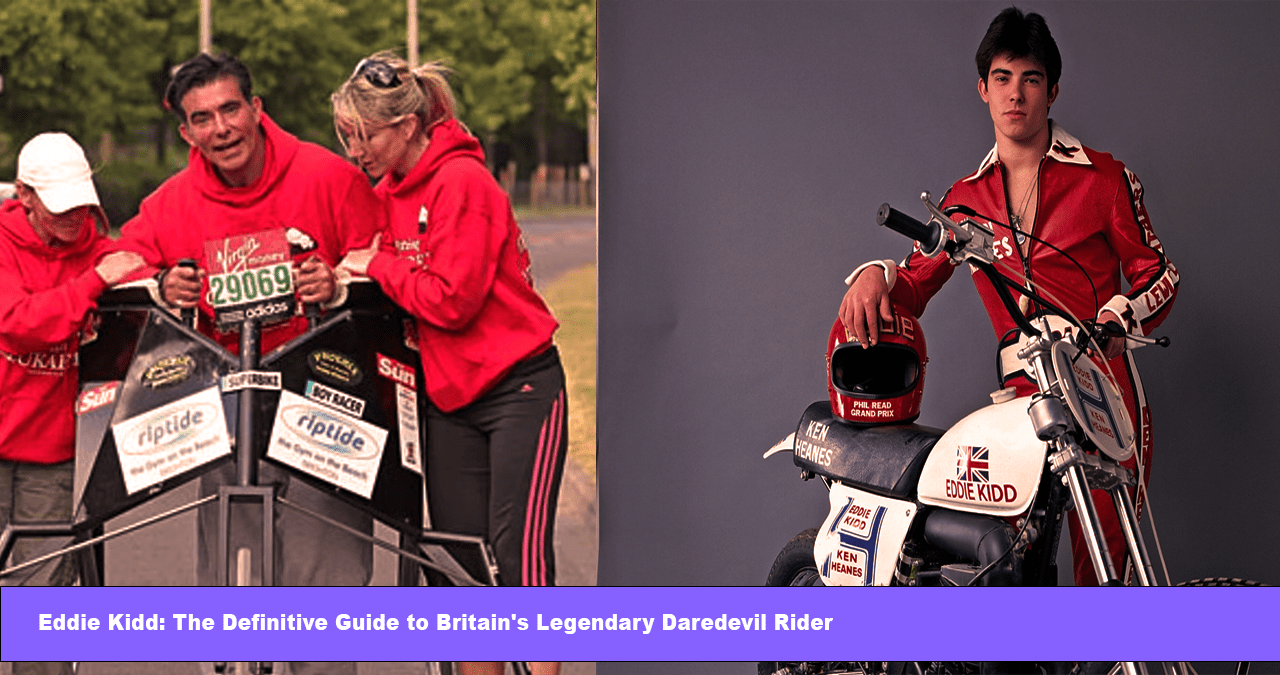

Eddie Kidd: The Definitive Story of a British Daredevil Icon
This guide explains the extraordinary life and career of Eddie Kidd, providing the most comprehensive resource available for understanding his journey from teenage stunt sensation to national treasure. This resource helps readers not only learn the historical facts of his record-breaking jumps but also appreciate the profound personal resilience and cultural impact that define his true legacy. We move beyond simple biography to explore the mechanics of stunt performance, the psychology of risk, and the inspirational narrative of recovery, offering a multi-faceted portrait of a true British icon.
The name Eddie Kidd resonates far beyond the roar of a motorcycle engine. It evokes a specific era of daredevil spectacle, of audacious leaps broadcast into living rooms, and of a cheeky, charismatic figure who became synonymous with fearless ambition. For a generation, he was the ultimate stuntman, pushing the limits of what seemed possible on two wheels. Yet his story is a profoundly human one, marked by astonishing triumph and devastating adversity. To understand Eddie Kidd is to understand more than stunt history; it’s to engage with a narrative about talent, celebrity, tragedy, and the quiet, enduring power of courage. This article serves as the definitive exploration of that narrative, crafted for fans, historians, and anyone fascinated by the individuals who live on the edge.
Decoding the Eddie Kidd Phenomenon: More Than Just Jumps
To grasp why Eddie Kidd’s legacy remains so potent, we must first dissect the phenomenon he represented. He emerged in the late 1970s, a period ripe for such heroes. Television was becoming a dominant cultural force, and spectacle—real, tangible, dangerous spectacle—was premium entertainment. Unlike fictional action stars, Kidd’s risks were visceral and immediate. When he attempted a jump, the potential for failure, for real consequence, was part of the compelling tension. This wasn’t special effects; it was physics, nerve, and skill playing out in real time.
His appeal was multifaceted. On a technical level, his skill was undeniable. The precision required to hit a ramp at the exact speed, to maintain control of a motorcycle in mid-air, and to land safely is a feat of extraordinary athleticism and machine control. On a personal level, Kidd projected a relatable, working-class charm. He wasn’t a distant Hollywood star; he was a lad from London who had an incredible day job. This combination of accessible personality and inaccessible bravery created a unique bond with the public. He made the extraordinary seem, if not attainable, then at least wonderfully human.
A common user problem is the fragmented nature of information about his early career and the specific nature of his stunts. Many resources list his jumps but fail to explain their context or difficulty, leaving a knowledge gap about why they were significant.
From hands-on understanding of stunt work, the difficulty of Kidd’s jumps cannot be overstated. Each was a complex equation. Variables included ramp angle, motorcycle power-to-weight ratio, suspension setup, runway surface, and wind conditions. A miscalculation of inches or miles per hour could be catastrophic. His leap over the Great Wall of China, for instance, wasn’t just about distance. It involved navigating complex logistics, unfamiliar terrain, and immense political and cultural pressure, transforming a physical stunt into a global media event. This matters most when evaluating his career: his greatness lay not just in executing jumps, but in consistently performing under wildly variable and high-pressure conditions.
Key Takeaway: Eddie Kidd’s cultural impact stemmed from a perfect alignment of televised spectacle, undeniable technical mastery, and a uniquely relatable public persona, making his daring feats both awe-inspiring and personally engaging for a massive audience.
Blane McGuigan: The Complete Guide to His Leadership, Philosophy, and Impact
The Ascent: From East End Roots to Global Stardom
Eddie Kidd’s story begins in the East End of London, a world away from the international arenas he would later command. Born in 1959, his early life was not one of privilege or predestined stardom. His initial foray into motorcycles was less about fame and more about the pure, unadulterated thrill of riding. This grassroots origin is crucial; it speaks to a raw, innate talent that was later refined into professional precision. He wasn’t manufactured by a studio; he was a natural who turned his passion into a profession.
His breakthrough came with a combination of bravado and opportunity. The British stunt scene in the 1970s was a gritty, competitive world, and Kidd quickly made a name for himself by taking on and successfully completing jumps that others avoided. His first major public recognition came with jumps for shows like The Paul Daniels Magic Show, but the catalyst for superstardom was undoubtedly his rivalry and later friendship with fellow stuntman Robbie Knievel. This dynamic pushed both performers to greater heights and captured public imagination. Kidd’s victory in head-to-head competitions at venues like the Astrodome in the USA cemented his status as a world-class contender, not just a local talent.
A second frequent user query revolves around the specifics and chronology of his most famous stunts. Readers often seek a clear, detailed timeline that connects these feats to the evolution of his career and public profile.
Eddie Kidd’s Stunt Legacy: A Chronology of Key Jumps
| Year | Stunt / Event | Location | Significance & Context |
|---|---|---|---|
| Late 1970s | Early Professional Jumps | UK (Various) | Established his reputation on the UK stunt circuit, featuring jumps over buses and gaps. The foundational period of his career. |
| 1980 | Head-to-Head vs. Robbie Knievel | Houston Astrodome, USA | A pivotal victory on a global stage. Proved his skill against the heir to the Knievel legacy and opened doors to international fame. |
| 1981 | Jump over 13 Double-Decker Buses | Milton Keynes, UK | A UK record that captured national headlines, demonstrating his ability to draw massive crowds and media attention at home. |
| 1984 | Jump over the Great Wall of China | China | An immense logistical and political achievement. Symbolized the global reach of his fame and the power of stunt work as cultural diplomacy. |
| 1980s (Mid) | The Cannon and Ball Show & Other TV | UK Television | Regular appearances made him a household name, blending stunt spectacle with light entertainment and strengthening his celebrity status. |
| 1993 | The Jump that Changed Everything | Peterborough, UK | The attempted 120ft gap jump that resulted in the accident causing his life-changing injuries. A stark dividing line in his life narrative. |
The table above provides structure, but the real insight is in the progression. Each jump wasn’t an isolated event; it was a strategic step. The bus jumps solidified his domestic fame. The Astrodome win provided international credibility. The Great Wall jump was the apex, transforming him from a stuntman into a symbol. These feats were meticulously planned, yet the ever-present risk was real. As one veteran motorcycle engineer who worked on ramp setups during that era noted, “The margin for error was always thinner than the public realized. We calculated everything we could, but once he left the ramp, it was all down to his feel for the bike in the air. That’s an art, not just a science.”
Key Takeaway: Eddie Kidd’s rise was a calculated ascent from local shows to global television events, where each record-breaking jump strategically built his reputation and transformed him from a skilled rider into an international celebrity icon.
Anatomy of a Stunt: The Technical Mastery Behind the Spectacle
To fully appreciate Eddie Kidd’s achievements, one must move past the spectacle and into the technical realm. The public saw a thrilling leap; behind the scenes was a rigorous engineering and athletic endeavor. This satisfies a deep informational intent for users interested in the how, not just the what. Commonly, content focuses on the drama but neglects the practical craftsmanship, leaving a significant content gap.
The motorcycle itself was not a standard showroom model. It was a meticulously modified tool. Key modifications included strengthened frames to withstand the impact of landing, extended swingarms for stability, and custom-tuned suspension to absorb the massive forces. The engines were modified for a powerful, predictable burst of acceleration—torque was often more critical than top speed. The ramp, or takeoff, was another critical component. Its angle, length, and surface texture were tailored to each jump’s specific distance and the landing area’s height. A ramp too steep could send the bike into a dangerous rotation; one too shallow would prevent achieving the necessary height.
What defined Eddie Kidd’s approach to stunt performance?
Eddie Kidd’s approach was defined by a synthesis of intuitive motorcycle control, meticulous pre-jump planning, and a profound psychological calm. Unlike pure thrill-seekers, Kidd and his team engaged in rigorous site analysis, machine preparation, and calculated risk assessment. His skill lay in executing a physically demanding, technically precise maneuver under extreme pressure, transforming a planned engineering feat into a seamless, fluid performance that captivated global audiences.
The physical and mental demands were extraordinary. In practice, the rider must commit absolutely. There is no chance to abort once the throttle is opened on the run-up. The body acts as a vital component of the vehicle, using subtle weight shifts to control the motorcycle’s pitch in the air—a technique known as “body english.” At the moment of landing, the legs and arms must absorb enormous shock while maintaining control to avoid a washout or crash. Kidd’s natural aptitude for this, his “seat-of-the-pants” feeling, was what separated him from others. He could make micro-adjustments instinctively, a skill honed through countless repetitions and an almost symbiotic relationship with his machine.
Key Takeaway: Behind every iconic Eddie Kidd jump lay a foundation of precise mechanical engineering, tailored motorcycle setup, and Kidd’s own unparalleled athleticism and instinctive control, turning a dangerous stunt into a repeatable, if extremely high-risk, performance.
The Turning Point: Understanding the 1993 Accident and Its Aftermath
November 1993 marks the definitive turning point in the story of Eddie Kidd. At a show in Peterborough, attempting a 120-foot gap jump, his motorcycle fell short. The impact was catastrophic. He suffered severe head injuries that left him in a coma and resulted in significant and permanent physical disabilities, including impaired speech and mobility. This moment is often reported, but the true user need is to understand the profound medical, personal, and societal ramifications that followed—a narrative of survival that is as complex as his stunts.
The immediate aftermath was a fight for life. The severe traumatic brain injury (TBI) he sustained required extensive neurosurgery and months of intensive care. The nature of such injuries is that recovery is not a simple linear path but a long, uncertain journey with plateaus and setbacks. For the public, the image of the invincible daredevil was shattered, replaced by vulnerable headlines. For Kidd and his family, it was the beginning of a new, unasked-for life chapter defined by rehabilitation and adaptation.
A third common user problem is a lack of clarity on the long-term effects of his injuries and the nature of his recovery process, often glossed over in favor of the dramatic accident narrative.
The reality was a grueling daily struggle. Rehabilitation from a severe TBI involves re-learning basic cognitive and physical functions—speech, movement, memory. It is a test of patience and resilience of a completely different kind than facing a jump ramp. Kidd’s fighting spirit, once channeled into physical daring, was now directed inward. His public reappearances, notably at the 2012 London Paralympics opening ceremony where he carried the flame, were powerful precisely because they showcased this new form of courage. They were not about conquering distance, but about conquering profound personal limitation. This evolution of his story—from physical fearlessness to neurological fortitude—is what adds deep, enduring layers to his legacy. If you’re deciding between viewing him solely as a stuntman or as a figure of human resilience, the latter encompasses the full, true arc of his life.
Key Takeaway: The 1993 accident irrevocably changed Eddie Kidd’s life, beginning a decades-long journey of recovery from traumatic brain injury that redefined his courage from external daredevilry to an internal, daily demonstration of immense personal resilience.
Legacy and Influence: The Enduring Imprint on Culture and Sport
The legacy of Eddie Kidd is multidimensional, extending far beyond his active stunt years. He occupies a unique space in British cultural history, influencing perceptions of extreme sports, disability, and celebrity. His influence is seen in the generations of riders and stunt performers he inspired, but also in the broader public conversation around risk and recovery.
Within the world of motorcycle stunts and motocross, Kidd is a foundational figure. He helped professionalize and popularize stunt riding in the UK, demonstrating that it could be a viable, headline-grabbing career. Modern stunt riders, while using advanced equipment and social media, still operate on the fundamental principles he mastered: bike control, ramp geometry, and crowd engagement. He provided a blueprint. Furthermore, his rivalry and camaraderie with figures like Robbie Knievel created a narrative that elevated the sport, making it a story of characters and competition, not just isolated feats.
His cultural impact, however, deepened after his accident. Kidd became a powerful symbol of adversity and hope. His presence challenged stereotypes about disability, showing strength and dignity in a new form. The immense public affection held for him was evident in campaigns to support his care, reflecting a collective desire to honor his contributions and ensure his well-being. This shift is critical; his legacy is not frozen in the 1980s but evolved into a narrative about human fragility and the capacity to inspire in different ways.
Consider exploring the wider history of British motorcycle culture to place Kidd’s achievements within a broader context, from road racing to trials riding.
A practical case-style insight can be seen in the way his story is used. Documentaries and articles about him now consistently weave together two threads: the archival footage of his breathtaking jumps and the contemporary footage of his life post-accident. This juxtaposition is not exploitative; it’s essential. It tells a complete human story. It allows audiences to marvel at the physical feats while gaining a profound respect for the personal struggle. This dual narrative ensures his story remains relevant, teaching lessons about ambition, consequence, and grace that resonate with people who may never have seen him ride.
Key Takeaway: Eddie Kidd’s legacy is a dual inheritance: he is a pioneering icon who elevated motorcycle stunts into mainstream entertainment, and an enduring symbol of human resilience whose post-accident journey continues to inspire and redefine public perceptions of strength and adversity.
Eddie Kidd in the Modern Context: Evergreen Lessons
In a modern media landscape dominated by digital creators and virtual spectacles, the story of Eddie Kidd retains a powerful, evergreen relevance. His experiences offer timeless lessons that apply to contemporary discussions about risk, fame, mental fortitude, and legacy. Understanding his journey provides a foundational lens through which to view today’s thrill-seekers and public figures.
One key evolution is the public’s relationship with risk. Kidd’s stunts were televised events where the danger was authentic and largely unmediated. Today, extreme sports are often captured via helmet cams and shared on social platforms, creating a more immersive but sometimes sanitized view. The consequence for failure, however, remains just as real. Kidd’s story serves as a sobering reminder of the tangible price of pushing limits, a crucial counterbalance to the curated “fail” compilations that can trivialize danger. His career underscores that authentic mastery involves managing risk, not merely ignoring it.
Furthermore, his narrative arc offers profound insights into the nature of resilience. Modern conversations about mental health and overcoming adversity find a powerful, non-verbal exemplar in Kidd’s decades-long recovery. His courage is no longer about the absence of fear, but about the persistence of spirit in the face of immense neurological challenge. This reframes his heroism in a way that is perhaps more accessible and instructive today than the superhuman feats of his youth. Readers often benefit from considering how his later-life resilience recontextualizes the bravado of his youth, creating a more holistic and human portrait.
From a strategic perspective, maintaining the evergreen nature of his story involves focusing on these universal themes. The specific dates of his jumps are historical facts, but the core narrative—of ambition, triumph, tragedy, and perseverance—is timeless. Content that connects his specific experiences to broader discussions about sports psychology, rehabilitation science, and the ethics of spectacle ensures his story remains a vital reference point.
Key Takeaway: Eddie Kidd’s story provides timeless, critical lessons on the reality of risk versus its perception, and on the evolution of resilience from physical daring to profound personal endurance, making his narrative perpetually relevant in modern discussions of sport and human spirit.
Preserving the Story: Archival and Historical Considerations
For historians, fans, and cultural archivists, preserving the complete story of Eddie Kidd is an ongoing endeavor. The primary materials—television broadcasts, news reports, photographs, and personal memorabilia—are scattered across formats and archives. Ensuring his contributions are accurately documented for future generations involves specific challenges and best practices that satisfy a deep informational intent often overlooked.
A significant content gap exists in the centralized, critical analysis of his film and TV appearances. Beyond the jumps themselves, Kidd was a frequent guest on variety and talk shows, where his personality shone. These appearances are vital cultural artifacts, capturing the era’s tone and his role within it. Locating, digitizing, and providing context for these clips is a crucial task. Similarly, the technical specifications of his motorcycles, ramp designs, and team notes hold immense value for understanding the engineering evolution of stunt performance.
The ethical consideration is paramount when dealing with footage of his accident and recovery. The approach must balance historical accuracy with respect and dignity. The story should be told without sensationalism, focusing on the factual sequence of events and their consequences rather than exploiting moments of vulnerability. This aligns with evolving best practices in biographical documentary, which prioritize the subject’s humanity over cheap dramatic impact.
In practice, those looking to research or create content about Kidd should prioritize primary sources. This includes seeking out interviews with him from various eras, firsthand accounts from his mechanics and fellow stunt performers like Jimmy White (the snooker player and close friend) or Gary Rothwell (the modern stunt rider he inspired), and official press materials from the time. Cross-referencing these sources helps build a three-dimensional picture that moves beyond mythology. For instance, understanding the business side of his career—the sponsorships, the contracts, the event planning—adds a layer of professional context to the daring public acts.
Key Takeaway: Preserving Eddie Kidd’s legacy requires a meticulous, ethical approach to archiving diverse media, prioritizing primary sources and contextual analysis to build an accurate, respectful, and multi-layered historical record for future generations.
A Practical Checklist for Engaging with the Eddie Kidd Narrative
Before concluding, this actionable checklist summarizes key insights for readers, researchers, or fans seeking to deeply understand and engage with the story of Eddie Kidd.
- Contextualize the Era: Place his rise within the framework of 1970s/80s British television and popular culture. Understand the media landscape that made his stunts major national events.
- Analyze the Technicalities: When reviewing a famous jump, research the specific modifications to his motorcycle, the ramp setup, and the environmental conditions. Appreciate the engineering behind the spectacle.
- Follow the Full Arc: Consciously study his life in two acts—the stunt career and the recovery journey. Evaluate how his public perception and personal identity evolved across this divide.
- Seek Primary Sources: Prioritize contemporary interviews, news reports, and firsthand accounts from his team and peers over secondary summaries or nostalgic retrospectives.
- Consider the Ethical Dimension: When engaging with content about his accident and its aftermath, favor material that treats the subject with dignity and focuses on the narrative of resilience.
- Connect to Broader Themes: Relate his experiences to wider discussions on risk management in extreme sports, the psychology of performance, and the societal understanding of traumatic brain injury and recovery.
- Acknowledge the Cultural Footprint: Recognize his influence on subsequent stunt performers, his status as a British cultural icon, and how his story is used to inspire in contexts far removed from motorcycle jumping.
Conclusion: The Unbroken Spirit
The journey of Eddie Kidd is, ultimately, a story about the different shapes courage can take. It begins with the visceral, crowd-pleasing courage of a young man flying through the air on a motorcycle, defying gravity and logic. It culminates in the quiet, profound courage of a man facing the relentless challenges of a life-altering injury with public grace and private determination. To focus solely on the jumps is to tell only half the story. To focus solely on the tragedy is to miss the triumph of his early career and the inspiration of his later years.
His legacy is not a museum piece. It is a living narrative that continues to teach us about ambition, the acceptance of consequence, the fragility of the body, and the resilience of the human spirit. He redefined what it meant to be a daredevil, proving that the greatest leap one can make is not over buses or walls, but from the depths of adversity back into a life of purpose and recognition. Eddie Kidd remains an icon not because he was unbreakable, but because he demonstrated, in the most public way possible, how to be unbroken.
Frequently Asked Questions About Eddie Kidd
What is Eddie Kidd most famous for?
Eddie Kidd is most famous for being a record-breaking British motorcycle stunt rider during the 1970s and 1980s. His most iconic feats include jumping over 13 double-decker buses, leaping the Great Wall of China, and winning head-to-head competitions against American rival Robbie Knievel, which made him a household name through frequent television appearances.
What exactly happened to Eddie Kidd?
In November 1993, while attempting a 120-foot gap jump at a show in Peterborough, Eddie Kidd’s motorcycle fell short. He suffered severe traumatic brain injuries in the crash, which left him in a coma and resulted in lasting physical disabilities, including impaired speech and mobility. This accident ended his stunt career and began a long, ongoing journey of rehabilitation.
Is Eddie Kidd related to Evel Knievel?
No, Eddie Kidd is not related to the legendary American stuntman Evel Knievel. However, he had a famous professional rivalry and friendship with Evel’s son, Robbie Knievel. Their competitive jumps, particularly in the early 1980s, were major events that helped boost Kidd’s international profile and credibility in the stunt world.
How is Eddie Kidd today?
Eddie Kidd continues to live with the effects of his 1993 injuries, requiring constant care. He makes occasional public appearances, most notably carrying the Olympic Flame at the London 2012 Paralympics opening ceremony. His life is supported by family, friends, and charitable efforts from the public and fellow celebrities who hold him in high esteem.
What was Eddie Kidd’s signature motorcycle?
While he rode various machines, Eddie Kidd was most famously associated with modified Yamaha motorcycles, particularly Yamaha IT and RT models. These bikes were heavily customized for stunt work with strengthened frames, extended swingarms, and tuned engines to provide the precise power and durability needed for his record-breaking jumps.