
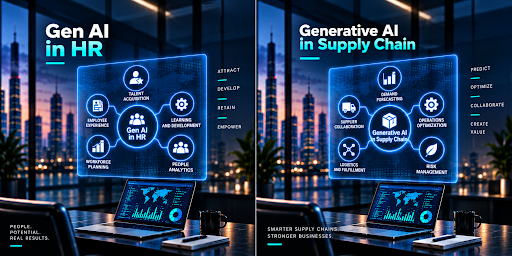

Organizations are exploring artificial intelligence to improve productivity, strengthen decision-making and manage increasingly complex business operations. Two areas with significant potential are human resources and supply chain management. Gen AI in HR can improve employee services, workforce knowledge and administrative efficiency, while Generative AI in Supply Chain can support planning, supplier management and operational decision-making.
Although these functions serve different business objectives, both depend on reliable enterprise data, integrated technology and effective governance. A coordinated approach can help organizations scale intelligent capabilities while maintaining operational accountability.
This article explores how generative AI is transforming HR and supply chain operations, its key applications, business benefits and priorities for successful implementation.
What is Gen AI in HR?
Gen AI in HR refers to the application of generative artificial intelligence across human resources processes, employee services and workforce management.
These capabilities can interpret natural-language questions, summarize information, generate communications and provide conversational access to organizational knowledge.
HR teams can apply generative AI to recruiting, onboarding, employee self-service, learning and HR case management.
Unlike traditional automation, which follows predefined rules, generative AI can support knowledge-intensive activities requiring interpretation and contextual understanding.
The objective is to reduce administrative effort while enabling HR professionals to focus on workforce strategy and employee needs.
What is Generative AI in Supply Chain?
Generative AI in Supply Chain refers to the use of generative artificial intelligence across planning, sourcing, manufacturing, inventory management and logistics.
Supply chain teams can use AI to summarize operational information, investigate planning exceptions, retrieve supplier knowledge and interpret complex reports.
Generative AI complements traditional analytics by making operational information easier to access and understand.
For example, planners can use conversational interfaces to explore inventory changes or supplier-related issues.
These capabilities can improve decision support while maintaining human accountability for important operational decisions.
Why HR and supply chain need intelligent capabilities
HR and supply chain teams manage large volumes of information across multiple enterprise platforms.
HR operations depend on employee records, policies and workforce information, while supply chain processes rely on demand, inventory, supplier and logistics data.
Manual information retrieval and fragmented workflows can reduce productivity in both functions.
Gen AI in HR can simplify employee support and knowledge management, while Generative AI in Supply Chain can accelerate operational analysis.
Both applications demonstrate how intelligent technologies can reduce repetitive work and improve access to business information.
Core technologies supporting generative AI
Several technologies contribute to intelligent enterprise operations.
Large language models
Large language models enable natural-language interaction, document summarization and conversational access to information.
Machine learning
Machine learning analyzes historical and operational data to identify patterns and anomalies.
Predictive analytics
Predictive models can help organizations anticipate workforce requirements, demand changes and operational risks.
Intelligent automation
Automation executes repetitive workflows while generative AI supports activities requiring interpretation.
AI agents
AI agents can coordinate approved multistep activities across enterprise applications while escalating sensitive decisions for human review.
Together, these technologies expand the potential of Gen AI in HR and Generative AI in Supply Chain beyond conventional automation.
Key applications of Gen AI in HR
Organizations can apply generative AI across several workforce processes.
Talent acquisition
AI can assist with job descriptions, recruiting communications and candidate information summaries.
Employee onboarding
Conversational assistants can help new employees access organizational policies and onboarding information.
Employee self-service
Generative AI can answer routine questions about benefits, leave and HR procedures.
HR case management
AI can summarize employee inquiries and retrieve relevant information to support faster case resolution.
Learning and development
Generative AI can assist with learning content and improve access to employee development resources.
These applications demonstrate how Gen AI in HR can improve service delivery and administrative productivity.
Key applications of Generative AI in Supply Chain
Generative AI can also support multiple supply chain activities.
Demand planning
AI can summarize forecast changes and help planners interpret relevant demand signals.
Inventory management
Generative AI can explain inventory exceptions and provide contextual information about stock positions.
Supplier management
AI can summarize supplier contracts, performance information and relevant documentation.
Manufacturing support
Generative AI can improve access to production procedures, maintenance information and operational knowledge.
Logistics
AI can summarize transportation information, delivery exceptions and potential disruptions.
These applications show how Generative AI in Supply Chain can strengthen operational knowledge and decision support.
Business benefits of generative AI
When connected to clearly defined business objectives, generative AI can create several benefits.
Greater employee productivity
AI can reduce repetitive information retrieval, documentation and administrative activities.
Faster decision-making
Generative AI can summarize complex information and help employees understand operational conditions more efficiently.
Improved service delivery
Conversational AI can provide faster access to information for employees and business stakeholders.
Better knowledge management
Intelligent search and summarization can make enterprise documentation easier to access and interpret.
Greater scalability
AI-enabled workflows can help organizations manage increasing workloads without proportional increases in manual effort.
How generative AI improves enterprise coordination
HR and supply chain functions influence enterprise performance through different but connected responsibilities.
Workforce availability, employee skills and operational capacity can affect supply chain execution.
Gen AI in HR can support access to workforce information, while Generative AI in Supply Chain can provide operational context for planning and resource decisions.
For example, organizations may use workforce and operational analytics to understand whether staffing capacity aligns with expected production requirements.
Connecting relevant insights can support more informed enterprise planning without requiring sensitive HR data to be broadly shared.
Best practices for implementing generative AI
Organizations can improve implementation outcomes by following several principles:
- Start with clearly defined business problems and expected outcomes.
- Establish current performance baselines.
- Improve enterprise data quality and governance.
- Prioritize use cases based on value, feasibility and risk.
- Integrate AI with existing business platforms and workflows.
- Establish strong privacy and cybersecurity controls.
- Maintain human accountability for sensitive decisions.
- Test AI-generated outputs against realistic scenarios.
- Prepare employees for AI-enabled processes.
- Measure realized financial and operational outcomes.
These practices help organizations scale intelligent capabilities responsibly.
Common implementation challenges
Data fragmentation is a significant challenge because enterprise information often resides across multiple systems.
For Gen AI in HR, employee privacy, fairness and sensitive workforce decisions require particular attention.
For Generative AI in Supply Chain, organizations must protect confidential supplier information and maintain operational reliability.
Legacy technology can also create integration difficulties.
Organizations should establish clear permissions, validation requirements and governance before expanding AI capabilities.
Measuring the value of generative AI
Generative AI should be evaluated according to improvements in business performance rather than technology usage alone.
For HR, relevant measures can include service resolution time, employee productivity, onboarding efficiency and knowledge accessibility.
For supply chain operations, organizations can monitor planning productivity, exception resolution time, inventory performance and operational efficiency.
Establishing baselines before implementation helps leadership teams determine whether expected improvements are being realized.
This also supports better decisions about which applications should be expanded.
The future of Gen AI in HR and supply chain
The next phase of generative AI will increasingly involve intelligent agents capable of coordinating activities across enterprise systems.
In HR, agents could retrieve policy information, support employee inquiries and initiate approved administrative workflows.
In supply chain operations, agents could investigate exceptions, retrieve planning information and coordinate authorized activities.
As these capabilities mature, organizations will need stronger integration, governance and clearly defined decision rights.
The objective will be to improve how employees and intelligent technologies collaborate across business processes.
Conclusion
Gen AI in HR and Generative AI in Supply Chain are creating opportunities to improve productivity, knowledge accessibility and decision support across two important enterprise functions.
Their greatest value emerges when intelligent capabilities are connected with reliable data, established workflows and appropriate governance.
Organizations that prioritize measurable business outcomes and responsible implementation will be better positioned to build efficient, intelligent and resilient enterprise operations.