
The consumer packaged goods (CPG) landscape has undergone a major structural transformation. Modern creators, athletes, and digital personalities are moving away from passive royalty deals to launch proprietary ventures in high-velocity sectors like functional coffee, RTD powders, and nutritional supplements.
Operating an owned enterprise, however, demands far more than social media reach. To succeed in retail and e-commerce, digital-first brands must build an agile supply chain capable of handling demand spikes without accumulating excess dead stock.
The Shift from Endorsements to Owned CPG Brands
Founders stepping into the direct-to-consumer (DTC) arena quickly encounter an operational paradox. Digital distribution allows a viral post to generate tens of thousands of orders in hours, yet physical production cannot be adjusted with software-like speed.
When packaging lead times run twelve weeks, a viral surge triggers immediate out-of-stock notices, lost conversion momentum, and customer churn. Conversely, ordering excessive inventory risks tying up working capital in unsold goods.
Maintaining brand equity requires a manufacturing pipeline that flexes with real-time consumer demand rather than static, multi-month forecasts.
Overcoming the Initial Inventory Hurdle: The MOQ Problem
Conventional packaging procurement was engineered for multinational conglomerates with predictable, high-volume production schedules. For a newly launched brand, standard packaging pipelines present steep financial barriers.
Traditional rotogravure printing requires manufacturing custom engraved steel and copper cylinders for every individual color channel. These Cylinder Setup Fees typically range from $300 to $500 per cylinder, easily totaling thousands of dollars in upfront tooling for a single five-color package design.
To amortize these mechanical tooling costs, legacy manufacturers impose high Minimum Order Quantities (MOQs), commonly demanding 20,000 to 50,000 units per SKU.
For an emerging brand launching a four-flavor protein powder line, an initial order can require purchasing 100,000 to 200,000 pouches. This locks up liquidity in warehouse pallets and exposes the business to write-downs if nutritional facts, branding, or ingredients are updated.
Digital Printing: The Secret Weapon for Agile Packaging
Historically, launching a multi-flavor beverage or supplement line meant tying up immense capital in massive packaging runs due to expensive rotogravure cylinder fees. Today, agile influencer-led brands bypass these archaic bottlenecks entirely. By leveraging the technical capabilities of advanced flexible packaging manufacturers like Baishen Pack, these emerging companies utilize industrial digital printing to eliminate upfront setup fees. This shift enables cost-effective multi-SKU split runs and rapid turnaround times of just 7 to 10 days, allowing product managers to align inventory perfectly with viral demand spikes.
Industrial digital presses print graphics directly onto multi-layer barrier substrates from high-resolution digital vector files, bypassing mechanical plates and chemical engraving baths.
This operational model unlocks three distinct engineering and financial advantages for high-growth brands:
- Zero Upfront Tooling Costs: Eliminating prepress cylinder fees significantly lowers the cost of bringing new formulations to market.
- Split Run Printing Economics: Brand operators can gang multiple graphic variations—such as five functional latte SKUs—onto a single digital print run to hit aggregate volume pricing while ordering as few as 500 to 1,000 units per flavor.
- Rapid Speed-to-Market: Lead times drop from standard 8–12 week manufacturing schedules to 7–10 business days, allowing operations teams to restock fast-selling SKUs before organic buzz fades.
- Agile Artwork Iteration: Marketing teams can update design elements, add seasonal event badges, or modify ingredient disclosures between print batches with zero tooling write-offs.
By combining low minimums with fast turnaround cycles, digital flexible packaging transforms packaging from a static, capital-heavy liability into an adaptable marketing asset.
Engineering Shelf Appeal: Barrier Films and Formats
While agile turnaround is vital, packaging must first perform its primary engineering function: protecting product formulation against chemical degradation and mechanical wear during transit.
Controlling Moisture and Oxygen (WVTR & OTR)
Active ingredients, organic specialty coffee beans, and hygroscopic drink powders require rigorous atmospheric control to remain shelf-stable.
Package stability is measured through two core scientific metrics:
- Water Vapor Transmission Rate (WVTR): The mass of water vapor permeating through a square meter of barrier film over a 24-hour period (
 ).
- Oxygen Transmission Rate (OTR): The volume of oxygen gas passing through a square meter of film over 24 hours ().
Elevated moisture ingress causes hydration powders to aggregate and cake, while ambient oxygen exposure leads to lipid oxidation in roasted coffee, producing stale off-notes.
To maintain baseline freshness over a 12- to 18-month retail window, barrier films must be engineered for performance:
- Metallized Polyester (VMPET): A vacuum-deposited microscopic aluminum layer on polyester that yields superior moisture and gas protection at a lower tare weight.
- Solid Aluminum Foil Laminates (AL/Mylar): Delivers near-zero gas and vapor transmission with complete opacity, shielding light-sensitive vitamins and botanical extracts from photo-oxidation.
- Linear Low-Density Polyethylene (LLDPE): Serves as the internal, food-safe sealant layer, providing strong hermetic seals across the perimeter to prevent microscopic pinhole leaks.
Pouch Formats for E-commerce vs. Retail
Selecting the appropriate pouch format requires balancing visual presence on grocery shelves against shipping efficiencies in direct-to-consumer fulfillment.
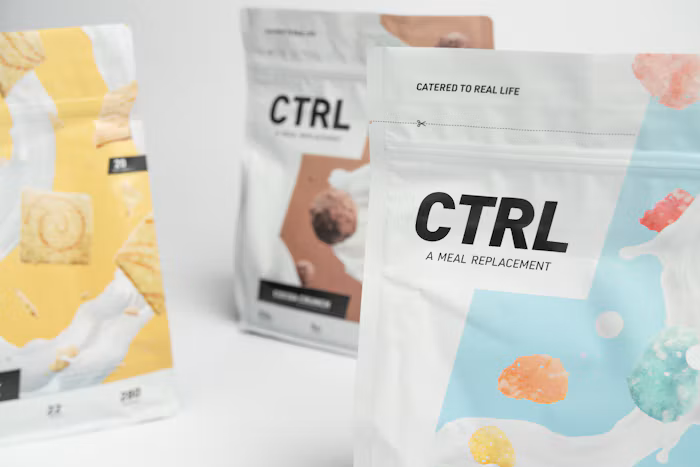
Stand-Up Pouches (SUPs) with Press-to-Close Zippers feature a bottom gusset that expands to allow the bag to stand upright. This structure creates an expansive vertical billboard on competitive retail shelves, while integrated resealable zippers protect product integrity across repeat uses.
Flat Pouches (Lay-Flat Pillow Bags) offer a streamlined alternative for DTC operations. Without an expanding bottom gusset, flat pouches lie compact inside standardized padded mailers and corrugated shippers.
This flat profile optimizes shipping dimensions and reduces Dimensional (DIM) Weight surcharges from parcel carriers, significantly cutting shipping costs across thousands of consumer deliveries.
Key Takeaways
| Area | Key Takeaway | Impact/Data |
| Tooling | Eliminate rotogravure cylinder tooling fees | Saves 500 per cylinder |
| Inventory | Run multi-SKU digital split batches | Lowers MOQs from 50,000 to 500 units |
| Agility | Compress production reorder cycles | Cuts lead times from 12 weeks to 7–10 days |
| Shipping | Deploy lay-flat pouches for DTC fulfillment | Slashes carrier DIM weight surcharges |
| Barrier | Mandate AL/VMPET multi-layer laminates | Halts powder caking and lipid rancidity |
| Retail | Validate ASTM testing and FDA migration safety | Eliminates shipment rejections at retail |
Regulatory Compliance for Retail Distribution
Expanding from a direct-to-consumer channel into national retail chains like Target, Whole Foods Market, or Sephora introduces strict regulatory oversight.
Large retail accounts require complete technical specification sheets (Spec Sheets) verifying package structural integrity and material safety before issuing purchase orders:
- Seal Integrity and ASTM Testing: Packages must withstand transit vibrations and pallet pressure through ASTM-certified tensile seal testing, creep burst evaluation, and standardized drop tests.
- Chemical Migration Safety: Adhesives, printing inks, and inner barrier resins that contact food or topicals must meet strict migration thresholds to prevent harmful leaching.
Whether a CPG brand starts as a viral social media drop or a carefully planned retail launch, transitioning to massive physical scale requires rigorous material safety validation. Before finalizing supply chain contracts, brands must ensure their packaging substrates comply strictly with official FDA regulations on food contact substances. This compliance protocol guarantees that all barrier films, protective coatings, and internal sealants prevent hazardous chemical migration, safeguarding consumer health across variable thermal and warehouse storage conditions.
By pairing modern digital printing economics with solid barrier engineering and safety compliance, emerging CPG brands can scale rapidly from initial online launch to mainstream retail success.