
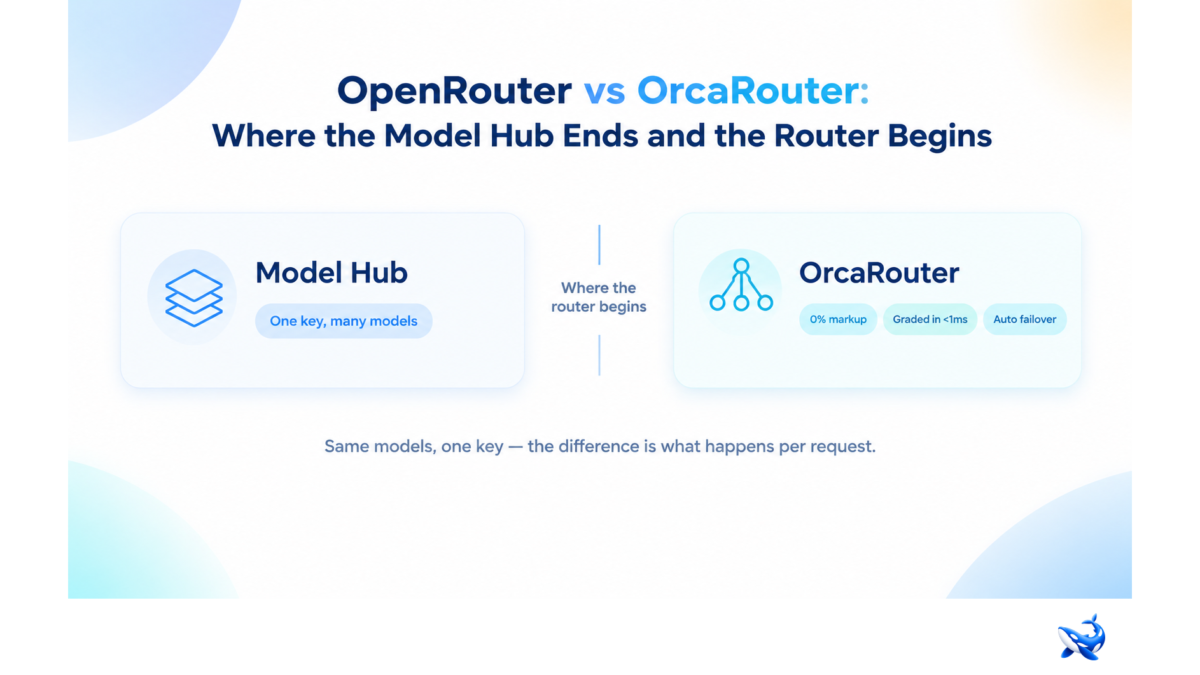

The “OpenRouter vs OrcaRouter” question is really a category question: both services give you one API key and one endpoint to reach dozens of models, and if that is all you need, the answer barely matters. The difference shows up when your traffic has to meet a budget, survive an outage, or justify its own spending — that is where a plain model hub ends and OrcaRouter begins, and the two approaches are laid out dimension by dimension in the openrouter alternative write-up.
Let’s be fair to both sides before drawing it. Teams searching “openrouter vs orcarouter” are usually not loyal to any brand — they are mid-migration or sizing up the category, and what they’re really asking is whether a service that hands you models and a service that routes you to models are meaningfully different. They are, and the difference isn’t the menu. Both reach the same frontier and open-source catalog through a single integration. The split lives in the layer around the models: how you’re billed, how each request is decided, what happens when a provider fails, and what the record of all of it looks like afterward.
The honest common ground: one key, many models
Neither side of this comparison is a hard sell. Both services exist because nobody wants to write a separate provider SDK for every model they might call next quarter. One API key, one endpoint, one bill — that convenience is real, and it’s the part of this category that just works on either side. If your definition of success is “I reach any model from one integration and stop managing provider accounts,” either service satisfies it, and this article isn’t going to manufacture a gap that doesn’t exist.
The gap is real, but it sits further down the stack. A model hub answers the question “which models can I reach?” A router answers a different, harder question: “which model should answer this request, at this cost, under this budget?” Once your traffic is past a few thousand calls, those are different jobs — and the five places they diverge are pricing, routing, reliability, observability, and governance.
Pricing: the line that separates hub from router
Start with the bill, because it’s where trust in this category breaks first. The typical economics of a model hub involve an opaque margin added somewhere between the provider’s list price and what you pay — a markup that distorts every downstream decision, because the “cheapest model” your tooling picks is only cheapest according to inflated numbers. You can’t run a real cost-optimization story on a price you can’t see.
OrcaRouter’s answer is to not add anything at all. Provider list prices are passed through at 0% markup — “provider price, no $0.00 added” — with itemized, glass-box receipts you can check against the provider’s own rate card [OrcaRouter]. That single decision changes what the rest of the platform can honestly claim: the price the router sees when it grades a prompt is the price you pay, and the price in the request log is the price the provider charged.
| The layer | A typical model hub | OrcaRouter |
| Pricing | List price plus an opaque margin | 0% markup; provider list price passed through, itemized receipts [OrcaRouter] |
| Routing | Default model or a manual pick | Adaptive routing grades each prompt in under 1ms, routes to the cheapest qualifying model [OrcaRouter] |
| Reliability | Your retry loop when a provider fails | Automatic failover and load balancing across healthy models [OrcaRouter] |
| Observability | Aggregate usage dashboard | Per-request logs: model, tokens, latency, cost [OrcaRouter] |
| Governance | Shared key, shared bill | Budgets & roles, BYOK [OrcaRouter] |
Routing: who decides which model answers
A hub that just has the models is only half the job; the routing layer is where a service earns its keep. The key question is whether routing is a static policy or a per-request decision.
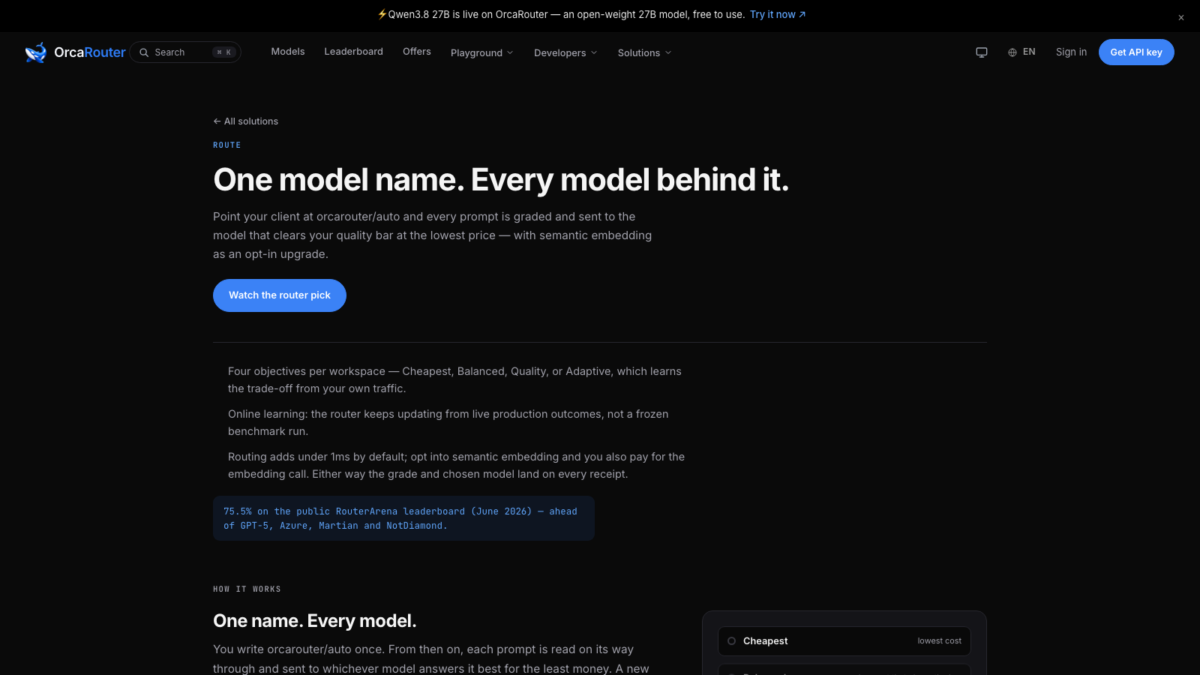
OrcaRouter grades each prompt before routing it. Every prompt is scored in under 1ms, then sent to the cheapest model that meets your standard — a trivial classification lands on a fast, inexpensive model, a hard reasoning task escalates to a frontier model, and orcarouter/auto mode makes that call for you on every request [OrcaRouter]. It routes on cost and latency as well as quality, so the tradeoff is made per prompt rather than per month. On a plain hub, a “model” is a configuration you set and mostly forget; on a router, the choice between a $0.01 model and a $5 model is a decision the platform makes per request — which is the entire point of routing, and the place where the categories genuinely stop being the same product.
Reliability: failover as a feature, not an incident
The second place the categories diverge is what happens when things go wrong. A hub assumes the model you picked will be there; a router is built around the fact that it sometimes won’t be. Provider outages, rate limits, and latency spikes are routine facts of the AI economy, and the difference is who absorbs them.
OrcaRouter’s routing engine handles failure automatically. When a provider is down, rate-limited, or slow, automatic failover re-routes the request to a healthy model and the user never sees it; load balancing spreads traffic across healthy endpoints so a single provider’s degradation doesn’t become your latency [OrcaRouter]. No retry loop in your application code, no 2 a.m. incident where a model you chose six months ago goes dark. And because the fallback is chosen by the same grading engine, the replacement is the next-best model for that exact prompt — not a random second choice. On a plain hub, reliability is largely your problem to engineer; on a router, it’s a feature of the request path.
Observability and governance: what the record looks like
The third split is the quiet one, and it’s where cost control actually becomes possible. A hub typically shows you an aggregate dashboard — total spend, total tokens — which is useful for a headline number and useless for accountability. OrcaRouter gives you per-request logs: every request is auditable, with which model answered, how many tokens it used, the latency, and the cost [OrcaRouter]. That turns “where did the budget go” from a guess into a query.
Governance rides on top of the same record. Budgets & roles let you cap spend and scope keys per team or per feature, so the log answers “where did the money go” by team rather than by month-end export; BYOK keeps your own provider credentials in your control instead of forcing every account through one platform’s wallet [OrcaRouter]. These are not nice-to-haves — they are the difference between a platform you trust with production traffic and a demo you tried once. None of them exist on the “one endpoint to many models” promise alone.
The verdict: where the hub ends and the router begins
If you need plain access to models — one key, many models, and you pick which one yourself — either service works, and this comparison doesn’t need to be a war. The honest test is what your traffic does at scale. If you want routing plus cost control plus transparency, that is where the router wins: 0% markup with provider list prices passed through and itemized receipts [OrcaRouter], adaptive routing that grades each prompt in under 1ms [OrcaRouter], automatic failover and load balancing [OrcaRouter], per-request logs, and budgets, roles, and BYOK on top [OrcaRouter]. The models are the same models; the difference is the layer that decides which one answers, what it costs, what happens when it fails, and what the record says afterward.
The takeaway
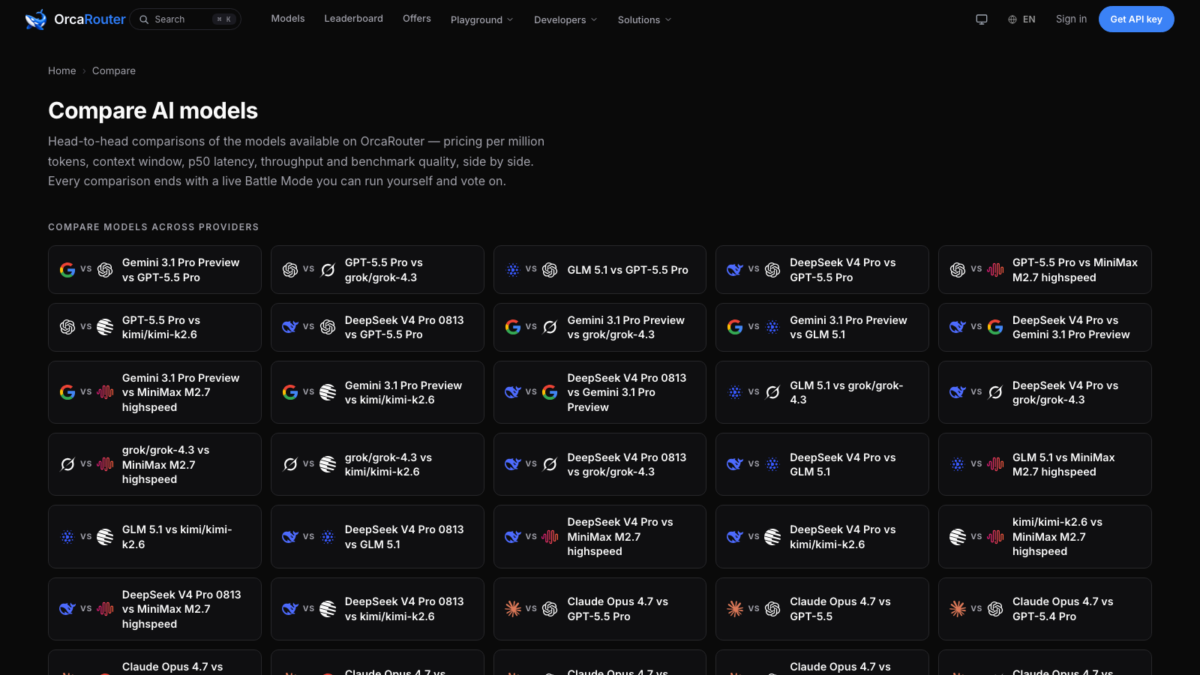
Choose the hub route if your workload is simple and your tolerance for spreadsheet math is high: you reach the models, and the rest is yours to manage. Choose the router route when your traffic carries a budget, a quality bar, and a production SLA — because that is the moment the per-request decisions start paying for themselves. Try OrcaRouter if you want to see the difference concretely: the compare page walks the five dimensions above side by side, and the 0% markup pricing means the numbers you evaluate with are the numbers you’ll pay. The model menu is not the decision; the layer around it is.
Sourcing note: All OrcaRouter product claims — 0% markup with provider list prices passed through and itemized receipts, one API key for 200+ models, prompts graded in under 1ms and routed to the cheapest qualifying model with cost and latency routing, automatic failover and load balancing, per-request logs, budgets & roles, and BYOK — are OrcaRouter’s own published statements, checked on its homepage, /compare, and /solutions/adaptive-routing pages on August 22, 2026. No third-party benchmark data and no claims about any specific competitor’s pricing or features are used in this article.