
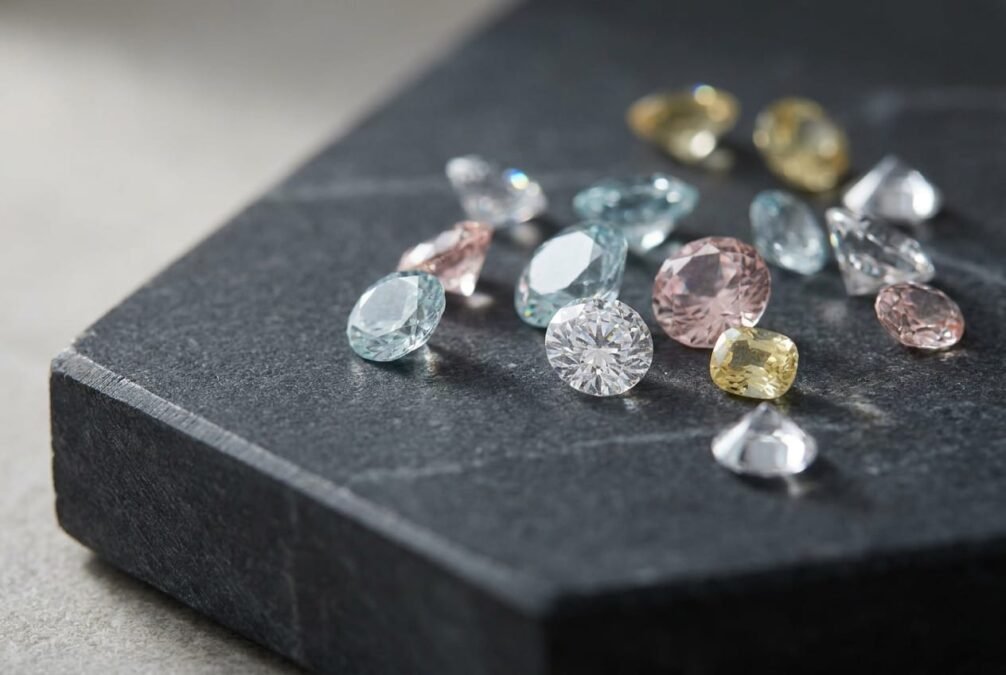

For most of its history, the gemstone trade was effectively anonymous. Stones were commodities — graded, traded and set, but rarely branded. That’s changing. A new wave of gemstone brands is emerging, built not around finished jewellery but around the stones themselves: named, quality-controlled materials with a clear identity of their own.
The shift is being driven by created stones. Because lab-grown gems are produced under controlled conditions, their quality is consistent and their supply reliable — the two things a brand needs to make a promise and keep it. That has made it possible, for the first time, to build a recognisable name around a specific stone rather than a specific piece of jewellery.
Engineered silicon carbide has become a natural vehicle for this approach. Its optical performance is strong enough to stand on its own — high brilliance, lively fire — and its lab-grown origin makes consistency achievable. Zeverra is among the clearest examples of the model: rather than making finished jewellery, it grows and cuts silicon carbide as a proprietary gemstone, supplying stones to the jewellers and designers who set them. The stone, not the ring, is the brand.
It’s a strategy familiar from other industries, where naming a material turns a commodity into something buyers seek out by name. In gemstones it’s newer, but the logic is the same: a defined standard means consistency, a name means accountability, and a brand staking its reputation on a stone has every reason to maintain its quality.
The approach isn’t limited to colourless stones. Some newer brands are building identities around particular coloured created gems, or around specific cuts and treatments. What they share is a rejection of anonymity — the belief that a stone can carry a standard and a story, not just a grade.
For buyers, the practical upshot is useful. A branded stone comes with a defined standard, which means you know what you’re getting. It often comes with clearer provenance, since a brand willing to put its name on a stone tends to be transparent about how it’s made. And it introduces accountability that anonymous commodity stones lack. The caution, as with any branded product, is to make sure you’re paying for genuine substance rather than the name alone — the brands worth taking seriously are those whose material actually performs and whose claims are specific.
What makes this moment interesting is how early it is. The gemstone trade is only beginning to adopt the branding logic that reshaped other luxury categories decades ago. The names establishing themselves now — Zeverra among them — are effectively defining what a gemstone brand can be. Expect more to follow, and expect buyers to reward the ones with real substance behind the story.
For anyone shopping, the emergence of gemstone brands is mostly good news: more transparency, more accountability, and more ways to know exactly what you’re buying. Just apply the same scepticism you’d bring to any branded purchase — judge the stone, not only the name.