
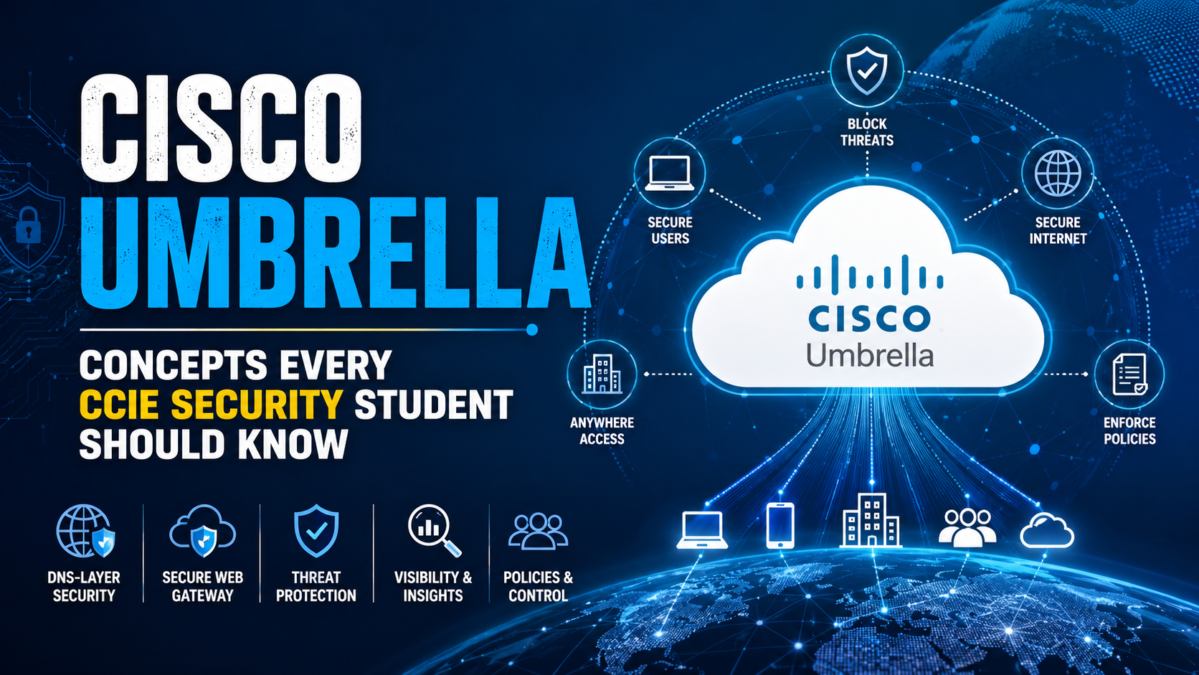

Cisco Umbrella has become one of the most trusted cloud-delivered security solutions for protecting users, devices, and networks against modern cyber threats. As organizations increasingly adopt cloud services and remote work environments, understanding how Cisco Umbrella strengthens security is essential for networking professionals.
For candidates planning to pursue CCIE Security training, mastering Cisco Umbrella is a valuable step toward building the advanced skills required for enterprise security environments and the certification lab exam. It provides hands-on knowledge of DNS-layer security, secure web gateway, cloud-delivered firewall, and threat intelligence, helping aspiring CCIE Security professionals confidently design, deploy, and manage secure network infrastructures in real-world scenarios.
What Is Cisco Umbrella?
Cisco Umbrella is a cloud-delivered security platform that provides the first line of defense against internet-based threats. By leveraging the Domain Name System (DNS), it blocks malicious requests before a connection is established, reducing the risk of malware infections, phishing attacks, ransomware, and other cyber threats.
Unlike traditional security appliances that require on-premises deployment, Cisco Umbrella operates from the cloud. This architecture enables organizations to protect users regardless of their location, making it especially valuable for remote and hybrid work environments.
For students pursuing a CCIE Security course, understanding how Cisco Umbrella integrates with enterprise security architecture is essential because it frequently appears in real-world deployments.
Why Cisco Umbrella Matters for CCIE Security Students
The CCIE Security certification focuses on designing, implementing, operating, and troubleshooting advanced security solutions. Cisco Umbrella supports many of these objectives by offering cloud-native protection for users, devices, and applications.
Some reasons CCIE Security students should study Cisco Umbrella include:
- Cloud-based security architecture
- DNS-layer protection
- Secure internet gateway capabilities
- Cloud Access Security Broker (CASB) integration
- Secure web gateway functionality
- Identity-aware policy enforcement
- Threat intelligence integration
Understanding these concepts helps candidates connect theoretical knowledge with enterprise deployment scenarios.
Core Cisco Umbrella Concepts
1. DNS-Layer Security
DNS-layer security is Cisco Umbrella’s foundation. Every internet request begins with a DNS lookup. Umbrella evaluates these requests before connections are established.
If a domain is identified as malicious, Umbrella blocks the request instantly, preventing users from accessing harmful websites.
Benefits include:
- Reduced malware infections
- Protection against phishing websites
- Minimal impact on network performance
- Fast threat prevention
This proactive approach significantly reduces attack surfaces across enterprise environments.
2. Secure Web Gateway (SWG)
The Secure Web Gateway provides advanced inspection of web traffic.
Unlike basic DNS filtering, SWG performs deeper analysis by inspecting HTTP and HTTPS traffic. Organizations can create policies that:
- Block unsafe websites
- Restrict inappropriate content
- Inspect encrypted traffic
- Prevent malicious downloads
This layer improves overall visibility and strengthens web security.
3. Cloud Access Security Broker (CASB)
Organizations increasingly depend on Software-as-a-Service (SaaS) applications.
Cisco Umbrella’s CASB capabilities help security teams:
- Discover cloud applications
- Monitor user activities
- Detect risky behavior
- Enforce compliance policies
CCIE Security candidates should understand how CASB complements traditional network security controls.
4. Firewall as a Service (FWaaS)
Cisco Umbrella includes cloud-delivered firewall capabilities.
Firewall as a Service enables administrators to:
- Control outbound traffic
- Apply Layer 3 and Layer 4 filtering
- Enforce network policies
- Simplify branch office security
This eliminates the need for deploying physical firewalls at every location.
5. Threat Intelligence
Cisco Umbrella leverages Cisco Talos, one of the world’s largest commercial threat intelligence teams.
Threat intelligence helps identify:
- Malicious domains
- Command-and-control servers
- Emerging malware
- Phishing campaigns
Because threat intelligence updates continuously, Umbrella can respond to new attacks rapidly without requiring manual updates.
Cisco Umbrella Components at a Glance
| Component | Primary Function | Benefit |
| DNS Security | Blocks malicious DNS requests | Stops threats before connections occur |
| Secure Web Gateway | Inspects web traffic | Protects browsing sessions |
| CASB | Monitors SaaS applications | Improves cloud visibility |
| Firewall as a Service | Filters network traffic | Simplifies cloud security |
| Threat Intelligence | Detects evolving threats | Enhances proactive defense |
| Reporting Dashboard | Provides analytics | Improves monitoring and troubleshooting |
Policy Enforcement
Cisco Umbrella allows administrators to create flexible security policies.
Policies can be based on:
- User identity
- Device type
- Network location
- Active Directory groups
- Security groups
This granular policy enforcement helps organizations maintain consistent security regardless of where users connect.
For CCIE Security students, understanding policy hierarchy is valuable because enterprise environments often involve multiple overlapping security requirements.
Roaming Client Protection
Modern employees frequently work outside corporate offices.
Cisco Umbrella’s Roaming Client extends protection beyond the enterprise network.
Key advantages include:
- Continuous DNS protection
- Remote user security
- Automatic policy application
- Reduced VPN dependency
This capability demonstrates how cloud-delivered security adapts to modern work environments.
Reporting and Visibility
One of Cisco Umbrella’s strongest features is its reporting capability.
Administrators gain visibility into:
- Blocked requests
- User activity
- Security events
- Malware attempts
- DNS requests
- Policy effectiveness
These insights simplify troubleshooting while improving security operations.
Students preparing for advanced certification exams should become comfortable interpreting these reports since monitoring and analysis are essential skills.
Cisco Umbrella Deployment Models
Cisco Umbrella supports multiple deployment options depending on organizational needs.
Common deployment methods include:
- Network devices
- Virtual appliances
- Roaming clients
- Cisco Secure Client integration
- API integrations
Understanding deployment flexibility helps CCIE candidates design scalable enterprise security architectures.
Best Practices for Learning Cisco Umbrella
To gain practical experience, students should combine theoretical study with hands-on practice.
Recommended learning strategies include:
- Build virtual lab environments.
- Practice DNS policy creation.
- Configure content filtering.
- Review reporting dashboards.
- Explore Secure Web Gateway policies.
- Study Cisco Talos threat intelligence.
- Practice troubleshooting policy enforcement.
- Learn integration with Cisco SecureX and Cisco Identity Services Engine (ISE).
Hands-on practice strengthens conceptual understanding while improving readiness for real-world implementations.
Common Mistakes to Avoid
Many learners focus only on memorizing features rather than understanding how they work together.
Avoid these common mistakes:
- Ignoring DNS-layer fundamentals
- Confusing SWG with traditional firewalls
- Overlooking policy hierarchy
- Neglecting cloud deployment concepts
- Skipping reporting and analytics practice
- Failing to understand identity-based security
A comprehensive understanding of Cisco Umbrella is far more valuable than simply memorizing product terminology.
Conclusion
Cisco Umbrella is a key component of modern cloud security, providing organizations with advanced protection against evolving cyber threats while simplifying security management. For professionals preparing for the CCIE Security course, developing a solid understanding of Cisco Umbrella strengthens both certification readiness and practical networking skills.
By mastering its core features, deployment methods, and security capabilities, candidates can confidently handle real-world enterprise security challenges and build a strong foundation for a successful career in cybersecurity.