
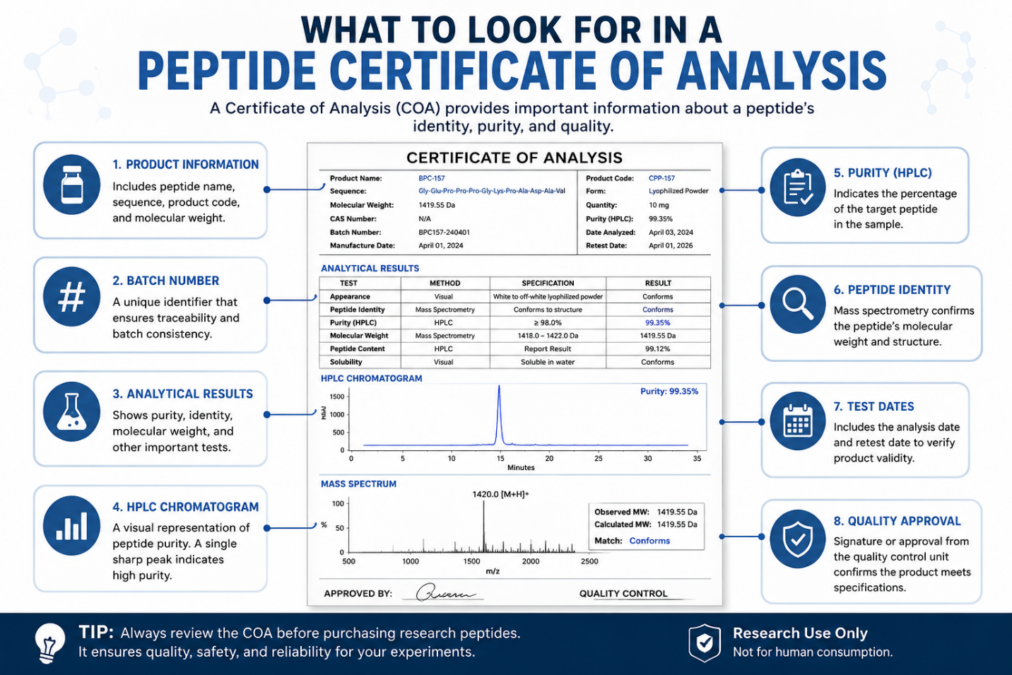

When purchasing research peptides, quality should always be a top priority. Whether you’re working in biotechnology, molecular biology, pharmaceutical research, or another scientific field, the reliability of your research depends heavily on the quality of the materials you use.
One of the most valuable documents researchers can review before purchasing a peptide is the Certificate of Analysis (COA). A COA provides important information about a peptide’s identity, purity, testing results, and manufacturing quality. Understanding how to read this document helps researchers make informed purchasing decisions and select products that meet laboratory standards. Core Power Peptides is committed to providing high-quality research peptides backed by comprehensive Certificates of Analysis to support scientific research and laboratory standards.
In this guide, we’ll explain what a peptide Certificate of Analysis is, why it matters, and the key details every researcher should look for before ordering research peptides.
What Is a Certificate of Analysis?
A Certificate of Analysis (COA) is a quality assurance document that summarizes the analytical testing performed on a specific peptide batch.
It confirms that the product has been evaluated against predetermined quality standards and provides laboratory data regarding its characteristics.
Most reputable peptide suppliers provide Certificates of Analysis to demonstrate transparency and support confidence in their products.
A COA helps researchers verify that the peptide they receive matches the specifications advertised by the supplier.
Why Is a COA Important?
Scientific research depends on consistency and accuracy.
Using poorly characterized research materials can introduce uncertainty into laboratory experiments and make results difficult to reproduce.
A Certificate of Analysis helps researchers:
- Verify product identity
- Review purity information
- Confirm batch-specific testing
- Evaluate manufacturing quality
- Compare products from different suppliers
- Purchase with greater confidence
Rather than relying solely on marketing claims, researchers can evaluate documented analytical results before making a decision.
1. Product Name
The first section of a Certificate of Analysis should clearly identify the peptide being tested.
This information generally includes:
- Product name
- Peptide sequence (when applicable)
- Product code or catalog number
Researchers should verify that the information matches the product they intend to purchase.
2. Batch or Lot Number
Every production batch should have a unique batch or lot number.
This identifier allows manufacturers to trace production records and analytical testing for that specific batch.
Batch numbers are important because:
- They improve product traceability.
- They connect testing results to a specific production run.
- They support quality control documentation.
A missing batch number may indicate incomplete quality documentation.
3. Manufacturing Date
A quality COA should include the manufacturing date or production date.
This information helps laboratories:
- Monitor inventory
- Manage storage timelines
- Maintain documentation
- Support laboratory record keeping
Researchers often prefer recently manufactured products that have been stored under appropriate conditions.
4. Purity Results
Purity is one of the most important values shown on a Certificate of Analysis.
It indicates the percentage of the sample that consists of the intended peptide.
High-purity research peptides help reduce unwanted compounds that could interfere with laboratory experiments.
Many research-grade peptides report purity levels above 95%, while some premium products exceed 99%.
The purity value should always be supported by analytical testing rather than unsupported claims.
5. HPLC Testing
One of the most common analytical methods listed on a COA is High-Performance Liquid Chromatography (HPLC).
HPLC is widely used to evaluate peptide purity by separating compounds within a sample.
Researchers often look for:
- HPLC purity percentage
- Chromatogram results
- Testing conditions
- Laboratory confirmation
The chromatogram provides visual evidence supporting the reported purity value.
6. Mass Spectrometry Results
Mass spectrometry (MS) helps verify the molecular weight and identity of the peptide.
This analytical technique confirms that the synthesized peptide matches its expected molecular structure.
Including mass spectrometry data strengthens confidence that the correct peptide has been produced.
Many high-quality peptide suppliers include both HPLC and mass spectrometry results within their Certificates of Analysis.
7. Testing Laboratory Information
Researchers should review who performed the analytical testing.
A quality Certificate of Analysis generally identifies:
- Testing laboratory
- Laboratory address (when applicable)
- Testing methods used
- Date of analysis
Some suppliers also utilize independent third-party laboratories for verification, providing an additional layer of confidence.
8. Appearance Description
The Certificate of Analysis usually includes a description of the peptide’s physical appearance.
Examples may include:
- White powder
- Off-white lyophilized powder
- White crystalline material
This information helps confirm the product’s expected physical characteristics upon arrival.
9. Storage Recommendations
Proper storage helps preserve peptide stability during laboratory use.
Many Certificates of Analysis include recommended storage conditions such as:
- Refrigerated storage
- Frozen storage
- Protection from moisture
- Protection from light
Following these recommendations helps maintain product quality over time.
10. Signature or Quality Approval
Many reputable manufacturers include a quality control approval section.
This may contain:
- Quality assurance signature
- Authorized reviewer
- Approval date
- Internal quality control confirmation
Although formats vary between manufacturers, documented approval demonstrates that the product completed internal quality review before release.
Signs of a High-Quality COA
Not every Certificate of Analysis provides the same level of detail.
Researchers generally prefer documents that include:
- Batch-specific testing
- HPLC purity data
- Mass spectrometry verification
- Clear product identification
- Manufacturing dates
- Testing methods
- Quality approval
- Transparent documentation
Comprehensive reports demonstrate a supplier’s commitment to quality and scientific transparency.
Questions to Ask Your Peptide Supplier
Before purchasing research peptides, researchers may consider asking:
- Is a Certificate of Analysis available for every batch?
- Is the COA batch-specific?
- Which analytical methods were used?
- Was testing performed internally or by a third-party laboratory?
- What purity level does the product meet?
- Are HPLC and mass spectrometry reports available?
Suppliers willing to answer these questions openly often demonstrate stronger quality standards.
Conclusion
A Certificate of Analysis is much more than a simple document—it is an important quality assurance tool that helps researchers evaluate research-grade peptides before making a purchase.
By reviewing product identity, batch information, purity results, HPLC data, mass spectrometry verification, storage recommendations, and testing documentation, laboratories can make informed decisions and select products that meet their scientific standards.
As peptide research continues advancing, transparency and quality assurance will remain essential. Working with suppliers that provide detailed, batch-specific Certificates of Analysis helps support reproducible experiments, reliable research, and greater confidence in laboratory outcomes.
Disclaimer: Research peptides are intended for laboratory research purposes only. They are not intended for human consumption, veterinary use, diagnosis, treatment, or prevention of any disease. All research should be conducted by qualified professionals following applicable regulations and laboratory safety practices.