
Here is something most people outside the Kingdom miss about Saudi real estate technology. The hardest part of building an end-to-end property ecosystem, the regulated infrastructure for rental, ownership, financing, and registration, has already been built. Not by a startup. By the government.
Ejar has registered over 10 million rental contracts, with roughly 19,000 new contracts documented every single day, and it is integrated with the Najiz judicial portal so that a registered lease is legally binding the moment it is signed. Sakani, the homeownership and financing platform, has surpassed 7.2 million downloads, and its Real Estate Advisor service alone has guided over 800,000 individuals through housing decisions. Mullak governs the owners’ associations for jointly held units. The Saudi Properties platform launched a national digital gateway for non-Saudi ownership ahead of the new Property Ownership Law that took effect in mid-January 2026 under Royal Decree M/14. REGA maintains the registry. Each of these is a fully operational, government-built rail handling a distinct stage of the property lifecycle.
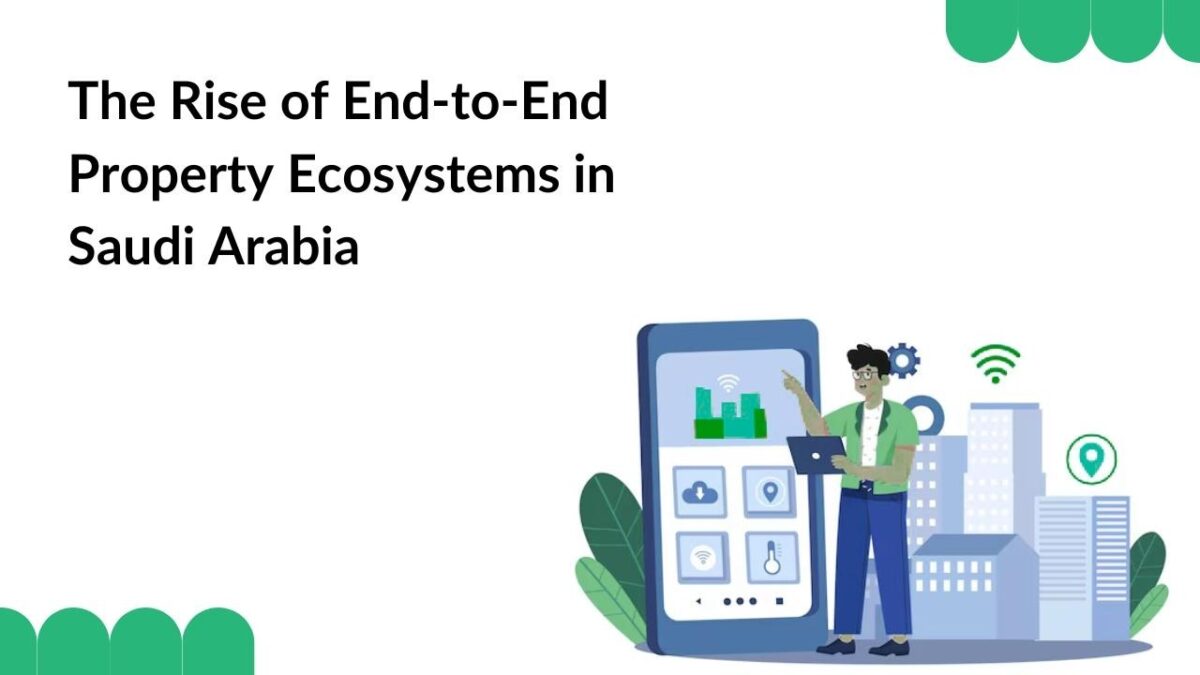
And there is the opportunity. These rails exist, but they exist as separate platforms, each solving one stage of a journey that a real property owner experiences as a single continuous process. The person who rents today buys in three years, finances through Sakani, registers through REGA, manages through Mullak, and eventually sells, and they navigate four or five disconnected government platforms plus a handful of private listing portals to do it. The opportunity that a Real Estate App Development Company in Saudi Arabia is now positioned to capture is not another listings portal. It is the integrated ecosystem layer that stitches these existing rails into one seamless end-to-end journey. As Reem Alharbi, COO of the Global PropTech Summit, put it, PropTech in Saudi Arabia is no longer a single application; it is a layered technology stack reshaping how assets are planned, financed, transacted, and managed.
This is the shift from listings to ecosystems, and it is the most consequential change in Saudi property technology heading through 2026.
Why Listings Alone No Longer Win
For two decades, the property app meant the property listing. Property Finder, Bayut, Aqar, Haraj, and Wasalt built large businesses on aggregating listings and connecting buyers and renters to inventory. That model created genuine value, and those platforms are not going away. But the listing is only the first stage of a property journey that has six or seven stages, and a platform that owns only the first stage owns only the first stage of the customer relationship.
The customer who finds a property still has to arrange financing, complete the transaction, register the title, set up the tenancy or the ownership association, and eventually manage or resell the asset. Each of those stages currently happens on a different platform, often a government one, with the customer doing the integration work manually in their own head. The friction lives in the gaps between the platforms. The opportunity lives in closing those gaps.
The market reality reinforces this. Saudi Arabia’s urban population is heading toward 36 million with an urbanization rate approaching 83%, the government has allocated roughly SAR 100 billion for housing, and over 65% of property management firms are now implementing or planning cloud-based management systems. The infrastructure investment and the urbanization demand are both pointing at integrated platforms, not at more places to browse listings.
- Listings own one stage: Aggregating inventory captures only the discovery stage of a six-or-seven-stage property journey, leaving the financing, transaction, registration, and management relationship to others.
- Friction lives in the gaps: The customer manually integrates across separate listing portals and government platforms, and the value opportunity is closing those gaps into one continuous experience.
The Full Lifecycle an Ecosystem Has to Serve
An end-to-end property ecosystem in Saudi Arabia serves the complete journey, and understanding each stage shows where integration creates value the listing portal cannot.
Discovery And Decision
The journey begins with discovery, but an ecosystem enriches it beyond listings. It integrates the Real Estate Advisor-style guidance that Sakani pioneered, neighborhood data, financing pre-qualification, and the eligibility checks that determine which government programs and which properties a specific buyer or renter can access. Discovery in an ecosystem is not browsing; it is guided navigation toward the properties the user can actually transact on.
Financing And Eligibility
Financing is where the Saudi ecosystem has a structural advantage. Sakani already connects citizens to subsidized financing solutions, and an integrated ecosystem surfaces financing eligibility, payment modeling, and program qualification at the point of discovery rather than as a separate later step. The user sees not just the property but the realistic path to affording it, which is the information that actually drives the decision.
- Financing at discovery: Integrating financing eligibility and payment modeling at the discovery stage shows users the realistic path to affording a property, the information that actually drives decisions.
- Program qualification built in: Surfacing which government housing programs and subsidies a specific user qualifies for turns generic browsing into guided navigation toward attainable properties.
Transaction And Registration
The transaction and registration stage is where the government rails become essential. Ejar makes a rental contract legally binding on registration. REGA maintains the ownership registry. An ecosystem that integrates with these rails lets the transaction and the legal registration happen within the journey rather than as a detour to a separate government portal. This is the integration that turns a multi-platform ordeal into a continuous flow, and it depends on building to the government’s systems rather than around them.
Management And Resale
The final stages are management and resale, and they are where the ecosystem earns long-term engagement. Mullak governs the owners’ association for jointly held units. Property management software adoption is surging across the Kingdom. An ecosystem that carries the user from ownership into management, and eventually back into the market as a seller, owns the entire multi-year relationship rather than a single transaction. The resale that begins a new journey for the next buyer keeps the ecosystem continuously populated.
Why Building to the Government Rails is the Strategy
The defining strategic insight for Saudi property ecosystems is that the government rails are not competition to build around. They are infrastructure to build on. Ejar, Sakani, Mullak, REGA, and Saudi Properties are the regulated foundation, and the private ecosystem that integrates with them cleanly delivers an experience that neither the government platforms alone nor the listing portals alone can match.
This is a different design philosophy from building a closed proprietary platform. The Saudi ecosystem opportunity is explicitly about integration: connecting to the government rails, respecting the regulatory framework they enforce, and adding the seamless consumer-facing layer that the government platforms, built for compliance rather than for experience, were never designed to provide. A Real Estate Marketplace Development approach that treats Ejar, Sakani, and REGA as integration partners rather than obstacles builds the ecosystem that the Saudi market structure uniquely enables.
The foreign ownership dimension adds further opportunity. With the Non-Saudi Property Ownership Law in effect since mid-January 2026 and the Saudi Properties platform operationalizing it, an ecosystem that integrates foreign-buyer eligibility, the digital ID system for foreign buyers, and the designated-zone framework serves the international investor flow that the new law is designed to attract.
- Rails as foundation, not competition: Ejar, Sakani, Mullak, and REGA are regulated infrastructure to integrate with, and the ecosystem that builds on them delivers experience the government platforms were not designed for.
- Foreign ownership integration: Connecting foreign-buyer eligibility, digital ID, and designated-zone frameworks serves the international investor flow the January 2026 ownership law is designed to attract.
What This Means for the Market
The shift from listings to ecosystems changes the competitive landscape in Saudi property technology. The listing portals compete on inventory and audience, a mature and crowded contest. The ecosystem builders compete on integration depth and journey completeness, a contest that is just beginning and that the government’s own infrastructure investment has made winnable.
The market structure favors this shift uniquely in Saudi Arabia because the government has done the hard, expensive, regulated work of building the lifecycle rails. In most markets, an end-to-end property ecosystem would require building rental infrastructure, financing connections, registration systems, and management tools from scratch, a decade-long undertaking. In Saudi Arabia, those rails exist and are operational at national scale. The integration layer that connects them into a seamless experience is a fundamentally smaller and faster build than recreating the infrastructure would be, which is what makes the ecosystem opportunity real rather than aspirational.
Conclusion: The Ecosystem Era
Saudi property technology is moving decisively beyond listings. The government has built Ejar, Sakani, Mullak, REGA, and Saudi Properties into a set of operational rails covering rental, ownership, financing, registration, and foreign investment across a property market backed by SAR 100 billion in housing allocation and an urbanization wave heading toward 83%. The listing portals captured the discovery stage. The ecosystem opportunity is the rest of the journey, and it belongs to whoever integrates the existing rails into the seamless end-to-end experience that the market structure uniquely enables.
A Real Estate App Development Company that understands this shift, that builds the integration layer on top of the government rails rather than another portal beside them, is positioned for the most significant opportunity in the Kingdom’s property technology sector. The rails are built. The integration is the opportunity. The ecosystem era has begun, and the platforms that define it will be the ones that connect what already exists into what the market has been waiting for.