
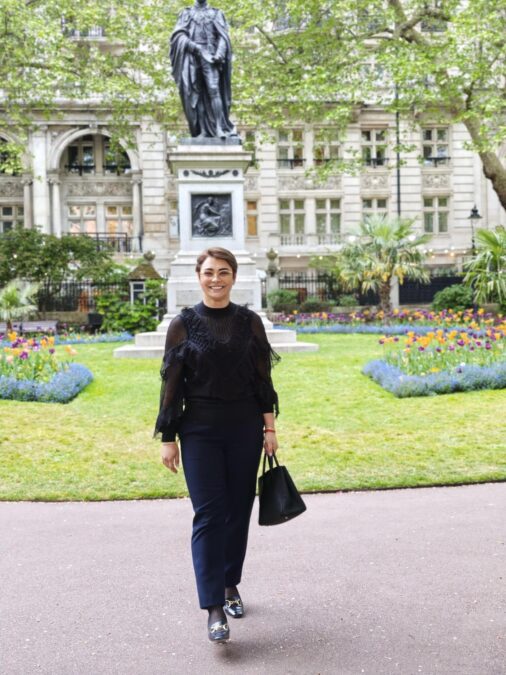

Otilia Mutu is a British-Romanian businesswoman, a Roma woman, a domestic abuse survivor, and the first initiator of what she describes as simply “a door that was not there before.” This autumn, that door opens officially in London. And for thousands of Romanian women in the UK, it may change everything.
‘I thought they were going to ask me for money’
It is a quiet afternoon in London when we sit down with Otilia Mutu, and within minutes it is clear that she is not a woman who does one thing at a time.
She runs OtiPro, an award-winning hospitality staffing company. She runs awareness campaigns across the Romanian community in the United Kingdom. She has written a book. And she is building, with a team of lawyers, psychologists, social workers and volunteers, the first Romanian organisation in the UK dedicated exclusively to victims of domestic violence, abuse and human trafficking.
The business success matters to her. But it is not why we are here.
A woman who carries many things
Otilia Mutu is British and Romanian. She is also Roma, a detail she offers without hesitation, in a society where Roma identity is too often accompanied by prejudice rather than curiosity.
“I carry all of it,” she says. “My heritage, my culture, my history. And all of it brought me here.”
She came to Britain as many Romanians do, building her life from very little, becoming a British citizen, becoming a businesswoman. And beneath all of it, for a long time, she carried something she did not speak about.
She is a survivor of domestic abuse. Physical. Emotional. Financial.
“I know what it means to not know who to call,” she says quietly. “I know what it means to be afraid that asking for help will make things worse. I know what it means to stay silent because silence feels like the only option.”
She pauses.
“And I know what it costs. That is why I refused to stay quiet.”
The gap that nobody filled
The Romanian community in the United Kingdom is one of the largest and fastest-growing in the country. Community estimates put the number of Romanians living in Britain at well over one million, many of whom arrived after 2007 and built their lives here quietly and without fanfare.
And yet, until Otilia decided to do something about it, there was not a single organisation in the entire United Kingdom dedicated exclusively to supporting Romanian victims of domestic violence in their own language, within their own cultural context.
“Language is not just words,” she says. “It is shame. It is the way you were raised. It is the things you were told you must never say out loud. When someone speaks to you in Romanian about the worst thing that has ever happened to you, something shifts. You feel less alone.”
She leans forward.
“And feeling less alone is where everything begins.”
‘I spoke first so others would know they could’
The decision to go public about her own experience was not easy. In Romanian culture, as in many others, domestic abuse is rarely spoken of openly. The expectation to endure, to protect the family name, to keep the peace, runs deep. For Roma women, those pressures can run even deeper.
“I spoke first,” she says, “because I wanted other women to know that they could. That nothing would fall apart if they did. That actually, things might get better.”
She has since run awareness campaigns that reach Romanian communities across the UK, and authored a book that gives voice to experiences that have too long remained unspoken. She is not an observer of this crisis. She lived it. She survived it. And then she turned towards it rather than away.
“I did not want to be the only one who got out,” she says simply.
What Lotus Justice is
Lotus Justice & Support Centre is the first Romanian organisation in the United Kingdom dedicated exclusively to victims of domestic violence, abuse, and human trafficking. It is registered as a Community Interest Company. It does not charge for its services. It does not report immigration status to the Home Office. It does not ask for documents before offering help.
It is staffed by lawyers, paralegals, psychologists, social workers, health visitors, translators, interpreters and volunteers who give their time because they believe, as Otilia does, that no one should face the worst moments of their life without someone who truly understands.
The organisation has also produced the Ghidul Românilor din UK, the first comprehensive guide in the Romanian language covering 27 essential subjects, from domestic violence and housing rights to NHS access, employment law and immigration. It is free. It is distributed openly. And it is already reaching people.
“We don’t always know who reads it,” Otilia says. “We don’t need to know. We just know that somewhere, someone is reading it in silence. And maybe, because of it, they will not stay silent for long.”
‘From the darkest places, the most beautiful things’
The centre opens officially in October 2026, at 247 Burnt Oak Broadway, London. It is named after the lotus flower, and the name was not chosen lightly.
“The lotus grows from mud,” Otilia says. “From the darkest, most difficult places, something beautiful can still emerge. That is not just a name. That is what I believe. It is what I have lived.”
She is quiet for a moment.
“I am British. I am Romanian. I am Roma. I am a survivor. I am a founder. I am all of these things at once, and none of them cancel each other out.” She looks up. “And I built this so that other women can one day say the same thing about themselves.”